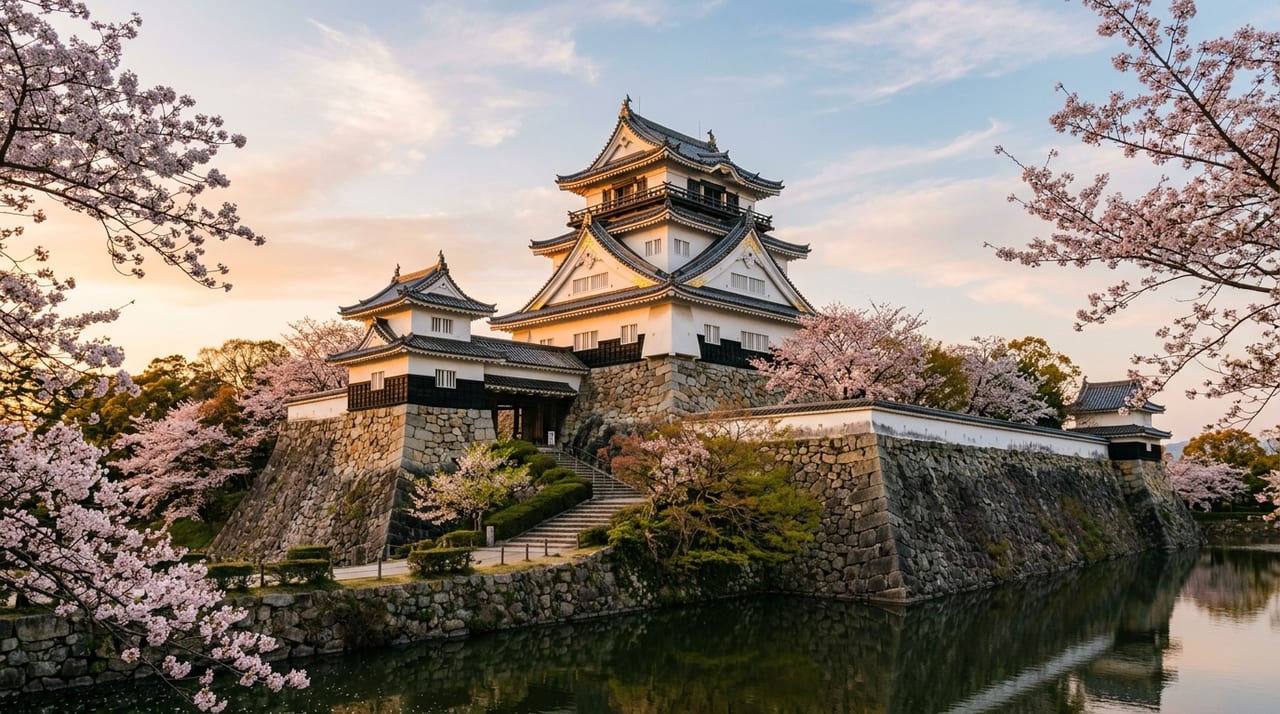
 * Image is for illustrative purposes only.
Okazaki Castle
岡崎城
Okazaki Castle is a historic castle in the Chūbu region (Built around 1452 (Kyōtoku 1)). Its lord was Tokugawa Ieyasu.
Overview
About the Castle
Okazaki Castle is a famous castle of Mikawa Province, known throughout Japan as the birthplace of Tokugawa Ieyasu. The castle is said to have originated when Saigō Tsuguyori, deputy shugo of Mikawa, built a fortress on Ryūtōzan on the north bank of the Sugō River (Oto River), between the 1st year of Kyōtoku (1452) and the 1st year of Kōshō (1455). In the 4th year of Daiei (1524), Matsudaira Kiyoyasu (Ieyasu's grandfather) entered the castle, after which it served as the main castle of the Mikawa Matsudaira family. On January 31, 1543 (Tenbun 11/12/26), Matsudaira Takechiyo (later Tokugawa Ieyasu) was born in this castle. Ieyasu's birth is commemorated as one of the most important births in Japanese history, as it laid the foundation for 260 years of peace under the Edo shogunate.
Tokugawa Ieyasu's Life and the Mikawa Bushi
As a child, Ieyasu was sent as a hostage to the Imagawa clan. After the Battle of Okehazama (1560), he became independent, suppressed the Mikawa Ikkō uprising, and in the 9th year of Eiroku (1566) pacified Mikawa and changed his surname to “Tokugawa.” He later also advanced into Tōtōmi. The core of Ieyasu's strength lay in the absolute loyalty of the “Mikawa bushi,” and Okazaki Castle was the spiritual homeland of those Mikawa bushi. The “stubbornness of the Mikawa bushi” has been passed down as a symbol of loyalty in Japanese samurai culture, and it became the driving force behind Ieyasu's eventual unification of the realm.
Changes and Development of the Castle
Even after Ieyasu moved his residence to Hamamatsu Castle and Sunpu Castle, Okazaki Castle remained important as a place associated with the main Tokugawa line. After Sekigahara, lords such as the Honda and Mizuno families served as castle lords, and it functioned as a key stronghold on the Tōkaidō until the late Edo period. The present main keep was rebuilt in reinforced concrete in Shōwa 34 (1959) and is beloved as a symbol of Okazaki City. Around the castle, several museums and experience facilities, including the Ieyasu-kan, have been developed, and tourism infrastructure advanced greatly with the broadcast of the taiga drama “Dō Suru Ieyasu” (2023).
Okazaki Stonemasonry
Okazaki is known as a source of granite, and Okazaki stonemasonry is highly regarded nationwide for its techniques in stone walls and stone processing.
Daiju-ji and the Tokugawa Family Memorial Temple
Daiju-ji, located about 3 km from Okazaki Castle, is the family temple of the Tokugawa clan and a venerable temple that enshrines the memorial tablets of successive shōguns. It is also the legendary site where Ieyasu, who fled to Daiju-ji after Imagawa Yoshimoto was killed at the Battle of Okehazama, was dissuaded from attempting suicide by the chief priest, who taught the doctrine of “Onri edo gongu jōdo.” On the straight line connecting Daiju-ji and Okazaki Castle, the “Vista Line (scenic view preservation line),” under which buildings exceeding a set height are not permitted, is still maintained in modern urban planning, and efforts to protect Ieyasu's life story and Okazaki's historic landscape continue.
Connection to Swords
As the birthplace of Tokugawa Ieyasu, Okazaki Castle is a place that symbolizes the origins of the warlord who built 260 years of peace in Edo, and it also holds multilayered significance in sword culture. Ieyasu is known for his excellent discernment in collecting and appraising swords, and his possessions included many famous blades. Among them, the Monoyoshi Sadamune is renowned as Ieyasu's favorite sword, and it is said that he always carried it when going into battle. The name “Monoyoshi” is said to derive from a good-luck practice, the idea that “things turn toward good fortune,” based on the belief that Ieyasu would win battles while carrying this sword. The Monoyoshi Sadamune is said to be the work of Sadamune, a disciple of Masamune, active from the late Kamakura period to the early Nanboku-chō period, and it is characterized by a hamon of gentle notare and ko-midare with deep nie, and a clear jigane. Ieyasu is also well known for anecdotes about Muramasa blades. There is a legend that, because his grandfather Kiyoyasu was cut down by a Muramasa blade, his father Hirotada was also wounded by one, and he himself was wounded by one in childhood, he came to regard Muramasa blades as cursed blades of the Tokugawa family and despised them. Muramasa was a swordsmith of Kuwana in Ise Province, an outstanding smith known for the sharpness of his blades. Later, Muramasa blades became a political symbol: anti-Tokugawa activists carried them to show their defiance of the shogunate. Exhibits inside the main keep of Okazaki Castle and at the Mikawa Bushi no Yakata Ieyasu-kan introduce the history of Ieyasu and Okazaki Castle.
Highlights
- Okazaki Castle main keep (reconstruction) — the castle where Ieyasu was born. Exhibits on the history of Okazaki Castle and Ieyasu
- Mikawa Bushi no Yakata Ieyasu-kan — a facility in Okazaki Park. Introduces the history of Ieyasu and the Mikawa bushi
- Daiju-ji — the family temple of the Tokugawa clan. The Vista Line (view preservation line) connecting it with Okazaki Castle is still protected today
- Stonemasonry culture of the Okazaki castle town — stone shops and craft facilities that carry on Okazaki stonemasonry techniques
- Oto River and cherry-tree-lined path — a famous cherry-blossom viewing spot in Okazaki. Beautiful scenery of castle and river
* Opening hours and admission fees are subject to change. Please check the official website before visiting.