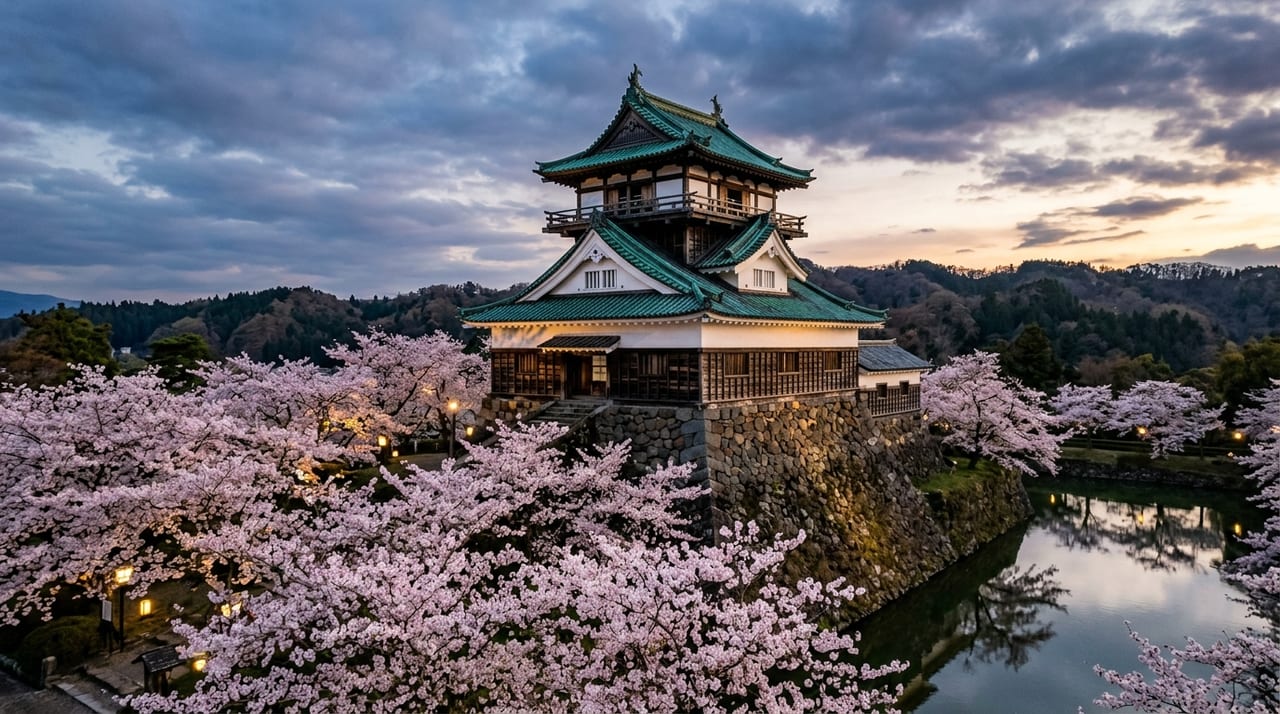
 * Image is for illustrative purposes only.
Maruoka Castle
丸岡城
Maruoka Castle is a historic castle in the Chūbu region (Built in 1576 (Tenshō 4)). Its lord was Shibata Katsutoyo / Arima clan.
Overview
About the Castle
Maruoka Castle was built in Tenshō 4 (1576) by Shibata Katsutoyo, nephew of Oda Nobunaga's senior retainer Shibata Katsuie, and it is the only extant keep in the Hokuriku region. At the time, Katsuie was serving as commander-in-chief of the Hokuriku front under Nobunaga's orders, suppressing Ikkō ikki uprisings, and Maruoka Castle was built as the forward base for that effort. The two-story, three-floor keep is modest in size, but its archaic appearance led it to be long called one of the oldest surviving keeps; however, a 2019 survey estimated that it was built in the Kan'ei era (1624–1644) of the Edo period. Its greatest feature is its roof of stone tiles made from Shakudani stone.
Architecture and Structure
Unlike ordinary clay tiles, the stone tiles made by thinly processing the blue-gray Shakudani stone quarried in Fukui are a practical structure that withstands Hokuriku's heavy snow, and they also have a unique beauty in that they turn blue-green when wet with rain. During the Shōwa-era repair and reconstruction work, the roof was also re-laid with Takigahara stone from Komatsu, Ishikawa. The interior of the keep, with its steep staircases and thick pillars, preserves its original structure, letting visitors experience its austere atmosphere. The keep collapsed in the Fukui earthquake of Shōwa 23 (1948), but it was reassembled in Shōwa 30 (1955), making maximum use of the original components. It bears the elegant name 'Kasumigajō' (Mist Castle); in spring, Somei Yoshino cherry trees turn the castle a pale pink, and it has also been selected as one of Japan's 100 Famous Cherry Blossom Spots.
Battles and Military History
Also, the letter known as Japan's shortest, 'Ippitsu keijō / Hi no yōjin / O-Sen nakasuna / Uma koyase' (roughly: 'A brief note: beware of fire. Don't make O-Sen cry. Feed the horse well.'), was sent to his wife from the field by Tokugawa retainer Honda Shigetsugu (Oni-Sakuza). Because 'O-Sen' in the text was later Honda Narishige, the first lord of Maruoka domain, a contest for 'Japan's shortest letter' is held every year in the castle town in connection with this anecdote. Though small, Maruoka Castle's keep, which holds genuine history, is a rare presence that lets visitors directly feel a simple charm that large castles lack. The steep stairs inside the keep are so steep that one climbs them using a rope in place of a handrail, letting visitors physically feel the pragmatic structure of the castle.
Culture and Craftsmanship
Maruoka Castle embodies 'unadorned beauty,' and its plain form silently speaks to people today of the samurai aesthetic. The blue-gray of the stone tiles, which have endured the wind and snow of Echizen, has a flavor that deepens the longer time passes. Maruoka Castle's keep is the subject of ongoing efforts by the local Sakai City to aim for National Treasure designation, and its historical value is expected to rise further in the future. Small though it is, this keep, which holds genuine history, teaches us the origins of Japan's castle culture. Maruoka Castle is also illuminated at night, and the stone-tiled keep floating in darkness shows a mysterious beauty different from its daytime appearance.
Connection to Swords
Echizen Province (present-day Fukui Prefecture) has long been known as a major sword-producing region, and its history reaches back to Chiyozuru Kuniyasu of the Nanboku-chō period. Chiyozuru Kuniyasu is said to be a swordsmith who moved from Kyoto to Echizen-Fuchū and is regarded as the founder of Echizen uchihamono (forged cutlery). Afterward, many swordsmiths gathered in Echizen and mass-produced swords with a practical, sturdy style. Echizen blades were widely used in battles of the Sengoku period, and warlords valued them for their reliability in actual combat. The Echizen uchihamono tradition continues steadily in present-day Echizen City, which, as one of Japan's leading cutlery industry areas, produces a wide variety of blades including kitchen knives, sickles, and scissors. At the core of that craft lies the forging technique cultivated by Echizen swordsmiths. An essential figure in discussing Echizen's sword culture is Echizen Yasutsugu. The first Yasutsugu was summoned by Tokugawa Ieyasu on the recommendation of Yūki Hideyasu of Echizen, was granted the character 'Yasu,' and became an official swordsmith. As an official swordsmith to the shogunate, Yasutsugu was permitted to cut the hollyhock crest into the tang, and many of his copies carry the inscription of Honda Narishige, lord of Maruoka Castle, as their owner. Yasutsugu's swords, known by the nickname 'Aoi Shimosaka,' are highly regarded as masterpieces combining practicality and dignity. The Yasutsugu name was passed down through generations and continued until the end of the Bakumatsu period. Shibata Katsuie, the uncle of Shibata Katsutoyo who built Maruoka Castle, was the man who governed Echizen after the fall of the Asakura clan, and is directly connected to Echizen's martial history of the Sengoku period. At the Fukui Prefectural Ichijōdani Asakura Family Site Museum, visitors can see artifacts excavated from the Asakura clan's castle town, and visiting it together with the Echizen uchihamono Kaikan in Echizen City allows a comprehensive understanding of Echizen's sword culture. The culture of Echizen swords and cutlery is a rare tradition that has continued unbroken from the medieval period to the present, and its continuity shows the foundation of Japan's craftsmanship culture. The area around Maruoka Castle is also close to Fukui's representative sightseeing spots such as Tōjinbō and Eihei-ji, offering a Hokuriku-specific journey where you can experience castle, nature, and Zen culture together. After touching the spirit of Zen at Eihei-ji, standing in the plain keep of Maruoka Castle, one will likely come to feel how deeply Japan's bushidō and Zen are connected.
Highlights
- Extant keep (Important Cultural Property) — the only surviving keep in the Hokuriku region; experience its plain and sturdy castle construction
- Shakudani stone tile roof — a building material unique to Hokuriku, with a distinctive beauty that turns blue-green when wet with rain
- Cherry blossoms of Kasumigajō Park — one of Japan's 100 Famous Cherry Blossom Spots; Somei Yoshino trees adorn the castle
- Museum of Japan's Shortest Letter — a base for promoting letter culture rooted in the anecdote of Honda Shigetsugu
- Ichijōdani Asakura Family Site (about 40 minutes by car) — ruins of a Sengoku daimyo's castle town
- Echizen Uchihamono Kaikan (Echizen City) — a cutlery hub carrying on the forging techniques dating back to Chiyozuru Kuniyasu
* Opening hours and admission fees are subject to change. Please check the official website before visiting.