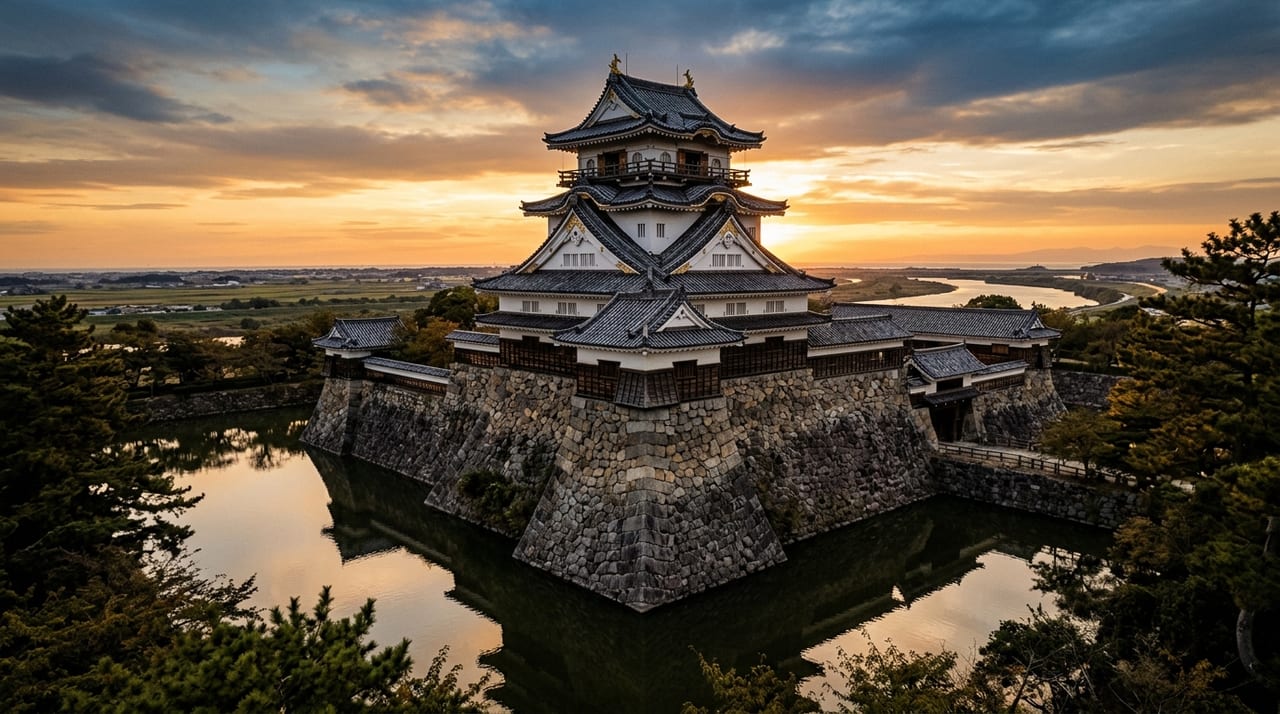
 * Image is for illustrative purposes only.
Yoshida Castle
吉田城
Yoshida Castle is a historic castle in the Chūbu region (Built in 1505 (Eisho 2)). Its lord was Makino Kohaku / Matsudaira Clan / Okochi Matsudaira Clan.
Overview
About the Castle
Yoshida Castle was built at Imahashi, near the mouth of the Toyokawa River, and was the foremost strategic stronghold on the Tōkaidō. It began in Eishō 2 (1505), when Makino Kohaku built it as Imahashi Castle. Located on the left bank of the Toyokawa, it was a key junction linking Mikawa, Tōtōmi, and Owari, and it was the scene of fierce contests for control throughout the Sengoku period. The name Yoshida is said to have been adopted either in Daiei 2 (1522), when Makino Nobushige renamed it Yoshida Castle, or during the Tenbun era, when Imagawa Yoshimoto changed the name. Afterward, lordship changed hands in rapid succession among the Toda clan, Matsudaira clan, Imagawa clan, Tokugawa clan, Ikeda Terumasa, and Takenoya Matsudaira family.
Lords and History
Sakai Tadatsugu, one of the Four Tokugawa Heavenly Kings, briefly held the castle and demonstrated its military strategic importance. Under the Toyotomi regime, Ikeda Terumasa governed eastern Mikawa from Yoshida Castle as his base before moving to Himeji Castle. After the Battle of Sekigahara, the Takenoya Matsudaira family was enfeoffed, and after a succession of fudai daimyo, the Ōkōchi Matsudaira family became lords of Yoshida Domain and continued in that role until the end of the Bakumatsu period. The castle was laid out to make use of the natural moat formed by the Toyokawa River, and it was developed as an early-modern castle combining stone walls, earthen ramparts, and moats. Today, the Kurogane-yagura, a replica reconstructed in Shōwa 29 (1954), stands on the former honmaru (main enclosure).
Development of the Castle Town
Yoshida prospered as a post town on the Tōkaidō and was known as a lively station, so much so that it was sung of in the folk song 'Yoshida tōreba nikai kara maneku, shikamo kanoko no furisode ga' (roughly: 'Pass through Yoshida and they beckon from the second floor, and the furisode are kanoko-dyed as well'). After the Meiji period it was renamed Toyohashi, and today it has developed as a major city in the Tōkai region.
Nature and Landscape
The view from the Kurogane-yagura, looking down on the Toyokawa, takes in the Mikawa plain and allows visitors to relive the vantage point from which former lords watched travelers passing along the Tōkaidō. The castle ruins, developed as Toyohashi Park, serve as a place of rest for citizens while remaining a historic space that conveys the spirit of the Mikawa samurai to the present day.
Connection to Swords
Yoshida Castle and the sword culture of Mikawa are inseparably tied to the Mikawa samurai corps, who supported Tokugawa Ieyasu. The Mikawa samurai are known for their loyalty to their lords and their martial valor. Mikawa also had swordsmiths, and the famous spear Tonbokiri, used by Honda Tadakatsu, one of the Four Tokugawa Heavenly Kings, is said to be the work of Fujiwara no Masazane of the Mikawa Monju school. Sakai Tadatsugu, who served as castellan of Yoshida Castle, is counted among the Four Tokugawa Heavenly Kings. Ikeda Terumasa governed eastern Mikawa as lord of Yoshida Castle and moved to Himeji the year after the Battle of Sekigahara. The Toyohashi City Museum of Art and History, located within Toyohashi Park on the castle site, houses and exhibits historical materials related to Yoshida Domain and Yoshida Castle. The sword culture of Yoshida Castle, which embodies the spirit of the Mikawa samurai, is an ideal case for deeply understanding the practical value of the Japanese sword and the spirituality of the samurai.
Highlights
- Kurogane-yagura — a corner turret replicated in Shōwa 29 (1954) at the northwest corner of the honmaru; its interior is a museum
- Views across the Toyokawa — the Toyokawa River and the Mikawa plain as seen from the castle
- Toyohashi City Museum of Art and History — located within Toyohashi Park on the castle site, housing and displaying local art and historical materials
- Stone walls and moats of the honmaru — remains of stone walls built during Ikeda Terumasa's time and the early Edo period
- Toyohashi Park (former castle site) — a citizens' place of rest, developed on the former honmaru through sannomaru enclosures
* Opening hours and admission fees are subject to change. Please check the official website before visiting.