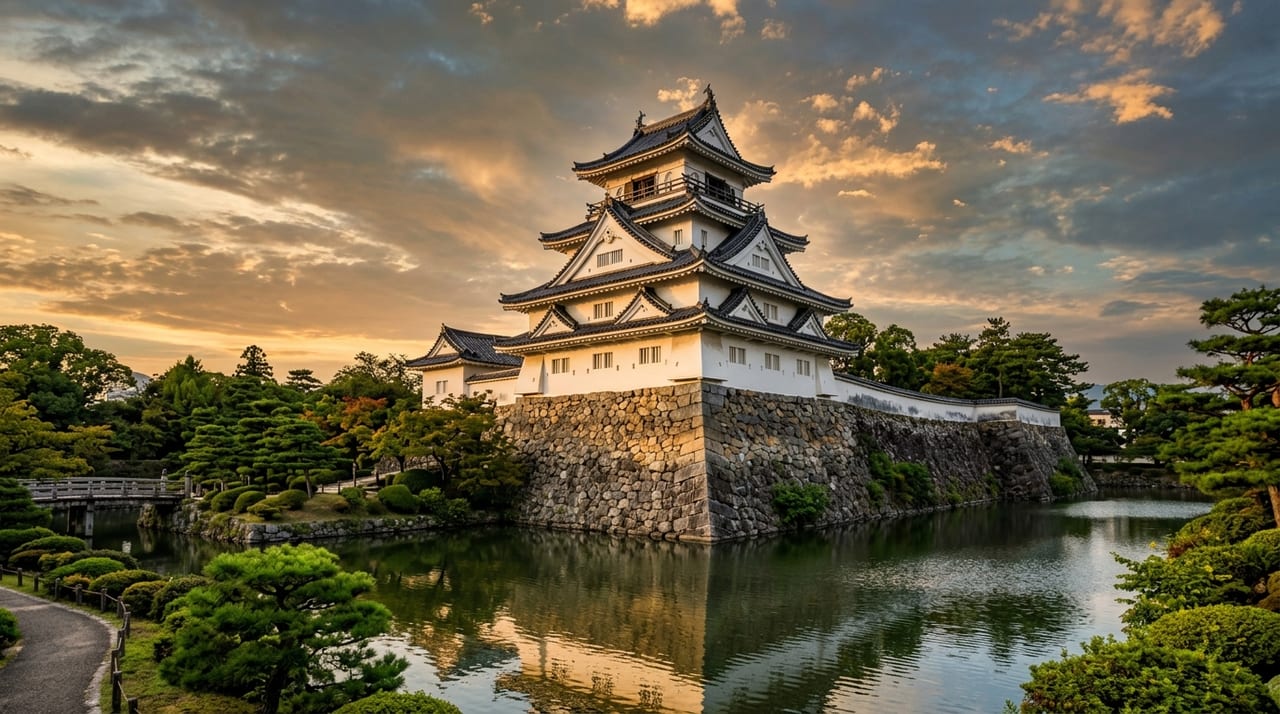
 * Image is for illustrative purposes only.
Ogaki Castle
大垣城
Ogaki Castle is a historic castle in the Chūbu region (Built around 1535 (Tenbun 4)). Its lord was Toda Ujikane.
Overview
About the Castle
Ogaki Castle was a flatland castle built in Mino Province (present-day Ogaki, Gifu Prefecture). Its history is said to begin when Miyagawa Yasusada built it around Tenbun 4 (1535). The four-story keep no longer survives, but the reinforced-concrete reconstruction (reconstructed in Shōwa 34 (1959)) conveys its former majesty. Ogaki Castle made its mark in history through its role as a major base of the Western Army in the Battle of Sekigahara in Keichō 5 (1600). Ishida Mitsunari used the castle as the Western Army's main headquarters and had prepared for a siege until the eve of its advance to Sekigahara.
The Battle of Sekigahara and Ogaki
The Battle of Sekigahara, fought on the 15th day of the 9th month of Keichō 5 (1600) in the Sekigahara basin west of Ogaki Castle, was the largest decisive battle in Japanese history. The clash between the Toyotomi coalition army (Western Army) led by Ishida Mitsunari and the Eastern Army led by Tokugawa Ieyasu ended in an overwhelming victory for the Eastern Army after just half a day, and became the foundation for the Tokugawa unification of the realm. The Western Army troops who had remained at Ogaki Castle were surrounded by the Eastern Army. Because an insider had defected, they surrendered and opened the castle. Mitsunari fled to the foot of Mount Ibuki but was captured and beheaded. In this battle Ogaki Castle became the stage for a historic turning point. In the Edo period, after passing through the Ishikawa and Matsudaira clans and others, Toda Ujikane was enfeoffed in Kan'ei 12 (1635) and governed the domain.
Ishida Mitsunari and Swords
Ishida Mitsunari is known as a close administrative official (bugyō) of Toyotomi Hideyoshi, but he also had an aspect as a military commander. Few of the swords Mitsunari owned have been transmitted, but as a powerful figure in the Toyotomi regime, he is considered to have had ample access to famous blades. Of particular note is the total quantity of swords mobilized by both the Eastern and Western armies at the Battle of Sekigahara. This era was a transitional period from the late Sengoku period to the early Edo period, and was the last age in which the finest swords made by famous smiths from various regions were used in actual combat.
Ogaki and the Haiku Master Matsuo Bashō
Ogaki is also a place with a deep connection to the haiku master Matsuo Bashō. The journey of 'Oku no Hosomichi' in Genroku 2 (1689) came to an end in Ogaki, and Bashō set out for Ise, parting regretfully from his disciples. The haiku 'Hamaguri no Futami ni wakare yuku aki zo' was composed at this time. Ogaki is known as a city of water and has many spring-water sites within the city.
The Toda Family and Domain Governance
The Toda clan, enfeoffed in Kan'ei 12 (1635), governed the domain throughout the Edo period as lords of the 100,000-koku Ogaki domain. The Toda family were fudai daimyō and played an important political role from a position close to the center of the shogunate. The keep of Ogaki Castle displays armor and other items actually used by the Toda clan.
Connection to Swords
The significance of Ogaki Castle in the history of swords appears most clearly in the context of the Battle of Sekigahara in Keichō 5 (1600). Sekigahara was one of the last decisive battles in which the finest swords forged during the Sengoku period were committed to large-scale field battles. After this, in the Edo period, swords changed their character from weapons of actual combat to spiritual symbols of the samurai, ceremonial objects, and works of art. The daimyō and warriors who joined Ishida Mitsunari's Western Army carried swords forged in famous production regions such as Mino, Ōmi, Owari, and Settsu. One may say that the Battle of Sekigahara was a great 'stage of swords' where Japan's finest practical blades gathered. Mino Province (Gifu) shines in the history of Japanese swords as a production center of 'Mino-mono,' and it produced many master smiths, including 'Shizu Saburō Kaneuji' from the late Kamakura to Nanboku-chō periods and 'Kanemoto (Magoroku Kanemoto)' and 'Kanesada' from the Muromachi period. In particular, the blades of 'Magoroku Kanemoto' are known for a distinctive hamon called 'sanbon sugi' ('three cedars'), and they enjoyed tremendous popularity among Sengoku warriors for their sharpness. The Mino-den smiths, who drew from the Masamune tradition, were none other than the producers of the swords that many warriors who took part in the Battle of Sekigahara chose as their practical blades. Considering Ishida Mitsunari, who based himself at Ogaki Castle, together with the Battle of Sekigahara, one can see that this place symbolizes the end of the era in which Japanese swords shone most brightly as 'weapons of actual combat'. In the keep of Ogaki Castle, in addition to armor used by the Toda clan, there are exhibits of materials related to the Battle of Sekigahara, conveying to the present day the brilliance of the era of practical swords.
Highlights
- Ogaki Castle Keep (reconstruction) — a four-story keep reconstructed in Shōwa 34 (1959). Displays materials on the Battle of Sekigahara and armor associated with the Toda clan
- Sekigahara Battlefield — about 20 minutes by car from the castle. The battlefield of the decisive contest that determined the fate of the realm. The Sekigahara Battlefield Memorial Museum (opened 2020) is well-equipped
- Ishida Mitsunari's Encampment Site (Sasao-yama) — the camp of the Western Army's commander-in-chief. From the summit, the entire battlefield can be viewed from above
- Oku no Hosomichi Musubi no Chi Memorial Museum — a facility commemorating the place where Matsuo Bashō ended his journey of 'Oku no Hosomichi'
- Suimon-gawa Promenade — a walking path along the historic waterway linking Ogaki Castle and the water city of Ogaki
* Opening hours and admission fees are subject to change. Please check the official website before visiting.