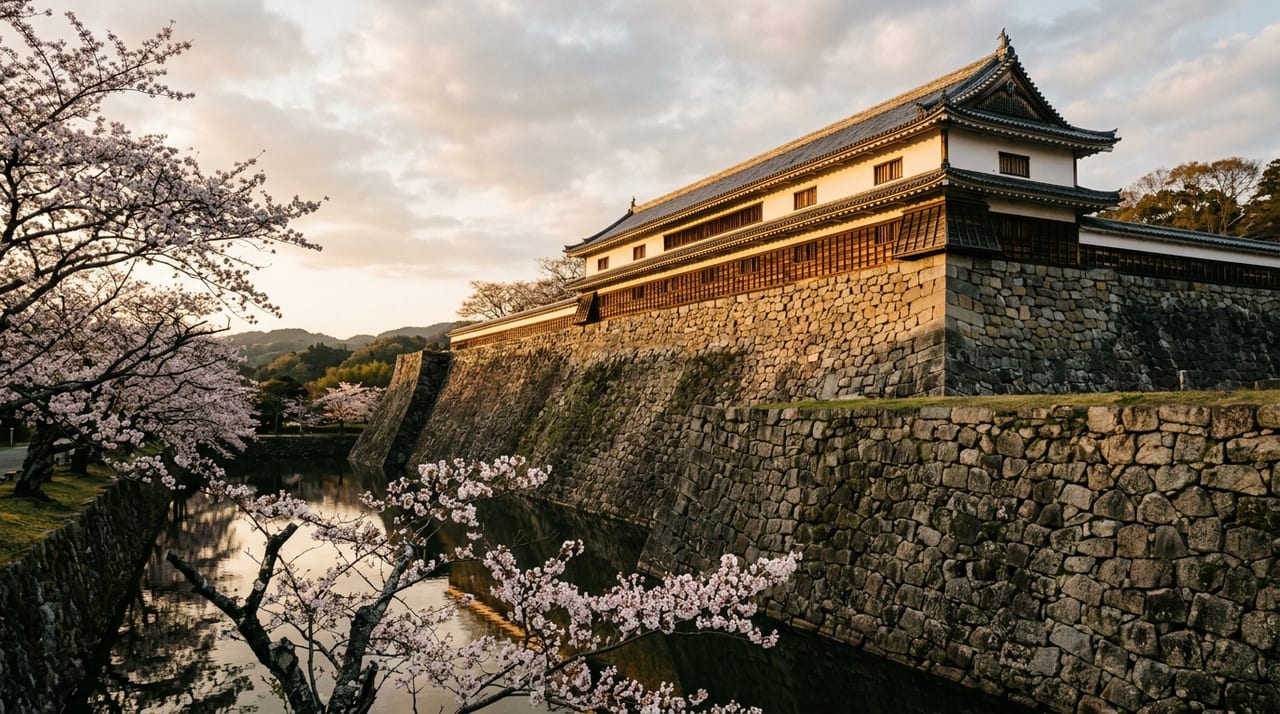
 * Image is for illustrative purposes only.
Noda Castle (Mikawa Province)
野田城(三河国)
Noda Castle (Mikawa Province) is a historic castle in the Chūbu region (Late Muromachi period (built during the Eishō era, early 16th century) to 1590, when it was abandoned following the lord's transfer). Its lord was Suganuma Sadanori (builder), Suganuma Sadamura (2nd), Suganuma Sadamitsu (3rd).
Overview
Overview
Noda Castle was a flatland-mountain castle (hirayama-jiro) in Toyoshima, Shinshiro, Aichi Prefecture, and the seat of the Mikawa Suganuma clan, which held power in the Oku-Mikawa region. Also known as Negoya Castle or Mikawa Noda Castle, it is remembered as the last castle Takeda Shingen besieged in his lifetime.
Founding and History
The castle was built during the Eishō era (early 16th century) by Suganuma Sadanori of the Mikawa Suganuma clan and was held as the family seat across three generations — Sadanori, his son Sadamura, and grandson Sadamitsu. After the Battle of Okehazama (1560), Sadamitsu broke from the Imagawa and sided with the Tokugawa, briefly surrendering the castle before retaking and repairing it the following year. It was subsequently attacked repeatedly by both the Imagawa and Takeda.
Siege by Takeda Shingen and the Sniper Legend
In January 1573, having defeated Tokugawa Ieyasu at the Battle of Mikatagahara, Takeda Shingen surrounded Noda Castle — defended by roughly 500 men — with an army of about 30,000. The siege took about a month, and with the castle's water supply cut off, Suganuma Sadamitsu surrendered on February 16 of that year. According to legend, during the siege Shingen was drawn toward the sound of a flute played by Muramatsu Hōkyū inside the castle and was shot by the marksman Torii Sanzaemon — an episode said to have inspired Akira Kurosawa's film "Kagemusha." Given Shingen's characteristic caution, however, some accounts suggest the target may actually have been a different commander. Shingen's condition reportedly worsened shortly afterward, and he died on the return journey to Kai.
Structure and Remains
The castle's layout arranged the main bailey, second bailey, third bailey, subsidiary enclosures, and samurai residences in a linear sequence, with rivers on both sides serving as natural moats. Today only the remains of the main bailey — earthworks and a dry moat — can be confirmed.
Present State and Access
The castle was abandoned in 1590 following the transfer of its lord. The site is maintained as a historic area, about a 15-minute walk from Noda-jō Station on the JR Iida Line. The matchlock gun associated with the sniper legend, "Shingen-zutsu," is a Shinshiro City-designated cultural property on display at the Shitaragahara Historical Museum.
Highlights
- Seat of three generations of the Mikawa Suganuma clan (Sadanori, Sadamura, Sadamitsu) in Oku-Mikawa
- Site of the 1573 siege — the last castle Takeda Shingen attacked in his lifetime
- Setting of the legend of Shingen being shot by a sniper, said to have inspired Kurosawa's "Kagemusha"
- The matchlock gun "Shingen-zutsu," linked to the sniper legend, survives as a Shinshiro City-designated cultural property
* Opening hours and admission fees are subject to change. Please check the official website before visiting.