 * Image is for illustrative purposes only.
Kakegawa Castle
掛川城
Kakegawa Castle is a historic castle in the Chūbu region (Bunmei era (1469–1487): said to have been built by Asahina Yasuteru; after Tenshō 18 (1590), developed into an early modern castle by Yamauchi Kazutoyo). Its lord was Yamauchi Kazutoyo / Ota clan.
Overview
About the Castle
Kakegawa Castle is a hirayama-style castle built at the center of Tōtōmi Province. It is said that Asahina Yasuteru built it under the orders of Imagawa Yoshitada during the Bunmei era (1469–1487), and the Imagawa clan later developed it into a key stronghold for controlling Tōtōmi. In Eiroku 11 (1568), the Imagawa clan declined rapidly after Takeda Shingen invaded Suruga, and Tōtōmi came under the control of Tokugawa Ieyasu. After Toyotomi Hideyoshi's Odawara campaign in Tenshō 18 (1590), Yamauchi Kazutoyo became lord of Kakegawa Castle and governed the area for about ten years. Kazutoyo devoted himself heart and soul to developing the castle and its castle town, and in doing so established the basic form of the present-day Kakegawa Castle.
Yamauchi Kazutoyo's Far-sighted Vision and the Merit of a Supportive Wife
Yamauchi Kazutoyo is famous for the anecdote of naijo no kō (the merit of a wife's quiet support). The story of his wife Chiyo buying a famous horse with savings she had secretly accumulated became known throughout Japan as the archetype of naijo no kō. Under the Toyotomi regime he served Hideyoshi as a retainer. At the Battle of Sekigahara, he quickly declared allegiance to the Eastern Army, and this was valued. As a result, he was granted the whole of Tosa Province (later a little over 202,600 koku) and transferred to Kōchi in Tosa. After this, Kakegawa Castle was held in turn by fudai daimyō such as the Matsudaira and Ii clans. In Enkyō 3 (1746), the Ōta clan was enfeoffed, and the Ōta clan held the castle until the Meiji era.
Architecture and Reconstruction
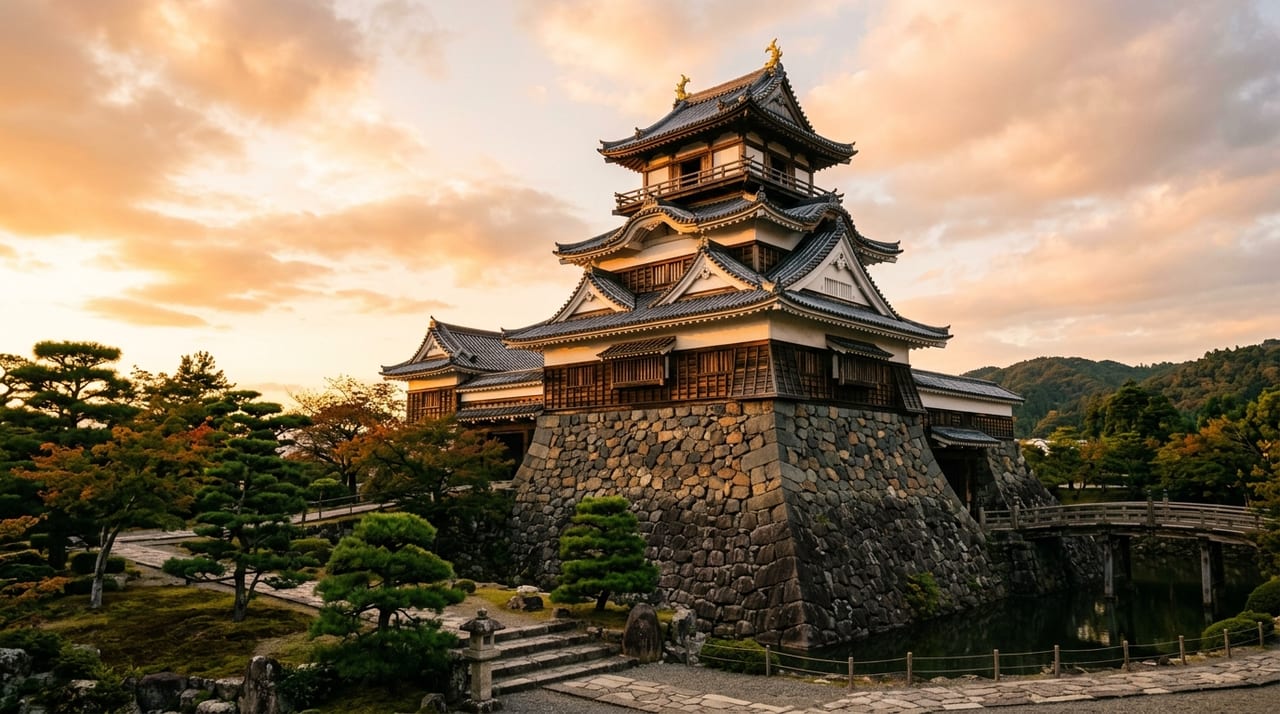
The present main tower of Kakegawa Castle was rebuilt in Heisei 6 (1994) as Japan's first authentic wooden reconstruction of a main tower. It attracted national attention as a wooden structure that faithfully recreates the construction methods of the Keichō era. The Ninomaru Palace of Kakegawa Castle is an extant building rebuilt from Ansei 2 (1855) to Bunkyū 1 (1861), and it is designated an Important Cultural Property. It is one of the few surviving palaces of early modern castles, and it is a valuable building that conveys the administration and daily life of the samurai society of that time.
Development of the Castle Town
Kakegawa also prospered as a post town on the Tōkaidō. It was known as a production center of Enshū momen cotton cloth, which made use of Enshū cotton. Kakegawa is also nationally known as a famous producer of Japanese tea, and the culture of Kakegawa tea, represented by green tea, is deeply connected to the merchant culture of the castle town.
Connection to Swords
Yamauchi Kazutoyo was a Sengoku-period daimyō who governed Tōtōmi and Tosa, and he had a deep understanding of swords and experienced numerous battles as a warlord. From his youth, Kazutoyo revered swords as the soul of a warrior. Alongside the anecdote of purchasing a famous horse (the merit of his wife Chiyo's quiet support), he is said to have also taken pains to obtain fine blades. Kazutoyo's record as a warlord is also reflected in the political decision to quickly declare allegiance to the Eastern Army at the Battle of Sekigahara. Behind that judgment, it is said, lay both the situational judgment cultivated as a warrior and the samurai resolve nurtured through swords. The stories of Kakegawa Castle and Yamauchi Kazutoyo eloquently show that the bond between a warrior and his sword was a spiritual connection far beyond that of a mere weapon.
Highlights
- Wooden reconstructed main tower — completed in Heisei 6 (1994), Japan's first authentic wooden reconstruction of a main tower, a pinnacle of traditional construction methods
- Ninomaru Palace (Important Cultural Property) — an extant early modern castle palace that conveys the atmosphere of domain governance as it was
- Views of Enshū-nada and Lake Hamana from the main tower
- Ōtemon gate and Ōtemon guardhouse — the Ōtemon gate was rebuilt in wood in Heisei 7 (1995), and the guardhouse is a late-Edo-period building (city-designated cultural property)
- Cherry blossoms at Kakegawa Castle Park — the Ninomaru plaza in spring is a famous spot for hanami
- Kakegawa tea producing area — enjoy Kakegawa matcha and sencha at the Ninomaru tea room within the castle
* Opening hours and admission fees are subject to change. Please check the official website before visiting.