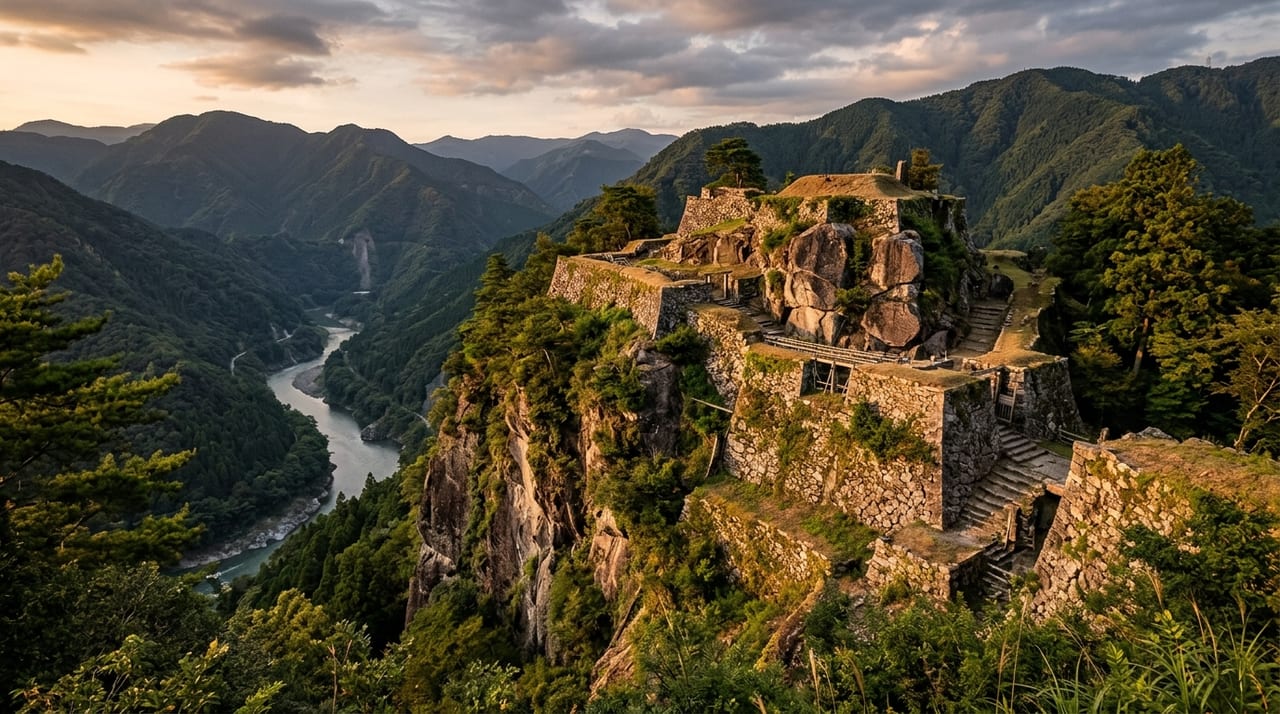
 * Image is for illustrative purposes only.
Futamata Castle
二俣城
Futamata Castle is a historic castle in the Chūbu region (Came under Tokugawa control around the end of the Eiroku era (c. 1569); fell to Takeda Shingen in 1572; site of Tokugawa Nobuyasu's forced suicide in 1579). Its lord was Imagawa clan (Matsui clan) → Tokugawa Ieyasu → Takeda Shingen → Takeda Katsuyori → Tokugawa Ieyasu (site of Nobuyasu's suicide) → Horio Yoshiharu.
Overview
Futamata Castle in Hamamatsu City's Tenryū Ward is a clifftop mountain fortress above the Tenryū River, remembered above all for one of the most tragic events in Tokugawa history: the forced suicide of Tokugawa Nobuyasu, Ieyasu's eldest son, within its walls in 1579.
The castle's earlier history was shaped by the conflict between the Takeda and Tokugawa. In 1572, Takeda Shingen's "Western Advance" campaign swept through Tōtōmi Province (western Shizuoka), targeting the castle as a key Tokugawa stronghold. Unable to breach the cliff-side defenses directly, Takeda forces cut the castle's water supply by floating rafts down the Tenryū River to smash the well tower that drew water from the river — a technical stroke that forced surrender without direct assault. The castle fell; after Shingen died on his way home in 1573, the Tokugawa finally recaptured it in the 12th month of Tenshō 3.
In 1579, the castle became the site of the darkest episode in Ieyasu's career. His son Tokugawa Nobuyasu (age 21), husband of Oda Nobunaga's daughter, was accused — whether by Nobunaga's instigation or Ieyasu's own calculation — and ordered to commit suicide at Futamata Castle. The full circumstances remain disputed by historians, but the event forced Ieyasu to choose between his son and his alliance with Nobunaga, a choice with profound consequences for the subsequent Tokugawa rise to power.
After Horio Yoshiharu took over Hamamatsu Castle in 1590, Futamata became its branch castle, and it was abandoned in 1600 when the Horio clan was transferred to Izumo. The surviving stone walls and earthworks on the river cliff are preserved as a National Historic Site, offering sweeping views of the Tenryū River gorge.
Connection to Swords
Futamata Castle can be understood as one of the castle sites that most directly confronts the theme of "the Japanese sword and the samurai's death" through the forced suicide of Tokugawa Nobuyasu.
In Nobuyasu's seppuku, the kaishaku—in which an attendant cuts off the head of the person committing seppuku with a sword to release him from the agony of the short blade—became an issue. Accounts of who served as Nobuyasu's kaishakunin vary, but a famous tradition holds that Hattori Hanzō, when ordered to do so, broke down in tears, unable to strike his lord's son; the anecdote has been handed down as the scene that most sharply shows the samurai's ethics of the sword and the conflict between loyalty and orders. The kaishaku is said actually to have been performed by another warrior, but the scene has been depicted again and again in kabuki, novels and films.
The Takeda attack on Futamata's water supply—floating rafts down the Tenryū River to smash the castle's well tower—was a siege won not by direct use of the sword but by engineering.
Futamata Castle is indispensable for telling of the roles the sword played along the greatest Sengoku-period fault line in the Tōkai region, between the Tokugawa and the Takeda—from weapon of battle to ritual instrument at the most delicate moment of Nobuyasu's seppuku.
Highlights
- Futamata Castle stone walls and earthworks (National Historic Site) — clifftop ramparts above the Tenryū River gorge
- Keep platform (main bailey) — panoramic views of the Tenryū River canyon from the castle summit
- Tobayama Castle ruins (opposite hill) — the subsidiary fort built by Ieyasu to besiege Futamata
- Tenryū River rafting — the river down which the Takeda floated rafts to smash the castle's well tower
- Seiryūji temple (Nobuyasu's mausoleum) — where Nobuyasu was buried and Ieyasu built his mausoleum; a reconstructed well tower also stands here
* Opening hours and admission fees are subject to change. Please check the official website before visiting.