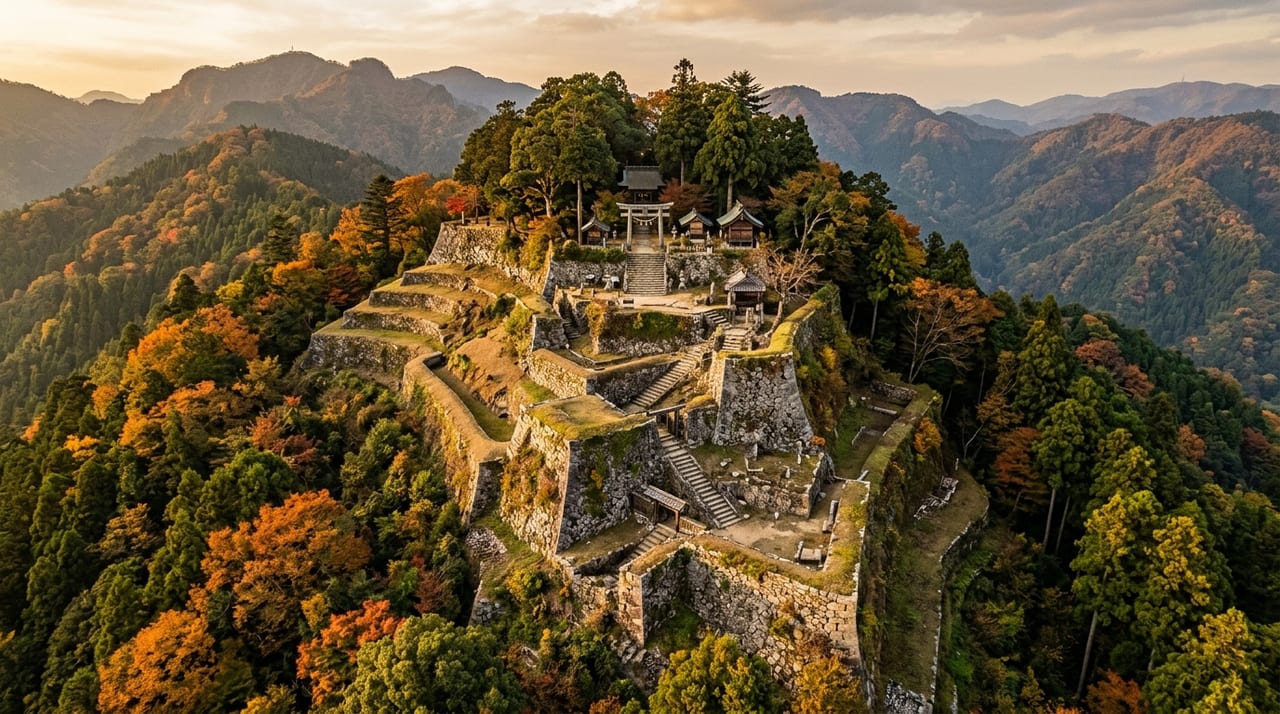
 * Image is for illustrative purposes only.
Samegao Castle
鮫ヶ尾城
Samegao Castle is a historic castle in the Chūbu region (Sengoku period (first documented in 1579)). Its lord was Horie Munechika.
Overview
Overview
Samegao Castle is a Sengoku-period mountain fortress in present-day Myoko City, Niigata Prefecture, built as a forward defensive position guarding the southern approach to Kasugayama Castle, the stronghold of Uesugi Kenshin. The castle first appears in historical records in 1579, when it was held by the local lord Horie Munechika. Built on a hill 185 meters above sea level, it consists of six large enclosures, six long defensive trenches, and more than 100 scarped cliffs, making it one of the largest mountain castles in Echigo Province.
Decisive Battle of the Otate no Ran
The previous year, 1578, Kenshin's sudden death had triggered the Otate no Ran, a succession struggle between his two adopted heirs, Uesugi Kagekatsu and Uesugi Kagetora. Driven from his base, Kagetora sought refuge at Samegao Castle as an escape route toward Kanto. Horie Munechika, however, secretly sided with Kagekatsu, set fire to the second bailey, and abandoned the castle. Facing an all-out assault, Kagetora took his own life along with his wife and children.
Present State
Excavations have uncovered fire-scorched artifacts from the late 16th century across a wide area, physical evidence of the fires set during the Otate no Ran. The remains are exceptionally well preserved and were designated a National Historic Site in 2008. Today the site is maintained as part of the "Hida Rekishi no Sato" historical park and has been selected as one of Japan's Continued 100 Fine Castles.
Connection to Swords
No specific named sword is recorded as having been kept at Samegao Castle itself, but the battle that ended there decided who would inherit Uesugi Kenshin's storied sword collection. Blades such as the Awataguchi Yoshimitsu tantō "Gokotai," said to have been bestowed on Kenshin by Emperor Ogimachi, and Kenshin's favored tachi "Himetsuru Ichimonji," passed down through the victorious Uesugi Kagekatsu and were later included among the "Thirty-Five Blades Selected by the Uesugi House." Both are now housed at the Yonezawa City Uesugi Museum (Himetsuru Ichimonji is owned by Yonezawa City; Gokotai is on deposit from a private owner). Kagetora's defeat and death at Samegao Castle was thus the turning point that decided the fate of these swords handed down in the Uesugi family.
Highlights
- Hida Rekishi no Sato — historical park encompassing the Samegao Castle ruins and Hida archaeological sites
- Main enclosure (honmaru) — where Uesugi Kagetora met his end during the Otate no Ran
- Six large defensive trenches — evidence of advanced Sengoku-era mountain castle engineering
- North, South, and East approach trails — maintained paths exploring the ruins from three directions
- Continued 100 Fine Castles — selected in 2017
* Opening hours and admission fees are subject to change. Please check the official website before visiting.