 * Image is for illustrative purposes only.
Naegi Castle
苗木城
Naegi Castle is a historic castle in the Chūbu region (Construction around Daiei 6 (1526); buildings demolished in Meiji 4 (1871)). Its lord was Tōyama clan (Naegi Tōyama family).
Overview
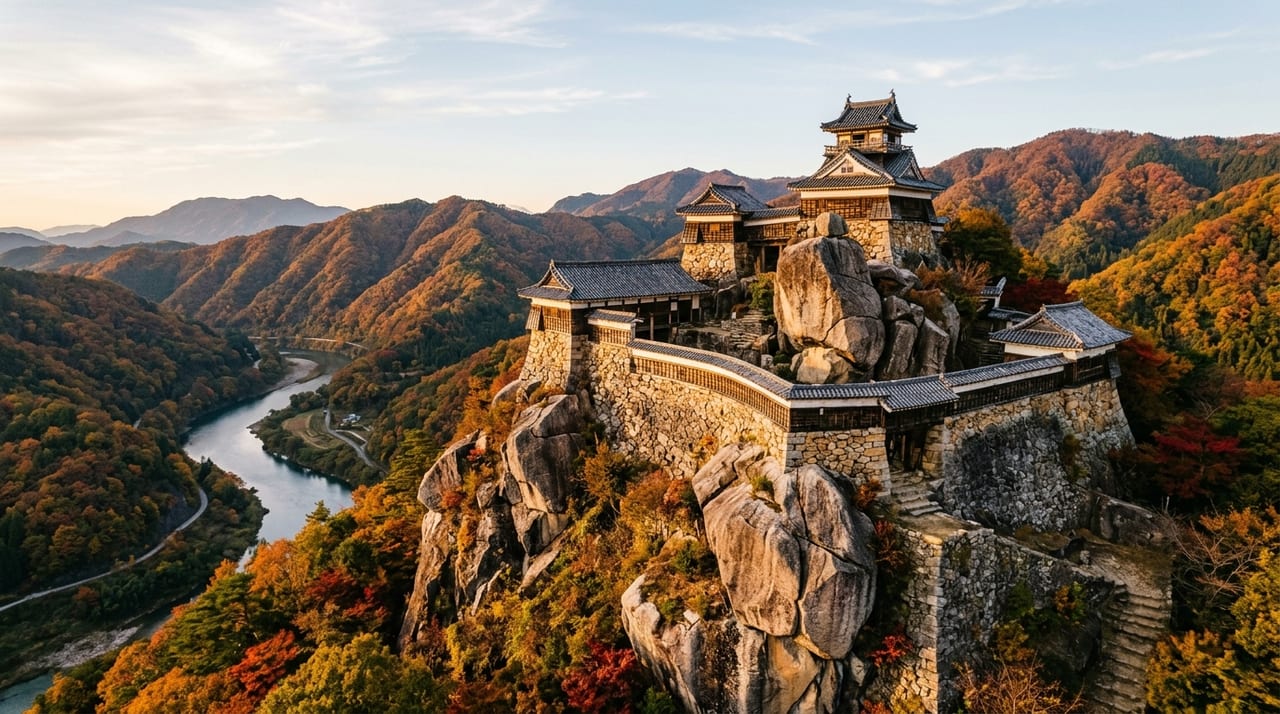
Naegi Castle is a mountain castle located in Nakatsugawa City, Gifu Prefecture. It is a ruin whose popularity has grown in recent years as the “Castle in the Sky,” characterised by stone walls that skilfully incorporate giant rocks atop the sheer cliffs of the Kiso River. The castle was built on the group of giant rocks of Shiroyama, at an elevation of 432 m, and its distinctive construction technique of fitting stone walls into the cracks and gaps of the rock is rare even by national standards.
The Tōyama clan (the Naegi Tōyama family), who governed Naegi Castle, were a branch of the Tōyama clan, a distinguished family of Mino, and for twelve generations throughout the Edo period they ruled the small Naegi domain as its lords. Using Naegi, which lies on the border between Mino and Shinano, as their base, the Tōyama controlled the mountainous area of the Kiso River basin in practice. Although the Naegi domain was a small domain of just 10,000 koku, it survived until the end of the Bakumatsu period as a domain that possessed a castle.
The greatest feature of the castle is the fused landscape of giant rocks and stone walls spreading across the tenshudai. The tenshu of Naegi Castle, which used giant rocks as natural foundation stones with stone walls and wooden buildings piled upon them, shows the pinnacle of stone wall techniques from the late Sengoku period to the early Edo period. The buildings were demolished in Meiji 4 (1871), but the stone walls remain in good condition, and they attract visitors from across the country as a spectacular sight, especially in the autumn foliage season and in the early morning when the sea of clouds forms.
In Heisei 29 (2017), it was selected as one of the Zoku Nihon Hyaku Meijō (Continued 100 Castles of Japan), and as a scenic castle ruin it is popular among younger generations as well.
Connection to Swords
The connection between Naegi Castle and swords is rooted in the history of Mino (Gifu) as a sword-producing region and in the warrior culture of the Naegi Tōyama family. Mino is known as a producer of excellent practical blades called “Minomono,” and Mino smithing, centred on Seki (Seki City, Gifu Prefecture), is a famous sword-producing region that has continued unbroken to the present day.
Naegi lies on the border between Mino and Shinano (Nagano), and it was a strategic point through which the culture and products of the two provinces passed along the road beside the Kiso River.
Materials relating to the Naegi Tōyama family are housed and exhibited at the Nakatsugawa City Naegi Tōyama Historical Museum, located at the foot of the castle ruins.
The tradition of “Sekikaji” (Seki smiths), representative of Mino smithing, continues today, and Seki City, about one hour by car from Naegi Castle, is still known as a production centre for swords and cutlery. When visiting Naegi Castle, it is recommended to experience the world of Mino swords together with the sword culture of Seki City.
Highlights
- Giant rocks and stone walls of the tenshudai — a one-of-a-kind view where natural rock and stone walls form a single whole
- Sea of clouds and autumn foliage viewpoint — a dreamlike scene where the early-morning sea of clouds and autumn colours overlap
- View of the Kiso River — the majestic flow of the Kiso River seen from sheer cliffs
- Nakatsugawa City Naegi Tōyama Historical Museum — a historical museum exhibiting materials on the Naegi Tōyama family and Naegi Castle
- Stone walls of the Ōyagura ruins — imposing stone wall remains that incorporate huge natural boulders
- Shijūhachi-magari-michi (Forty-Eight Bends) — the road along the Ōteguchi main approach, about 500 m long with a height difference of about 150 m
* Opening hours and admission fees are subject to change. Please check the official website before visiting.