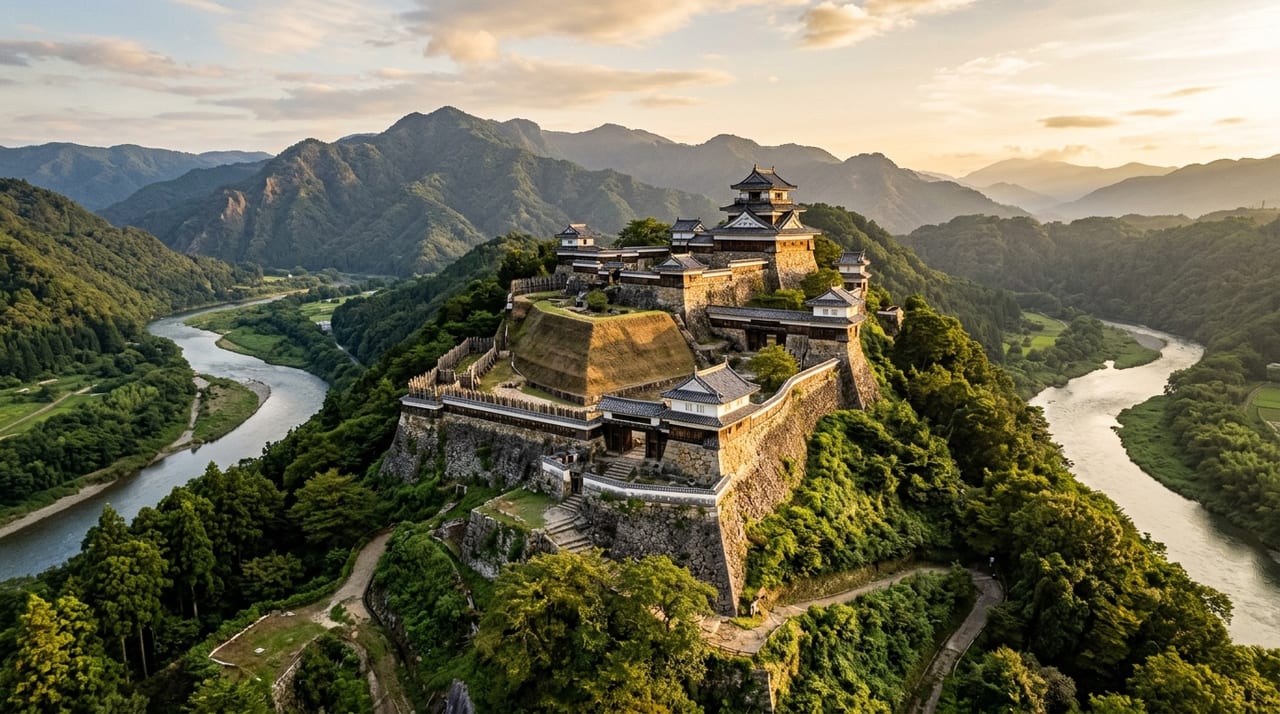
 * Image is for illustrative purposes only.
Nagashino Castle
長篠城
Nagashino Castle is a historic castle in the Chūbu region (Founded 1508 (Eishō 5); site of the decisive Battle of Nagashino in 1575). Its lord was Okudaira clan / Suganuma clan.
Overview
Nagashino Castle in Shinshiro, Aichi Prefecture, occupies a strategic promontory where the Kansa River meets the Ure River — its three sides bounded by water, the sole landward approach sealed by earthworks. Though modest in scale, it achieved immortality as the epicenter of the Battle of Nagashino (1575).
When Takeda Katsuyori's forces of approximately 15,000 besieged the castle, its commander Okudaira Nobumasa held out with only 500 men. The desperate messenger Torii Sune'emon broke through the siege lines to summon relief, enabling the combined Oda-Tokugawa army (est. 38,000) to confront the Takeda at Shitaragahara.
There, Oda Nobunaga deployed musketeer units behind palisades, devastating the Takeda cavalry — a tactical landmark in Asian military history. Nagashino Castle now operates as the Nagashino Castle Ruins History Museum, with detailed displays on the castle, siege, and battle.
Connection to Swords
The relationship between Nagashino Castle and the Japanese sword is crystallized in the Battle of Nagashino–Shitaragahara, a pivotal historical turning point. The battle is known as an event symbolizing the transition from the age of the Japanese sword to the age of firearms, and it is remembered as the place where the gleam of the uchigatana and tachi carried by the Takeda's mounted warriors gave way before Nobunaga's musket units.
Okudaira Nobumasa became the son-in-law of Tokugawa Ieyasu through his marriage to Ieyasu's daughter Kamehime; after the Battle of Sekigahara he moved from the Obata Domain in Kōzuke to the 100,000-koku Kanō Domain in Mino, and he also served as the first Kyoto Shoshidai. To reward Nobumasa's service at Nagashino, Ieyasu gave him the celebrated sword Daihannya Nagamitsu, which passed down the line of Nobumasa's youngest son, Matsudaira Tadaakira (the Matsudaira of the Oshi Domain). It is now a National Treasure in the collection of the Tokyo National Museum.
The Shinshiro City Shitaragahara History Museum holds and displays matchlock guns and other early firearms said to be the finest in Japan in both quality and quantity, while the Nagashino Castle Ruins History Museum exhibits arms and armour donated by descendants of the warriors who fought in the battle as well as artefacts excavated from the castle site, together offering a concrete account of the transition between Sengoku sword culture and firearms culture. As a place name, Nagashino carries special significance in sword history as a symbol of the great shift in Japanese weapons history from swords to firearms.
Highlights
- Nagashino Castle Ruins History Museum — detailed displays of the 1575 battle, arms, and siege
- Torii Sune'emon monument — memorial to the messenger who broke through Takeda lines
- Earthworks and moat ruins — well-preserved Sengoku-era defensive layout
- Shitaragahara History Museum (nearby) — matchlock collection said to be Japan's finest, with reconstructed palisades nearby
- Kansa–Ure river confluence — natural moat terrain that defined the castle's defensive strength
- Okudaira clan heritage sites — landmarks honoring Nobumasa, hero of the 1575 siege
* Opening hours and admission fees are subject to change. Please check the official website before visiting.