 * Image is for illustrative purposes only.
Komakiyama Castle
小牧山城
Komakiyama Castle is a historic castle in the Chūbu region (Founded in Eiroku 6 (1563)). Its lord was Oda Nobunaga.
Overview
About the Castle
Komakiyama Castle is a mountain castle that Oda Nobunaga newly built in 1563 (Eiroku 6) after relocating from Kiyosu Castle, and it holds an important historical position as the remains in which Nobunaga's revolutionary ideas about castle-building first took concrete form. Komakiyama, at an elevation of 86 m, is a small hill standing isolated on the Nōbi Plain, and Nobunaga developed the entire mountain into an artificial castle complex. The main enclosure (shukaku) at the summit was walled with stone, the mountainside was cleared to create many kuruwa (enclosures), and a comprehensive urban plan was carried out in which a castle town was developed at the foot of the mountain. This was an attempt to plan the castle and castle town as one unit, and it is evaluated as the origin of early-modern castles that led to later Azuchi Castle, Osaka Castle, and Edo Castle.
Architecture and Structure
Archaeological excavations have confirmed that stone walls were used at Komakiyama Castle. Introducing stone walls to a mountain castle in the Sengoku period was a groundbreaking attempt and is important evidence of Nobunaga's advanced view of castles. The mountainside was extensively leveled to create many kuruwa, and traces of planned town layout have been found at the southern foot, which indicates that the castle was designed not only as a military facility but as a castle with political capital functions. Because Nobunaga pacified Mino Province in 1567 (Eiroku 10) and moved to Gifu Castle (Inabayama Castle), Komakiyama Castle was in use for only four years, but its influence left a massive mark on the history of Japanese castles.
Battles and Warfare
Komakiyama Castle returned to the historical spotlight with the Battle of Komaki-Nagakute in 1584 (Tenshō 12). In this battle, in which Tokugawa Ieyasu and Hashiba Hideyoshi clashed in a dispute over Nobunaga's succession, Ieyasu took up position at Komakiyama Castle as his main camp and faced Hideyoshi's large army. Ieyasu built strong fortifications that made use of the hilly terrain and repelled Hideyoshi's direct attacks, while at Nagakute he completely defeated the separate forces of Ikeda Tsuneoki and Mori Nagayoshi. This battle is known as one of the rare cases in which Hideyoshi reached a peace settlement without achieving a complete military victory, and it showed the whole country Ieyasu's high level of military skill.
Nobunaga's Innovation
Nobunaga's Komakiyama Castle was the starting point of the 'castle revolution.' Whereas earlier mountain castles were purely military facilities that used the natural mountain itself, Komakiyama Castle was an artificial fortress city in which the entire mountain was systematically remodeled. In this castle, Nobunaga combined elements that led to later early-modern castles, such as stone walls, the main approach road (ōtemichi), and a planned castle town. Nobunaga's castle innovations from Eiroku through Tenshō were a remarkable event in the history of Japanese urban planning as well, and they prepared the birth of Momoyama culture from its architectural side.
Sightseeing and Experiences
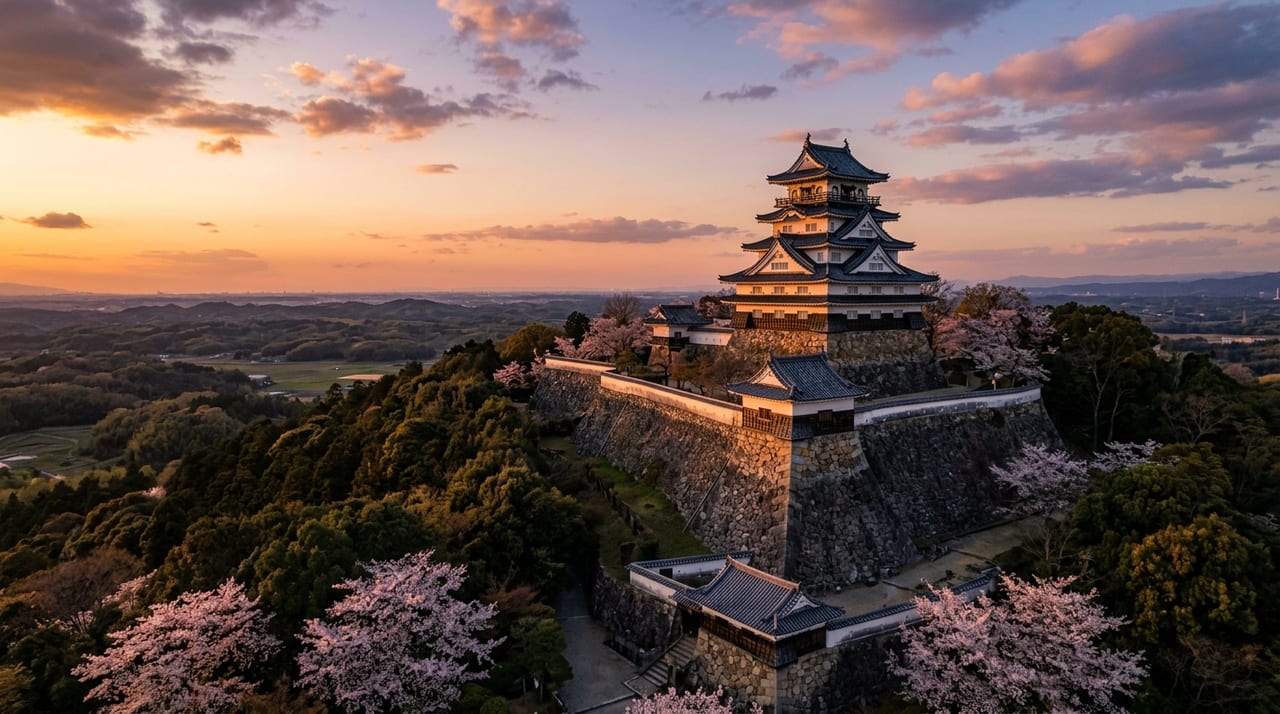
Today, Komakiyama Castle has a replica tenshu that opened in 1968 (Showa 43), and it is open to the public as the Komaki City History Museum. Parts of the excavation sites can be visited, and you can actually see stone walls and traces of residential areas from the Nobunaga era. Historic sites of the Battle of Komaki-Nagakute are also scattered in the surrounding area, making it a sacred site for Sengoku-period enthusiasts.
Connection to Swords
Oda Nobunaga was one of the warlords with the deepest understanding of swords in Japanese history, and his view of swords had a distinctive character that overturned conventional samurai wisdom. Nobunaga poured extraordinary passion into collecting famous swords. The Komakiyama Castle period (Eiroku 6–10, 1563–1567) was when Nobunaga advanced his conquest of Mino, corresponding to the dawn of his path toward unifying the realm. A particularly well-known famous sword that Nobunaga owned is the Yagen Tōshirō, and this tantō, said to be the work of Awataguchi Tōshirō Yoshimitsu, was one of the swords Nobunaga loved most. The name Yagen Tōshirō is said to derive from an anecdote: when Hatakeyama Masanaga, a Muromachi-period shugo daimyō, was defeated in the Meiō Coup and attempted to take his own life, this blade would not pierce his belly, and when he threw it away it pierced a yagen (medicine mortar). It is passed down as 'a loyal sword that does not cut its lord's belly but protects its lord.' Many of the famous swords that Nobunaga collected were lost in the flames of the Honnō-ji Incident (1582), but some were later passed on to the Tokugawa family and other daimyō and survive to the present day. Nobunaga actively used swords not merely as weapons but as symbols of political authority. By bestowing famous swords on capable retainers, he drew out their loyalty, and in diplomatic settings, gifts of famous swords functioned as the highest-grade diplomatic card. This refinement of 'sword diplomacy' shows the high level of Nobunaga's political sense, and it became a tradition inherited by later Toyotomi Hideyoshi and Tokugawa Ieyasu. As a place where one can experience the early period of Nobunaga's sword culture, Komakiyama Castle is also a historic site of significance for sword enthusiasts. Historic sites associated with Nobunaga, such as Okehazama and Kiyosu, are also nearby around the castle, and Komakiyama is an ideal place to start a 'Nobunaga pilgrimage of swords and castles.'
Highlights
- Excavated stone walls from the Nobunaga era — proof of the Sengoku-period castle revolution that can be seen on site in person
- Komakiyama Castle (Komaki City History Museum) — introduces the history of Nobunaga and Ieyasu through a replica tenshu and exhibits
- Komaki-Nagakute Battlefield Site — the battle of 1584 (Tenshō 12) in which Hideyoshi and Ieyasu faced off
- View of the Nōbi Plain from the Komakiyama summit — the horizon of 'tenka fubu' that Nobunaga looked out upon
- Okehazama Old Battlefield Park — the site of the battle in which Nobunaga defeated Imagawa Yoshimoto (about 1 hour by car)
- Kiyosu Castle (replica tenshu) — the central castle of Owari, known as Nobunaga's base (about 20 minutes by car)
* Opening hours and admission fees are subject to change. Please check the official website before visiting.