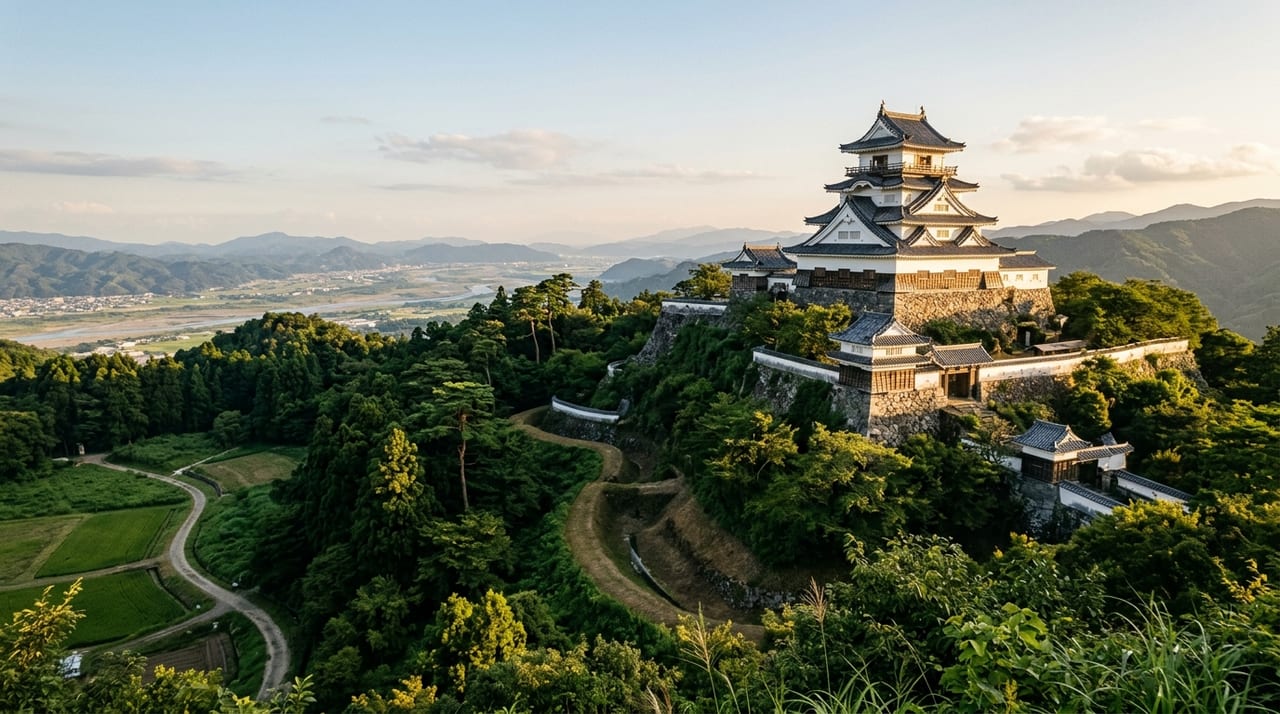
 * Image is for illustrative purposes only.
Oyama Castle (Tōtōmi Oyama)
小山城(遠江小山城)
Oyama Castle (Tōtōmi Oyama) is a historic castle in the Chūbu region (Construction date unknown (originally an Imagawa fort); rebuilt by the Takeda in 1571 (Genki 2)). Its lord was Imagawa clan (predecessor fortress) and Takeda clan (renovated by Shingen in Genki 2 (1571)).
Overview
Front line of the Takeda and Tokugawa
Oyama Castle (Tōtōmi Oyama) is a hirayama-style castle located in Yoshida Town, Haibara District, Shizuoka Prefecture. It was a front-line castle in the late Sengoku period, where the Takeda and Tokugawa clans fiercely contested control of Tōtōmi Province (western Shizuoka). The castle was built on a low mountain near the west bank of the Ōigawa River, and Takeda Shingen and his son Katsuyori renovated and strengthened it as a base for advancing into Tōtōmi. It is known for the distinctive arc-shaped moat called the Takeda crescent moat (mikazuki-bori), and castle researchers highly regard it as a showcase of the Takeda-style castle-building art.
Masterpiece of Takeda-style castle building
The layout of Oyama Castle is composed of the combination of the "round umadashi (maru-umadashi)" and the "crescent moat (mikazuki-bori)" that the Takeda clan was skilled at. This technique places a semicircular umadashi (an outer sallying point outside the castle) and surrounds its front with an arc-shaped moat, making it a sophisticated defensive method that complicates the intrusion of attacking forces. The crescent moat of Oyama Castle is known as one of the best-preserved examples among Japanese castles, and it is designated as a historic site of Yoshida Town as a remnant that conveys the castle-building technology of the Takeda house to the present day.
Takeda and Tokugawa contest for Tōtōmi and Oyama Castle
In Genki 3 (1572), Takeda Shingen launched a large-scale western campaign, aiming to subdue Tōtōmi and Mikawa and advance on the capital. In this campaign Shingen decisively defeated Tokugawa Ieyasu at the Battle of Mikatagahara (1572), but he died in camp in Genki 4 (1573). Takeda Katsuyori continued the offensive in Tōtōmi and Mikawa, and Oyama Castle functioned as one of its key bases. After the Takeda army was defeated at the Battle of Nagashino in Tenshō 3 (1575), the Tokugawa and Oda counteroffensive grew stronger, and with the fall of the Takeda house in Tenshō 10 (1582), Oyama Castle was ultimately brought under Tokugawa control.
Replica keep and restoration
Today, a replica keep built in Shōwa 62 (1987) stands at Oyama Castle, and inside it are exhibited items related to the Takeda clan and historical materials of the town. The entire castle site has been developed as Nōmanji-yama Park, and the remains of the crescent moat and the round umadashi are preserved and open to the public in good condition. In particular, the remains around the honmaru (main enclosure) are a textbook example of Takeda-style castle building, and they have become a popular destination that many castle enthusiasts visit, making them an essential place to visit for learning about "Takeda castles."
Connection to Swords
Swords of the Takeda army
Because Oyama Castle functioned as the Takeda clan's base for advancing into Tōtōmi, warriors of the Takeda army were stationed there. During the period when Takeda forces were deployed in Tōtōmi and Mikawa, a front line formed around Oyama Castle where Takeda swords and the swords of Tokugawa and Tōtōmi clashed in actual combat.
Kai swordsmiths and Tōtōmi swords
It is said that swordsmiths also worked in Kai Province (Yamanashi), the home domain of the Takeda clan, and produced practical swords suited to cavalry combat. Kai swords are not as ornate as those of Bizen or Sagami, but they are said to have valued durability and cutting ability in actual battle.
Warriors of Mikatagahara and Nagashino and their swords
The Battle of Mikatagahara (1572) and the Battle of Nagashino (1575), which took place in the period when Oyama Castle functioned as a front-line base, were also important battles marking the turning point from swords to firearms in Japanese Sengoku history. The Battle of Nagashino in particular is regarded as a symbol of the tactical revolution against cavalry forces through the concentrated use of firearms, but in practice, close combat with swords and spears still played a decisive role. The swords carried into battle by Takeda warriors who received training and supplies at Oyama Castle are, as witnesses who survived the combat of this historic turning point, at the core of the historical significance of Oyama Castle.
Highlights
- Triple crescent moats and round umadashi remains — a Yoshida Town designated historic site that conveys Takeda-style castle-building art to the present day
- A front-line castle of Takeda Katsuyori — experience the front line of the Takeda and Tokugawa contest for Tōtōmi
- Observation tower Oyama Castle (replica keep) — exhibits items related to the Takeda clan and historical materials of the town
- Views of the Ōigawa basin and Suruga Bay — distant views of the Southern Alps and Suruga Bay from the observation floor of the replica keep
- Combine with Tanaka Castle and Kakegawa Castle — ideal for a one-day tour of Sengoku-period castles in Shizuoka and Tōtōmi
* Opening hours and admission fees are subject to change. Please check the official website before visiting.