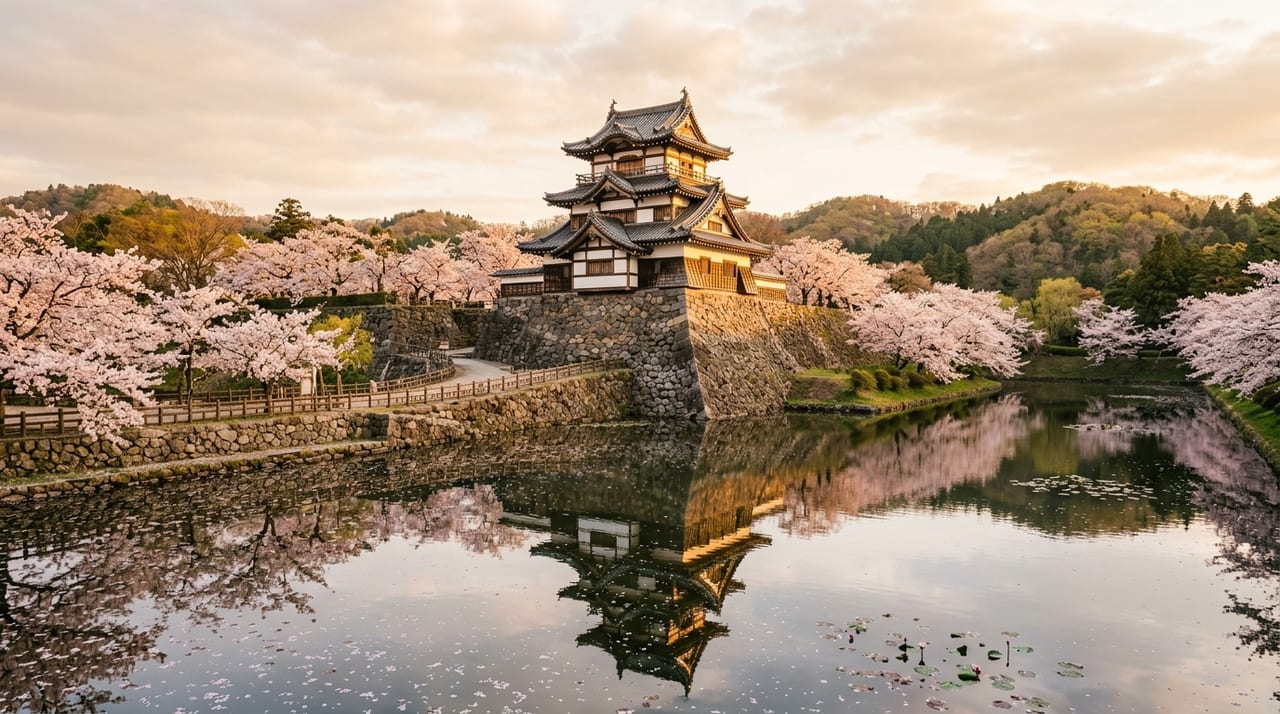
 * Image is for illustrative purposes only.
Takada Castle
高田城
Takada Castle is a historic castle in the Chūbu region (Built in 1614 (Keichō 19) under the national construction system (tenka-bushin)). Its lord was Matsudaira Tadateru (sixth son of Tokugawa Ieyasu) / Sakakibara clan / Sakai clan.
Overview
Takada Castle was built in Keichō 19 (1614) as the castle of Matsudaira Tadateru, the sixth son of Tokugawa Ieyasu, in the remarkably short period of just four months. What made this rapid completion possible was the large-scale labor-contribution system imposed on daimyo across the country, known as “tenka bushin” (nationwide construction), and daimyo and craftsmen gathered from various regions threw their full strength into the construction.
The greatest feature of Takada Castle is that it is a “castle without a tenshū” (main keep). Shortly after the completion of the construction, the Osaka campaigns and the dismissal of Tadateru followed in succession, so the building work on the turrets and other structures barely progressed. The turrets that served as substitutes for the tenshū were double-storied during the early Edo period; after the restoration following the Takada earthquake of Kanbun 5 (1666), they are believed to have become three-story triple turrets (the current triple turret was reconstructed in Heisei 5 (1993)).
The castle layout (nawabari) is a flat castle of the rinkaku (enclosure) type, surrounded by an inner moat, an outer moat, and water moats overgrown with lotus. The lotus beds in the moats of the present Takada Castle Ruins Park are abundant, and the lotus blooming in the outer moat in summer is celebrated as “the finest in the East,” making it a famous attraction alongside the spring night cherry blossoms. The spring night cherry blossoms in particular (about 4,000 Somei-yoshino trees) are nationally renowned as one of Japan's Three Great Night Cherry Blossom Sites.
Although Matsudaira Tadateru was the sixth son of Ieyasu, he was censured for his conduct during the Osaka campaigns, among other things, and was dismissed from his domain in Genna 2 (1616). The castle thereafter passed through the hands of the Sakai, Matsudaira, and Sakakibara clans, among others, and functioned as the main castle of the Takada Domain until the late Edo period.
Connection to Swords
The connection between Takada Castle and swords is deeply rooted in the castle's historical background and the samurai culture of Echigo. As the sixth son of Tokugawa Ieyasu, Matsudaira Tadateru was active as a daimyo during the period when the sword culture of the early Edo shogunate flourished most.
The Sakakibara family, who governed the Takada Domain from the mid-Edo period until the late Edo period, were a prestigious daimyo house of Tokugawa fudai retainers, and it was a family in which Sakakibara Yasumasa distinguished himself as one of Ieyasu's Four Heavenly Kings.
Highlights
- Reconstructed Sanjū-yagura (Triple Turret) — rebuilt in 1993; the illumination during the night cherry blossom season is especially fantastical
- One of Japan's Three Great Night Cherry Blossom Sites — about 4,000 Somei-yoshino cherry trees bloom along the moat, a famous spring attraction
- Summer Lotuses — the lotus beds filling the outer moat are celebrated as “the finest in the East”
- Takada Castle Ruins Park — spanning about 50 hectares, a park where residents and visitors gather throughout the four seasons
- Jōetsu City Museum of History — systematically exhibits historical materials on Takada Castle and the Takada Domain
- Water Surface of the Outer Moat — the triple turret reflected on the mirror-like water is an ideal photo spot
* Opening hours and admission fees are subject to change. Please check the official website before visiting.