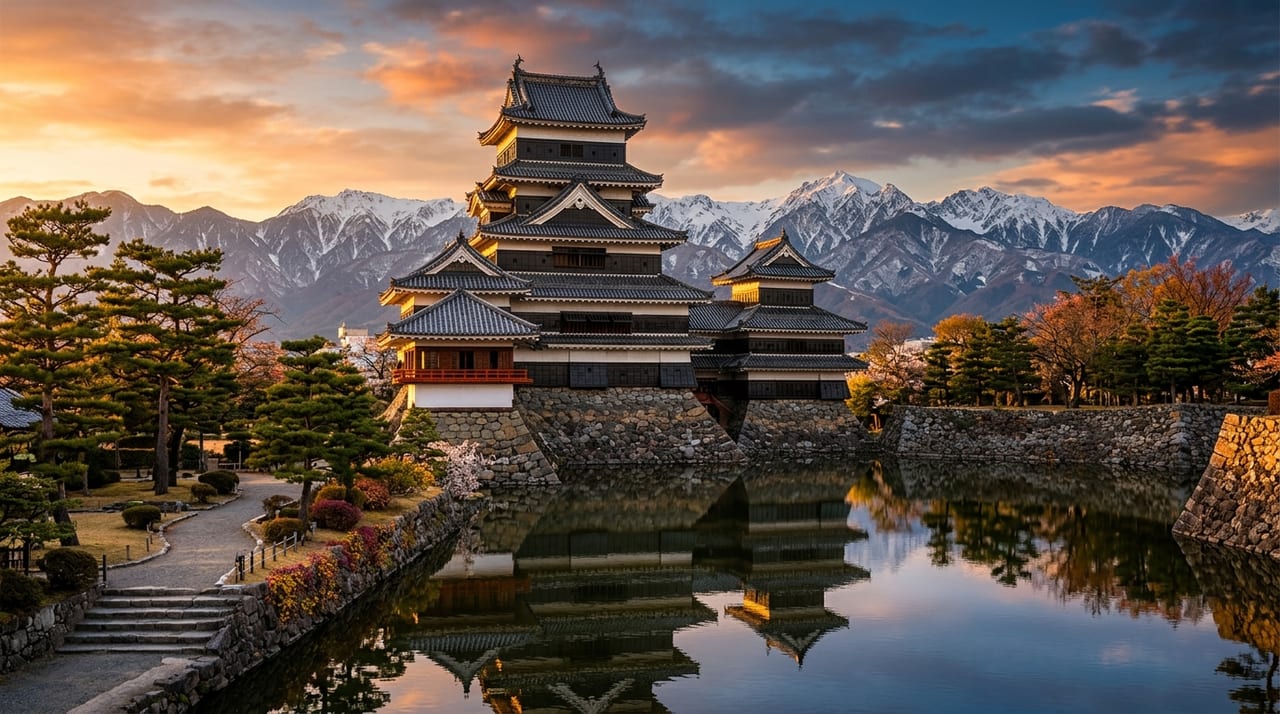
 * Image is for illustrative purposes only.
Matsumoto Castle
松本城
Matsumoto Castle is a historic castle in the Chūbu region (Built in 1593-94 (Bunroku 2-3)). Its lord was Ishikawa Kazumasa / Matsudaira clan.
Overview
About the Castle
Matsumoto Castle is a National Treasure famous castle with a five-story, six-level main keep, and it is the oldest of the surviving five-story keeps in Japan, a supreme presence. Its predecessor was Fukashi Castle, built by the Ogasawara clan during the Eishō era (1504–1520) of the Sengoku period. In Tenshō 18 (1590), Ishikawa Kazumasa, who entered Shinano under the order of Toyotomi Hideyoshi, began full-scale renovation into an early modern castle, and his son Yasunaga completed the current keep in Bunroku 2–3 (1593–94). The contrast of black lacquered shitamiita (lower wood cladding) and white plastered walls layered alternately simultaneously embodies the rugged austerity of the Sengoku period and the splendor of the Momoyama period, and it holds a jet-black beauty.
Architecture and Structure
The keep complex consists of five structures: the main keep, Inui Small Keep, Watari Turret, Tatsumi Annex Turret, and Moon-Viewing Turret (Tsukimi Yagura). Its connected multi-building composition, which unites wartime defensive function with peacetime elegance, is the finest example of Japanese castle architecture. Seen reflected in the moat with the 3,000-meter-class peaks of the Northern Alps behind it, the castle is known as the ultimate composition sought after by castle photography enthusiasts worldwide. The Moon-Viewing Turret is an open space said to have been added to welcome a shogun, and its design of enjoying the moon from the vermilion-lacquered veranda adds an elegance not found in Sengoku castles. Ishikawa Kazumasa was originally the chief retainer of Tokugawa Ieyasu, but in Tenshō 13 (1585) he suddenly defected to Hideyoshi's side, leaving behind one of the greatest mysteries in Sengoku history.
Culture and Craftsmanship
Because Kazumasa knew Ieyasu's military secrets inside out, his defection is said to have forced Ieyasu to decide to reform the military system dating back to the Mikawa days. In the Edo period, the Matsudaira clan (including the Toda clan) served as lords of the domain, and under a domain government that valued learning, Matsumoto flourished as the cultural center of Shinshū. After the Meiji Restoration, the keep at one point faced the crisis of demolition, but its preservation was achieved through the efforts of local benefactors including Ichikawa Ryōzō. This "power of the citizens who protected Matsumoto Castle" is recorded in history as a pioneer of Japan's cultural property preservation movement. Matsumoto Castle shows a different face in each season: cherry blossoms in spring, deep green in summer, autumn foliage, and snowy landscapes in winter. In every season, the jet-black keep stands out.
Development of the Castle Town
Especially in winter, the sight of the black keep standing before the white peaks of the Northern Alps never fails to captivate photography enthusiasts worldwide as the ultimate in Japanese castle beauty. Matsumoto is also a base of the Mingei folk craft movement, and it is a city where you can deeply appreciate Japan's traditional culture along with the atmosphere of its castle-town streets. Loved by mountain climbers as the gateway to Kamikōchi and Norikura Kōgen, Matsumoto is a city representing Shinshū, where nature, culture, and history are in harmony. When visiting Matsumoto Castle, it is also a delight to aim for the time of the Matsumoto Castle Festival held within the castle.
History of Castle Construction
Traditional martial arts demonstrations and samurai processions are held, allowing visitors to enjoy an experience in which castle architecture and martial culture are united.
Connection to Swords
Shinshū (Nagano Prefecture) also has a history of swordsmiths active in various places. Ishikawa Kazumasa, lord of Matsumoto Castle, was a figure who oversaw the military affairs of the Mikawa samurai band as Tokugawa Ieyasu's chief retainer. Shinshū's blacksmithing techniques took root in the region as a cutlery industry even after the Meiji period. By visiting the Matsumoto City Museum to learn about the history of Matsumoto Domain and the castle town, and visiting together with the National Treasure keep, you can experience the martial and aesthetic culture of Shinshū. The jet-black keep of Matsumoto Castle and the unadorned beauty of Shinshū swords are bound by a shared aesthetic of "genuine strength without ornament." When you climb the National Treasure keep and gaze at the majestic range of the Northern Alps, you can reflect on the history of Shinshū's warriors who forged swords and honed their martial arts within this very landscape.
Highlights
- National Treasure keep — five-story, six-level connected multi-building keep complex, reigning in Japanese castle history as the oldest surviving five-story keep
- Moon-Viewing Turret (Tsukimi Yagura) — open space with a vermilion-lacquered veranda, an elegant structure built to welcome a shogun
- Jet-black keep against the Northern Alps — castle scenery woven together by the jet-black keep and the Northern Alps
- Matsumoto City Museum — exhibits on the history of Matsumoto Domain and the castle town
- Castle-town Nakamachi Street / Nawate Street — Matsumoto's cultural landscape where storehouse-style (kura-zukuri) merchant houses and folk-craft streetscapes remain
* Opening hours and admission fees are subject to change. Please check the official website before visiting.