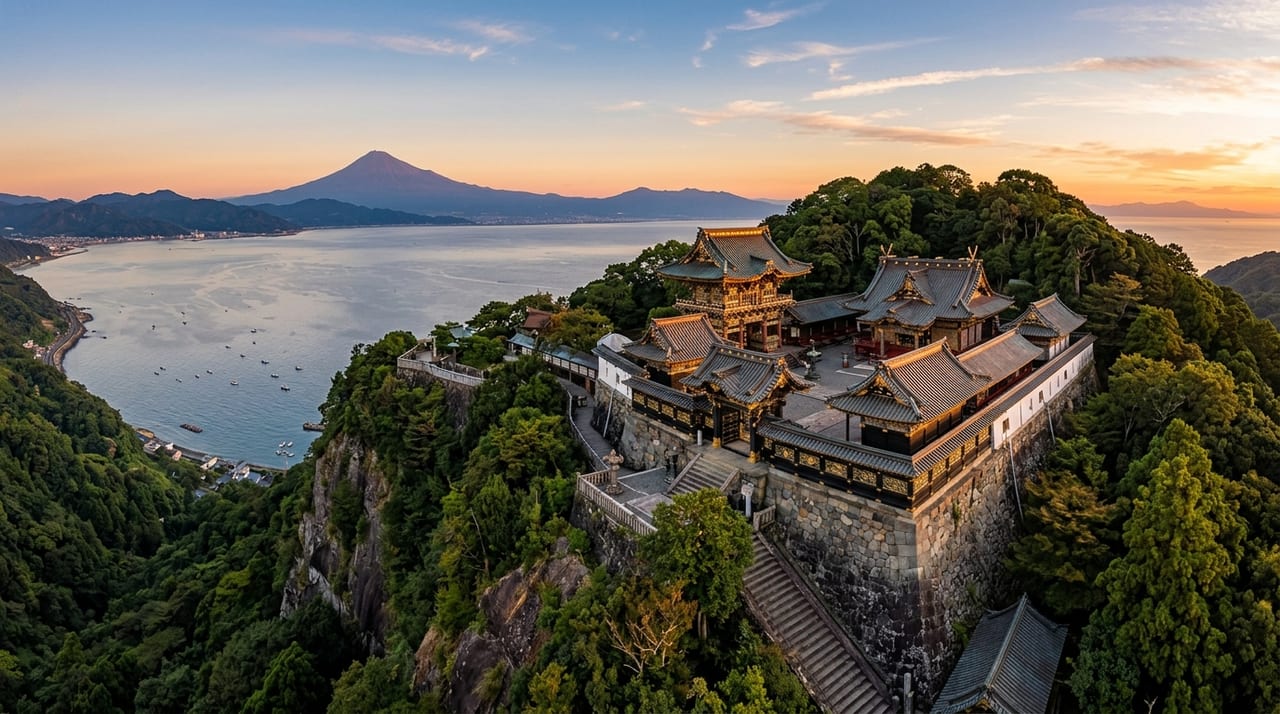
 * Image is for illustrative purposes only.
Kanegasaki Castle
金ヶ崎城
Kanegasaki Castle is a historic castle in the Chūbu region (Late Heian period to the Sengoku period). Its lord was Taira no Michimori; Nitta Yoshisada; the Kai clan; the Asakura clan (hereditary Tsuruga district governors).
Overview
Overview
Kanegasaki Castle is a mountain castle built on a hill 86 m above sea level that juts out into Tsuruga Bay, in Kanegasaki-chō, Tsuruga City, Fukui Prefecture. It is traditionally said to have originated when Taira no Michimori built the castle to prepare for battle against Kiso Yoshinaka during the Jishō–Juei War. From the Nanboku-chō period through the Sengoku period, it was repeatedly the site of fighting. It was designated a National Historic Site in 1934.
Struggles of the Northern and Southern Courts
In 1336 (Kenmu 3 / Engen 1), Emperor Go-Daigo sought to restore Southern Court power. He ordered Nitta Yoshisada to take Prince Takanaga and Prince Tsunenaga north to Hokuriku, accompanied by Wakiya Yoshisuke, Yoshisada's younger brother. Yoshisada left Mount Hiei for Tsuruga and entered Kanegasaki Castle in the 10th month of the same year. In the 3rd month of Engen 2 (1337), the castle fell under the fierce assault of Kō no Moroyasu, commander on the Ashikaga side, and others. Prince Takanaga took his own life, and Prince Tsunenaga was captured and is said to have been poisoned the following year.
Changes of Castle Lords
After the Northern and Southern Courts period, the Kai clan, deputy governors of Echizen, made the castle their seat. In Chōroku 3 (1459), they repelled an attack by the shugo Shiba Yoshitoshi. After the Asakura clan gained control of Echizen, Kanegasaki Castle was passed down for generations as the seat of the Tsuruga district governors, who were members of the Asakura clan.
The Kanegasaki Retreat
In Genki 1 (1570), Oda Nobunaga marched out to subjugate the Asakura clan of Echizen and brought Asakura Kagetsune, lord of Kanegasaki Castle, to submission. However, word then arrived that his ally Azai Nagamasa had turned against him. Nobunaga's army faced a critical situation in which it risked being caught between enemy forces. Nobunaga withdrew his entire army here. This engagement is widely known in later times as the Kanegasaki Retreat (Kanegasaki no Nokiguchi, also called Kanegasaki-kuzure).
Structure and Present Condition
The castle grounds retain the ruins of Tsukimi Palace, which corresponds to the honmaru (main enclosure), as well as the ruins of gates, enclosures, and dry ditches (horikiri). The site has been developed as a park. Within the castle grounds stands Kanegasaki-gū Shrine, founded in Meiji 23 (1890), which enshrines Prince Takanaga, who took his own life when the castle fell, and Prince Tsunenaga, who was captured.
Connection to Swords
The Taiheiki depicts Nitta Yoshisada, who fought in the siege of Kanegasaki, as carrying two heirloom long swords of the Minamoto clan, "Onikiri" and "Onimaru." After Yoshisada was killed in the Battle of Fujishima, the two swords are said to have passed into the hands of Shiba Takatsune.
Highlights
- Tsukimi-goten site (main enclosure)
- Kanegasaki-gu Shrine
- Site associated with the 'Kanegasaki Retreat'
* Opening hours and admission fees are subject to change. Please check the official website before visiting.