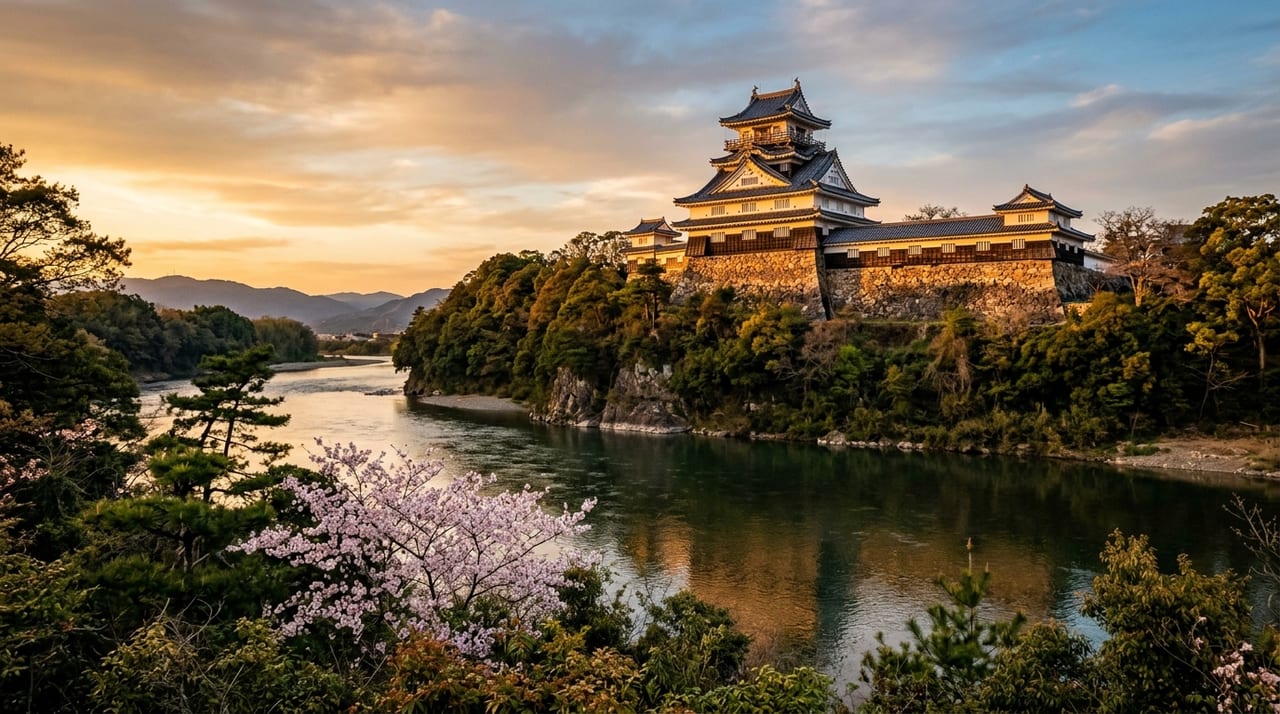
 * Image is for illustrative purposes only.
Sunomata Castle (The Overnight Castle)
墨俣城(墨俣一夜城)
Sunomata Castle (The Overnight Castle) is a historic castle in the Chūbu region (A fort said to have been built overnight by Kinoshita Tōkichirō (later Toyotomi Hideyoshi) in Eiroku 9 (1566). In 1991, a replica castle keep (history museum) was built on the castle site). Its lord was Saitō clan → Kinoshita Tōkichirō (later Toyotomi Hideyoshi, according to tradition) → Ikeda Tsuneoki (renovated by his retainer Iki Tadatsugu).
Overview
Sunomata Castle is a castle site on the bank of the Nagara River in Ōgaki, Gifu Prefecture. It is known as the setting of the most famous castle-building anecdote in Japanese history, the legend of “Sunomata Ichiya-jō” (One-Night Castle). In Eiroku 9 (1566), Kinoshita Tōkichirō (later Toyotomi Hideyoshi), who stood at the front line of Oda Nobunaga's campaign to conquer Mino (Gifu), is said to have built a fort overnight in the middle of enemy territory. This anecdote has been told as a symbol of Hideyoshi's rise to success from the Edo period to the present day.
At the time, Hideyoshi was still a low-ranking warrior known as “Kinoshita Tōkichirō.” On the site of Sunomata, where Nobunaga's senior retainers had failed in their repeated attempts to build a castle, Hideyoshi is said to have completed the framework of the fort with lightning speed by adopting an innovative method: timber was prepared upstream in advance and transported by raft. The story that the success of this “one-night castle” cemented Nobunaga's trust and opened Hideyoshi's path to becoming ruler of the realm has taken deep root in Japan as a symbol of “rising from humble beginnings to success.”
From a historical standpoint, the one-night castle story is based on later military chronicles and on the Bukō Yawa, which some argue is a forgery. Reliable primary sources such as the Shinchō Kōki contain no record of Hideyoshi building a castle at Sunomata, and no source confirms that it happened. The castle-style building that stands at the present site is a replica keep modeled on the keep of Ōgaki Castle, opened in 1991 (Heisei 3) as Sunomata Ichiya-jō / Ōgaki City Sunomata History Museum. It does not restore the castle as it appeared at the time, but many tourists visit it as a historical park and history museum.
Sunomata lies near the confluence of the Kiso Three Rivers, the Nagara, Ibi, and Kiso Rivers, at a key point for water transport. Throughout the Sengoku period it was the site of repeated fierce struggles, as it lay in the border zone between Mino and Owari. Because Hideyoshi later became ruler of the realm and Sunomata is said to be the starting point of his rise, the castle site is also affectionately known by the nickname “castle of advancement.”
Connection to Swords
The relationship between Sunomata Castle and Japanese swords is discussed in terms of the sword outlook of Toyotomi Hideyoshi himself, the castle's central figure, and the geographic proximity of Sunomata to Mino and Owari, among the most important production regions of Japanese swords.
Mino Province (Gifu Prefecture) was a major sword-producing region known as “Mino-mono.” In particular, Seki reached its peak during the Sengoku period as a leading center of swordsmiths counted among the Gokaden (Yamato, Yamashiro, Bizen, Sagami, and Mino). The sword style known as the Mino tradition (Mino-den) produced light, sharp blades suited to actual combat, and was widely favored by Sengoku warlords. Seki, about 25 km northeast of Sunomata, was already known at the time as one of the country's foremost sword-producing areas.
Toyotomi Hideyoshi himself, after becoming ruler of the realm, collected famous swords such as “Masamune,” “Osafune,” and “Shizu,” and used swords as political gifts. As the starting point of Hideyoshi's career, Sunomata Castle is a castle site located at the heart of the Mino sword culture.
Highlights
- Ichiya-jō Site — the site of the fort said to have been built by Toyotomi Hideyoshi, a historical park on the bank of the Nagara River
- Sunomata Ichiya-jō (History Museum) — a replica castle keep completed in 1991, with exhibits on the Sengoku period and Hideyoshi's rise to prominence
- Views of the Nagara River — the river on which Hideyoshi is said to have transported timber by raft; experience the strategic terrain of the time
- Mino and Seki Swordsmithing Region — the Seki Traditional Swordsmith Museum (Seki Kaji Denshōkan) in Seki, known as a sword-producing center
- Ōgaki Castle (central Ōgaki) — the castle where Ishida Mitsunari set up his headquarters during the prelude to the Battle of Sekigahara; about 15 minutes by car
- Kiso Sansen National Government Park — a national government park spanning the Kiso, Nagara, and Ibi Rivers, the three rivers of the Kiso Three Rivers
* Opening hours and admission fees are subject to change. Please check the official website before visiting.