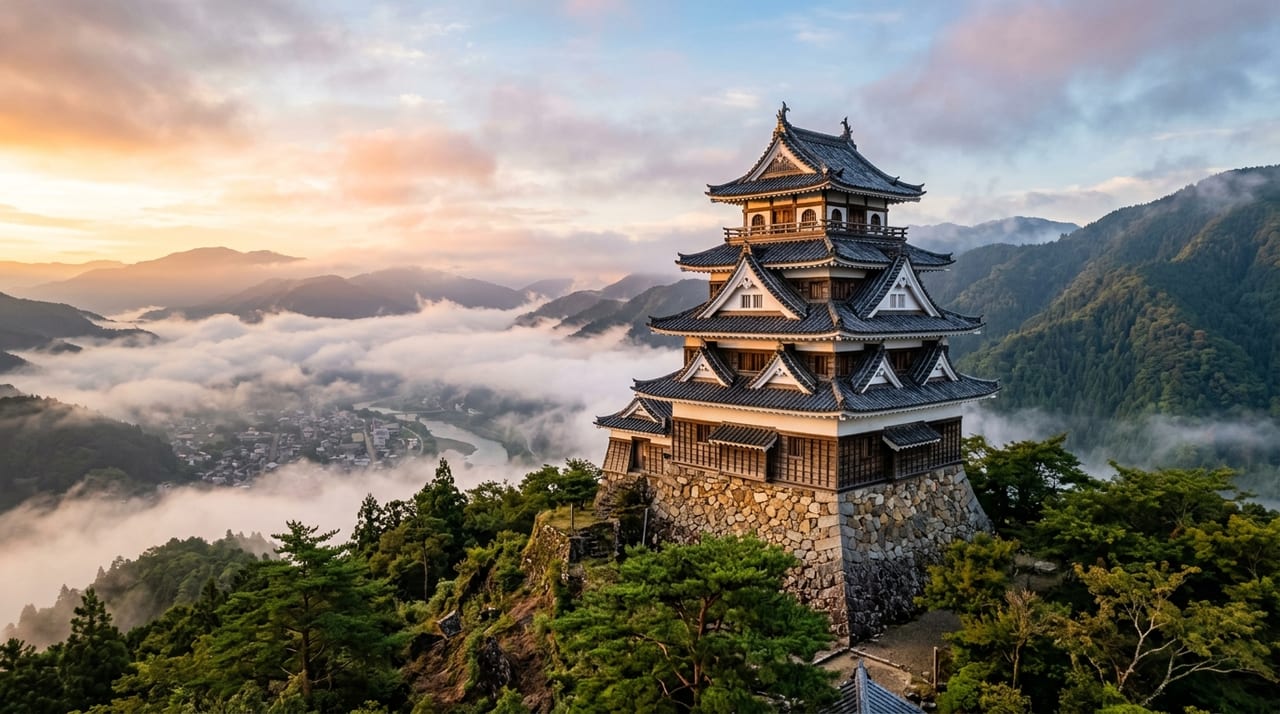
 * Image is for illustrative purposes only.
Gujo Hachiman Castle
郡上八幡城
Gujo Hachiman Castle is a historic castle in the Chūbu region (Founded in 1559 (Eiroku 2) by Endo Morikazu). Its lord was Endō Morikazu, Yoshitaka / Inaba Sadamichi / Endō clan / Inoue clan / Kanamori clan / Aoyama clan.
Overview
Gujō Hachiman Castle is a mountain castle on the Nagara River in Gujō City, Gifu Prefecture. The writer Shiba Ryōtarō praised it in Kaidō o Yuku as 'the most beautiful mountain castle in Japan.' It began in Eiroku 2 (1559), when Endō Morikazu built it on Mount Hachiman (354 meters above sea level). Through the Battle of Sekigahara, the One Castle per Domain Edict, and changes of lord, it has survived various upheavals. Its tenshu, rebuilt in wood in Shōwa 8 (1933), still stands on the summit today.
What sets Gujō Hachiman Castle apart is that its present tenshu was built early as a wooden tenshu reconstructed in the Shōwa era. The 1933 rebuilding is a wooden four-story mock tenshu modeled on Ōgaki Castle. It is said to be the oldest extant wooden reconstructed castle in Japan, and it is designated as a tangible cultural property of Gujō City. From the tenshu, you can see the Gujō Basin, the Nagara River, and the surrounding mountains. The early-morning scene, wrapped in mist, is especially popular with photographers as the 'Sea of Clouds Gujō Hachiman Castle.'
During the time of the domain lord Kanamori Yorikane, Gujō became the stage of a peasant uprising called the Gujō Ikki (Hōreki uprising, 1754–1758). The domain tried to increase tax levies by changing its annual tax collection from the fixed-rate system (jōmen-hō) to the annual inspection system (kemi-hō). The farmers opposed this. Their protest escalated to a direct appeal to a rōjū's palanquin (kagoso) and a petition to the complaint box (hakoso). At the shogunate's supreme court (Hyōjōsho), the case ended with the stripping of the Kanamori family's domain and the dismissal of the rōjū and wakadoshiyori. Japanese history records it as a rare case of this kind. After the uprising, Aoyama Yukimichi was enfeoffed in Gujō.
Gujō Hachiman is also known as a 'city of water.' The clear Yoshida River, which flows through the castle town, is famous for summer diving. The Gujō Odori is known as one of Japan's three great Bon dances, and its all-night dancing held every summer is a point of pride for the region. This abundance of water and dance culture is inseparably tied to the spirit of the castle town that Hachiman Castle has protected.
Connection to Swords
The connection between Gujō Hachiman Castle and swords is rooted in its location in Mino Province, a major center of sword production, and in the samurai culture of the castle's lords, the Endō family. Mino Province, where Gujō Hachiman Castle stands, was a major sword-producing region known as 'Mino-mono.' The Seki smiths, represented by Seki City, hold a unique place in the history of Japanese swords. Gujō borders Seki City, so Gujō's samurai could easily obtain swords made by Mino smiths.
The Endō family was a branch of the Tō clan of Gujō. In the time of Endō Morikazu, they were under the Sengoku daimyo Saitō clan of Mino, led by Saitō Tatsuoki, and they were deeply familiar with Mino's sword culture. Seki smiths supplied swords to many warlords in the Sengoku period, and it is thought that the lords of Gujō Castle also valued Seki swords suited for actual combat. The features of Mino blades lie in their hamon, such as the gunome-midare, togari-ba, and sanbon-sugi patterns. They are highly valued as swords that combine practicality with aesthetic appeal.
Armor and other military equipment, including armor of the Endō and Aoyama families, are displayed in the historical museum inside the tenshu of Gujō Hachiman Castle. These pieces convey part of the castle lords' samurai culture to the present day.
Highlights
- Reconstructed wooden tenshu (Shōwa 8 (1933)): a mock tenshu said to be the oldest extant wooden reconstructed castle in Japan
- Castle in the Sea of Clouds: the tenshu floating above morning mist is a famous photography spot, and early-morning visits are recommended
- Clear waters of the Nagara and Yoshida Rivers: among Japan's leading clear streams flowing through the castle town, with summer diving as its specialty
- Gujō Odori (one of Japan's three great Bon dances): danced in the castle town over 32 nights from mid-July to early September
- View of the Gujō Basin from the tenshu: a 360-degree panorama of mountains and townscape
- Gujō Hachiman Former Town Hall Memorial Museum and waterside townscape: experience the castle-town culture of the city of water, Gujō
* Opening hours and admission fees are subject to change. Please check the official website before visiting.