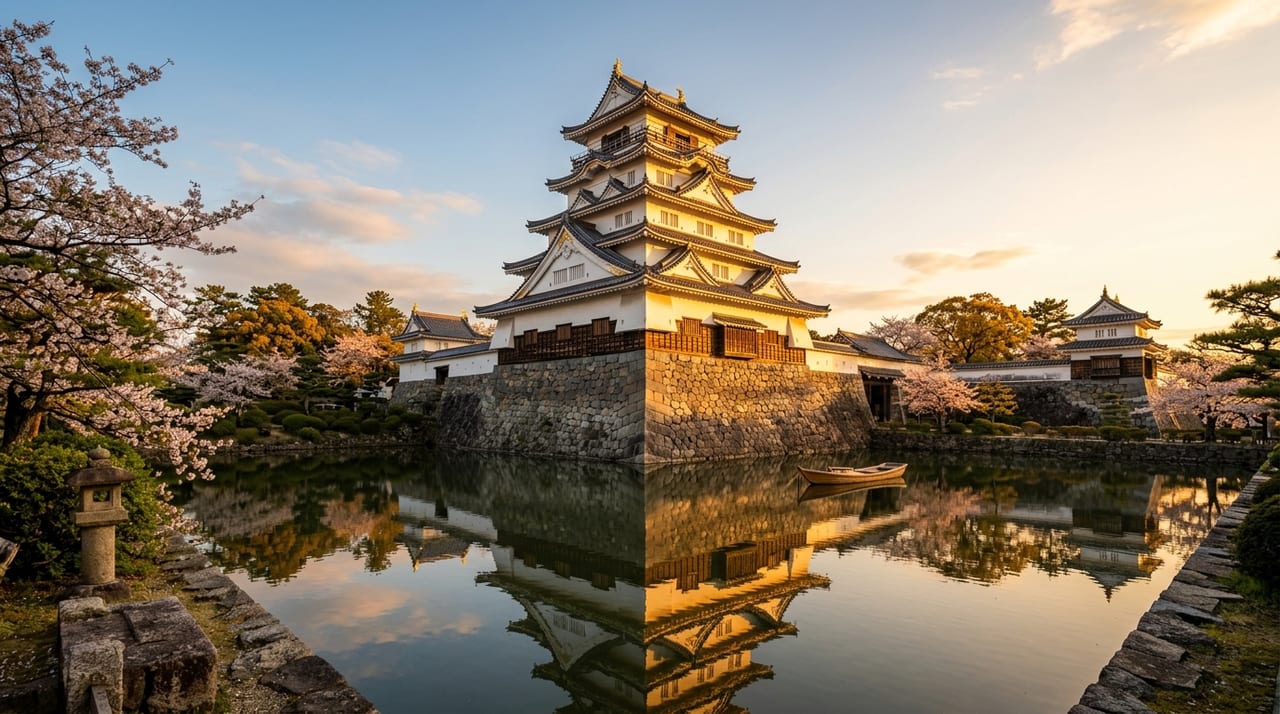
 * Image is for illustrative purposes only.
Sunpu Castle
駿府城
Sunpu Castle is a historic castle in the Chūbu region (Renovated by Ieyasu 1585 (Tenshō 13); rebuilt 1607 (Keichō 12)). Its lord was Imagawa clan / Nakamura Kazuuji / Tokugawa Ieyasu.
Overview
Ieyasu's Final Residence: The History of Sunpu Castle
Sunpu Castle stands in present-day Shizuoka City (formerly Suruga Province), the fortress Tokugawa Ieyasu developed as his retirement castle in his later years. Ieyasu's bond with Sunpu ran deep—as a youth, he spent years here as a hostage under Imagawa Yoshimoto (1549–1560). After fierce campaigns such as Mikatagahara and Nagashino, Ieyasu began building Sunpu Castle as an early modern castle in 1585 (Tenshō 13) and moved his residence there from Hamamatsu Castle the following year, 1586 (Tenshō 14).
Following his victory at Sekigahara (1600), Ieyasu was appointed shōgun at Fushimi Castle in 1603 (Keicho 8), then abdicated in 1605 (Keicho 10) to pass the title to Hidetada. Yet rather than retiring to Edo, he returned to Sunpu and exercised "Ōgosho politics" (rule as retired shōgun) until his final days. From 1607 (Keicho 12) Sunpu Castle was extensively rebuilt as a construction project imposed on the daimyō, and in 1610 (Keicho 15) a seven-level keep was completed (later destroyed by fire). Its keep base was larger than that of Edo Castle.
Sunpu O-wakemono: Ieyasu's Vast Sword Collection
From the perspective of sword culture, Sunpu Castle holds extraordinary significance. During his years at Sunpu, Ieyasu accumulated an immense collection of property, art, and swords. After his death, his estate was divided as the Sunpu O-wakemono ("Sunpu Division of Goods"): part went to Shōgun Hidetada and others, and the greater part to the three Tokugawa branch houses of Owari, Kii and Mito.
The O-wakemono inventories list 1,172 swords, naginata and spears. Only about 100 items can be matched to surviving pieces, but 42 of the 85 swords among them are designated National Treasures, Important Cultural Properties or Important Art Objects.
Ieyasu also protected the smiths of his own day, for example summoning the Echizen smith Yasutsugu to forge blades in Edo, granting him the character "Yasu" and permitting him to carve the hollyhock crest on his tangs.
Tokugawa Ieyasu: Seventy-Three Years and the Japanese Sword
Born in 1542 (Tenbun 11) in Mikawa Province (present-day Okazaki, Aichi), Ieyasu experienced a harsh youth, sent as a hostage to the Imagawa clan at age six and remaining under their rule until he turned nineteen. Yet this period forged him into a man of extraordinary patience and strategic acumen. The verse "Should the hototogisu (lesser cuckoo) not sing, I will wait for it to sing" captures his character precisely.
During his hostage years at Sunpu, Ieyasu was exposed to the Imagawa family's cultural sophistication, developing a deep appreciation for swords and the arts. As an adult, he fought in numerous campaigns under Nobunaga and Hideyoshi, understanding through firsthand experience the practical significance of swords in warfare.
After destroying the Toyotomi at the Osaka Summer Campaign in 1615 (Keicho 20), Ieyasu returned to Sunpu and died there in 1616 (Genna 2) at age seventy-five. Sunpu Castle, where he spent his final years, holds special historical weight as the place where the founder of the 265-year Tokugawa shogunate completed his life's work.
Sunpu Castle Today: Excavations and Park Development
Today Sunpu Castle stands as Sunpu Castle Park, with numerous precious remains discovered through excavation. Particularly notable are the stone walls from Ieyasu's era, revealed in excellent condition during excavations that began in 2016, earning high academic recognition. Portions of the excavation site are open to visitors, offering the rare experience of facing the stonework of four hundred years past.
The reconstructed Higashi Gomon gate and Tatsumi Yagura turret are open as visitor facilities, presenting the history and structure of Sunpu Castle in accessible form. Near Sunpu Castle Park, the Shizuoka City Museum of History, opened in 2023, introduces the history of Shizuoka connected with Ieyasu and the Imagawa clan.
Connection to Swords
The core of Sunpu Castle's sword culture is the Sunpu O-wakemono. When Ieyasu died at the age of 75 (by traditional reckoning) on 1 June 1616 (Genna 2/4/17), part of the vast estate accumulated at Sunpu went to Shōgun Hidetada and others as the Sunpu O-wakemono, and the greater part was divided among the three Tokugawa branch houses of Owari, Kii and Mito.
The inventories preserved by the Owari and Mito houses list a total of 1,172 swords, naginata and spears. Because the entries are brief, only about 100 items can be matched to surviving pieces, but 42 of the 85 swords among them are designated National Treasures, Important Cultural Properties or Important Art Objects.
Particularly noteworthy are the Masamune blades owned by Ieyasu. According to the Kyōho Meibutsuchō, the Kanze Masamune, handed down in the Kanze family of Noh actors, was taken from that family by Ieyasu and given to Hidetada; it is now a National Treasure in the collection of the Tokyo National Museum.
Ieyasu also protected swordsmiths: he summoned the Echizen smith Yasutsugu to forge blades in Edo, granted him the character "Yasu" from his own name, and permitted him to carve the hollyhock (aoi) crest on his tangs. Yasutsugu blades bearing the crest are known as "Gomon Yasutsugu" and are among the most explicit examples of the union of Tokugawa authority and the Japanese sword.
Highlights
- Tower base excavation (open to public) — ongoing excavation of Ieyasu-era stone walls in excellent condition
- Reconstructed Higashi Gomon gate and Tatsumi Yagura turret — visitor facilities with detailed historical exhibits
- Sunpu Castle Park — vast park on the castle site with surviving Ninomaru moats and stone walls
- Shizuoka City Museum of History — opened in 2023, introducing the history of Shizuoka connected with Tokugawa Ieyasu and the Imagawa clan
- Statues of Tokugawa Ieyasu — scattered throughout Sunpu celebrating Ieyasu's legacy
- Shizuoka local cuisine (Shizuoka oden, Abekawa mochi) — the food culture of Sunpu
* Opening hours and admission fees are subject to change. Please check the official website before visiting.