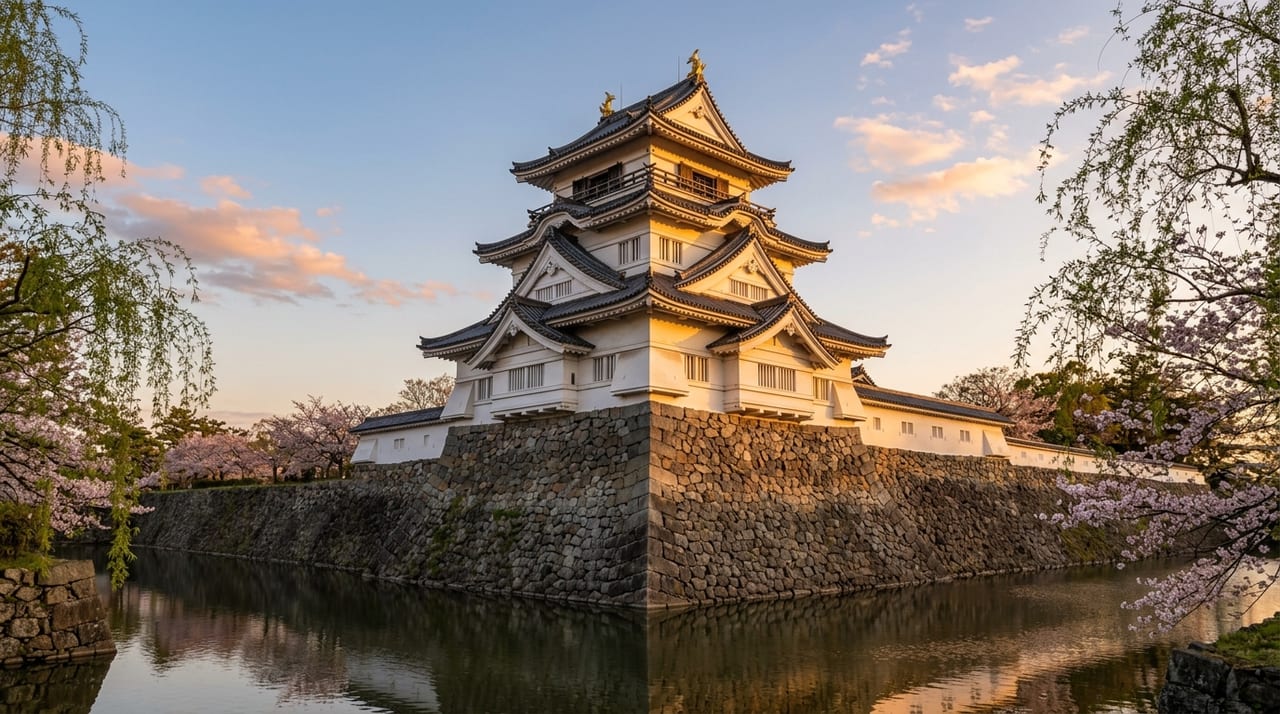
 * Image is for illustrative purposes only.
Shibata Castle
新発田城
Shibata Castle is a historic castle in the Chūbu region (Construction began in Keichō 3 (1598); completed in Jōō 3 (1654)). Its lord was Mizoguchi Hidekatsu / Mizoguchi Clan.
Overview
Shibata Castle is a flatland castle located in Shibata, Niigata Prefecture. It served as the main castle of Shibata Domain, a powerful domain of Echigo Province, and functioned in that role throughout the Edo period. The castle's most distinctive feature is that three shachihoko (ornamental roof-ridge fish) sit atop the ridge of the T-shaped roof of the Sangai Yagura. Castle enthusiasts know it as an unusual design rarely seen anywhere else in Japan.
The castle's origins date back to the Sengoku period, but the foundation of the present castle was laid by Mizoguchi Hidekatsu, who was granted 60,000 koku at Echigo Shibata in Keichō 3 (1598). Hidekatsu was a warlord who served Toyotomi Hideyoshi. At the Battle of Sekigahara he sided with the Eastern Army (the Tokugawa side), which secured his domain. From then on, the Mizoguchi family ruled the area as lords of Shibata Domain for 12 generations until the end of the Bakumatsu period.
The castle was a flatland castle that used the Kaji River flowing to the north as its outer moat. The Honmaru was enclosed by Furumaru to the north and Ni-no-maru to the south, with San-no-maru placed to the south of that. After the Meiji Restoration, many buildings were dismantled under the Abandoned Castles Edict. However, the former Ni-no-maru Sumi Yagura (now relocated to the site of the Honmaru Teppō Yagura) survived. Together with the Honmaru Omote-mon gate, it has been designated a national Important Cultural Property. (The Sangai Yagura and Tatsumi Yagura were rebuilt in wood in Heisei 16 (2004). The Sangai Yagura is located within the Ground Self-Defense Force Shibata Garrison.) The three shachihoko of the Sangai Yagura are the symbol of Shibata Castle, and the castle remains popular with tourists today as restoration work continues.
Shibata developed as a castle town. Successive domain lords encouraged learning. The 8th lord, Mizoguchi Naoyasu, opened the domain school Dōgakudō.
Connection to Swords
The connection between Shibata Castle and swords begins with its geographical and historical ties to Echigo Province, an important production region of Japanese swords. Echigo is known for swords called "Echigo-mono," and many swordsmiths were active there from the Muromachi through the Edo period.
In Shibata Domain, successive lords encouraged learning. For example, the 8th lord, Mizoguchi Naoyasu, opened the domain school "Dōgakudō."
Highlights
- Sangai Yagura with three shachihoko (wooden reconstruction, 2004) — the castle's emblematic building, with three shachihoko on the T-shaped ridge
- Former Ni-no-maru Sumi Yagura (Important Cultural Property) — a two-story yagura built after the great fire of Kanbun 8 (1668), relocated to the site of the Honmaru Teppō Yagura
- Honmaru Omote-mon gate (Important Cultural Property) — an extant gate tower rebuilt in Kyōhō 17 (1732)
- Cherry blossoms at Shibata Castle Park — famous for cherry blossoms and busy in spring
- Shimizu-en (daimyō garden) — a sukiya-style building and garden associated with the Mizoguchi family that remain in the castle town
- Shibata City Historical Library — holds historical materials such as ancient documents and maps donated by the former domain lords' Mizoguchi family and others
* Opening hours and admission fees are subject to change. Please check the official website before visiting.