 * Image is for illustrative purposes only.
Tatsuoka Castle
龍岡城
Tatsuoka Castle is a historic castle in the Chūbu region (Completed in 1867 (Keiō 3), a late-period castle built during the Bakumatsu era). Its lord was Matsudaira Norikata (Ogyū Matsudaira family).
Overview
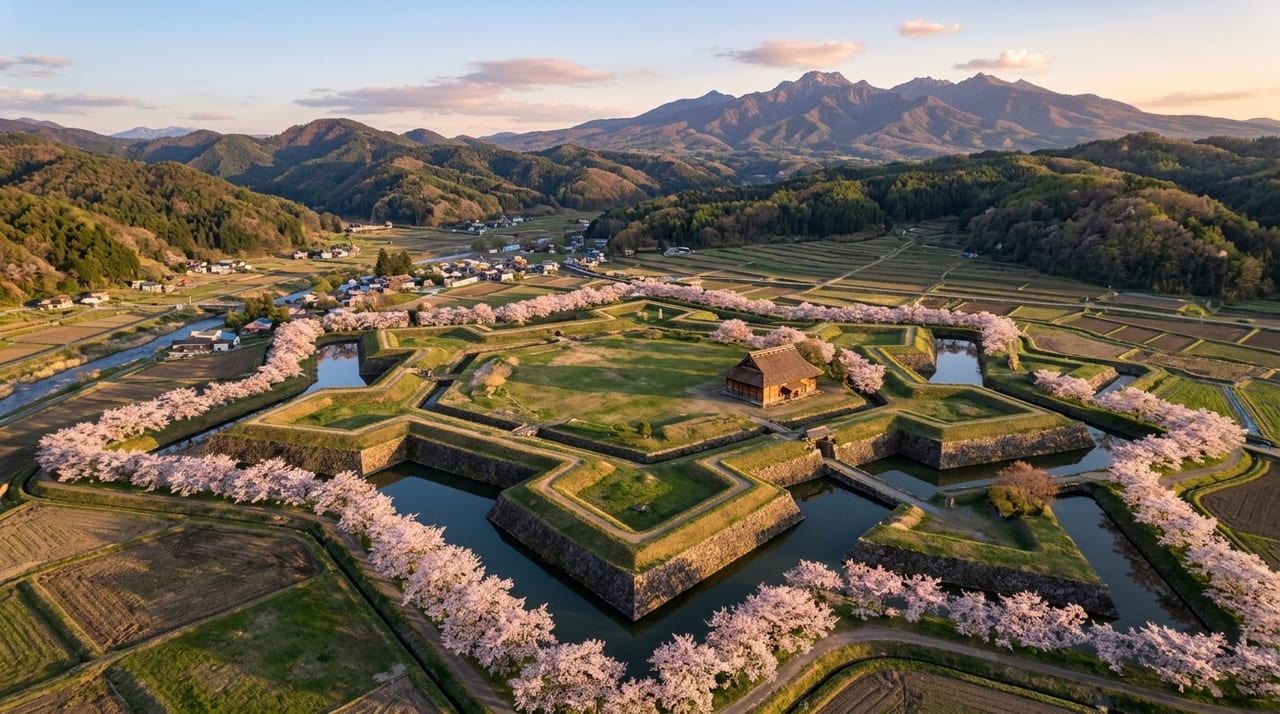
Tatsuoka Castle is located in Saku City, Nagano Prefecture. Completed in Keiō 3 (1867) during the late Edo period, it is one of only two Goryōkaku (five-pointed star fort, a bastioned fortress with five bastions projecting in a star shape) in Japan, the other being the Goryōkaku in Hakodate. Designed after Western star-shaped fortresses, the castle appeared in late Edo Japan as an advanced fortification method that incorporated the military technology of the artillery age. It was completed just before the Meiji Restoration and closed its chapter in history without ever being used in actual combat.
The castle was ordered built by Matsudaira Norikata, lord of Okudono in Mikawa and Tanoguchi domain in Shinano (later Tatsuoka domain). Norikata took an interest in Western military science, was an enlightened daimyō who adopted French-style military organization for his domain, and also served as army magistrate, senior councillor and army commander-in-chief for the shogunate. He decided to build a star-shaped castle with the same design philosophy as the Goryōkaku in the mountains of Shinano, began construction in Genji 1 (1864), and completed it in Keiō 3 (1867).
The design of Tatsuoka Castle is a star-shaped fortress with five bastions, following Western fortification methods that minimize blind spots. However, only one gun battery was placed at the southwest corner, and part of the moat was left unfinished. Within the honmaru (main enclosure), surrounded by moats, camp-style administrative buildings were arranged, forming a unique space that blends Western and Japanese styles. Today it is designated as a national historic site under the name Tatsuoka Castle Site (also called Tatsuoka Castle Goryōkaku), and the Odaidokoro (kitchen building) remains as the only extant building within the castle.
When people think of Goryōkaku, Hakodate comes to mind, but Tatsuoka Castle in Shinano is small in scale. Still, as one of only two Goryōkaku in Japan, it has high rarity value. The foresight of Matsudaira Norikata, who tried to introduce Western military technology in a time of turmoil in the late Edo period, and the fleeting fate of a castle that reached the Meiji era without ever seeing combat, lead visitors to deeply reflect on the history of the late Edo period.
Every spring, cherry blossoms bloom in full splendor across the castle grounds, making it a famous spot for cherry blossom viewing. Located in the Taguchi area of Saku City, it is a sightseeing destination where visitors can feel history in the refreshing highland air.
Connection to Swords
The relationship between Tatsuoka Castle and swords is deeply rooted in the late Edo transition from the sword to the firearm. Matsudaira Norikata studied Western-style military organization and held a modern military outlook that valued rifles and cannons over swords, yet for samurai of the late Edo period the Japanese sword still retained its spiritual and ceremonial significance.
The year Tatsuoka Castle was completed, Keiō 3 (1867), was the year Tokugawa Yoshinobu carried out the Taisei Hōkan (return of power), when the end of the age of the sword was imminent. In the following year, the Boshin War (1868), battles that mixed firearms and swords were fought across the country during this transitional period. The Western-style military organization that Matsudaira Norikata sought to develop was precisely what promoted the shift from swords to rifles.
Shinshū (Nagano) also had a tradition of swordsmiths. After the Haitōrei (Sword Abolition Edict) of 1876, the status of samurai swords changed to that of art objects and family treasures. Matsudaira Norikata in the Meiji era (Ogyū Yuzuru, Ogyū Matsudaira family) served as President of the Decorations Bureau, took part in establishing the modern Japanese system of honors, and was eventually granted the peerage rank of count. Together with Sano Tsunetami, he also worked to establish the Hakuaisha, the predecessor of the Japanese Red Cross Society.
Highlights
- Two Goryōkaku in Japan — a star-shaped fortress alongside the Goryōkaku in Hakodate, one of only two examples of this castle type in the country
- Matsudaira Norikata's foresight — a reform-minded late Edo daimyō who put Western military technology into practice in the mountains of Shinano
- Odaidokoro (extant building) — the only surviving building within the castle, a valuable relic of late Edo architecture
- Castle from the final years of the late Edo period — completed in Keiō 3 (1867), one of the last castles built just before the Meiji Restoration
- Tatsuoka Castle Goryōkaku (national historic site) — a clear five-pointed star when seen from above, a castle that embodies the irony of history
- Spring cherry blossoms — the cherry trees blooming along the stone walls and moats make for a spectacular view
* Opening hours and admission fees are subject to change. Please check the official website before visiting.