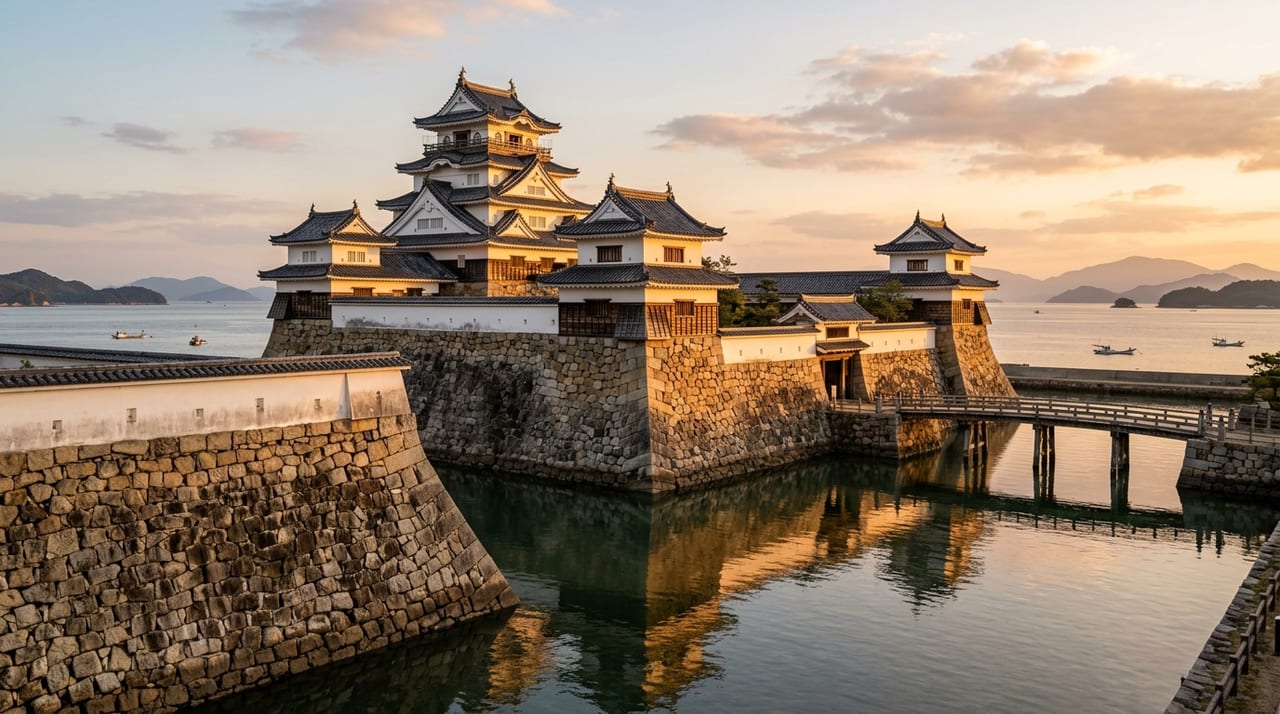
 * Image is for illustrative purposes only.
Kōkokuji Castle
興国寺城
Kōkokuji Castle is a historic castle in the Chūbu region (Late Muromachi to early Edo period (traditionally founded in 1487; abandoned in the third month of 1607)). Its lord was Ise Moritoki (Hōjō Sōun, by tradition the builder); the Tominaga family; the Imagawa; the Hōjō (Haga Ujitsugu); the Takeda; the Tokugawa (Makino Yasunari, Matsudaira Kiyomune, Kawage Shigetsugu); a retainer of Nakamura Kazuuji; Amano Yasukage (lord of the Kōkokuji domain).
Overview
Overview
Kōkokuji Castle was a linear-bailey hilltop castle (renkaku-shiki hirayama-jiro) in Negoya, Numazu, Shizuoka Prefecture. Built on the tip of a ridge extending south from Mt. Ashitaka, it commanded the junction of the Tōkaidō and Nekata highways. Also known as Negoya Castle, it is remembered as the castle from which Ise Moritoki — better known as Hōjō Sōun, progenitor of the Later Hōjō — first launched his career.
Founding and Tradition
Ise Moritoki attached himself to the Imagawa through his elder sister, principal wife of the Suruga governor Imagawa Yoshitada. After Yoshitada's sudden death he helped settle the succession dispute in favor of Imagawa Ujichika, and for this service is said to have received twelve villages in Fuji District in 1488 and become lord of Kōkokuji Castle. No contemporary document, however, confirms the castle's construction; the earliest secure record is a 1549 document in which Imagawa Yoshimoto ordered Kōkokuji temple relocated so the land could be used for the castle. The "founding by Sōun in 1487" is therefore treated as tradition rather than established fact.
Succession of Lords
Standing on the frontier where the Imagawa, Takeda, and Hōjō contested eastern Suruga, the castle changed hands repeatedly — passing among the Imagawa, the Hōjō (Haga Ujitsugu), the Takeda, and the Tokugawa (Makino Yasunari and others). Under the Toyotomi it was held by a retainer of Nakamura Kazuuji, and in the earliest Edo period Amano Yasukage entered and established the Kōkokuji domain. When Yasukage abandoned his post, the castle was decommissioned in the third month of 1607.
Structure and Remains
The layout arranged, from north to south, the tenshu platform, main bailey, second bailey, and third bailey in a straight line. Natural-stone (nozura-zumi) walling survives on the traditional tenshu platform north of the main bailey, estimated at about 24 m along the top, 13 m at the base, and 4 m high. The great dry moat cutting off the rear of the site is enormous — 22–30 m wide and roughly 15–20 m deep — and a crescent-shaped moat (mikazuki-bori) characteristic of Takeda engineering has also been detected.
Present State and Access
Designated a National Historic Site in 1995, the castle was selected in 2017 among the Continuation of Japan's Top 100 Castles (No. 145). Numazu City continues excavation and site development, and visitors can view the main bailey, earthworks, great dry moat, and the stonework of the tenshu platform at close range. About a 30-minute walk from JR Hara Station, or about 3–5 minutes on foot from the "Higashi-Negoya" Fujikyu bus stop.
Highlights
- Known by tradition as the castle from which Ise Moritoki (Hōjō Sōun), progenitor of the Later Hōjō, launched his rise
- A frontier castle in eastern Suruga contested by the Imagawa, Takeda, Hōjō, and Tokugawa
- A vast dry moat 22–30 m wide and 15–20 m deep, plus natural-stone walling on the traditional tenshu platform
- National Historic Site (1995); selected among the Continuation of Japan's Top 100 Castles (No. 145) in 2017
* Opening hours and admission fees are subject to change. Please check the official website before visiting.