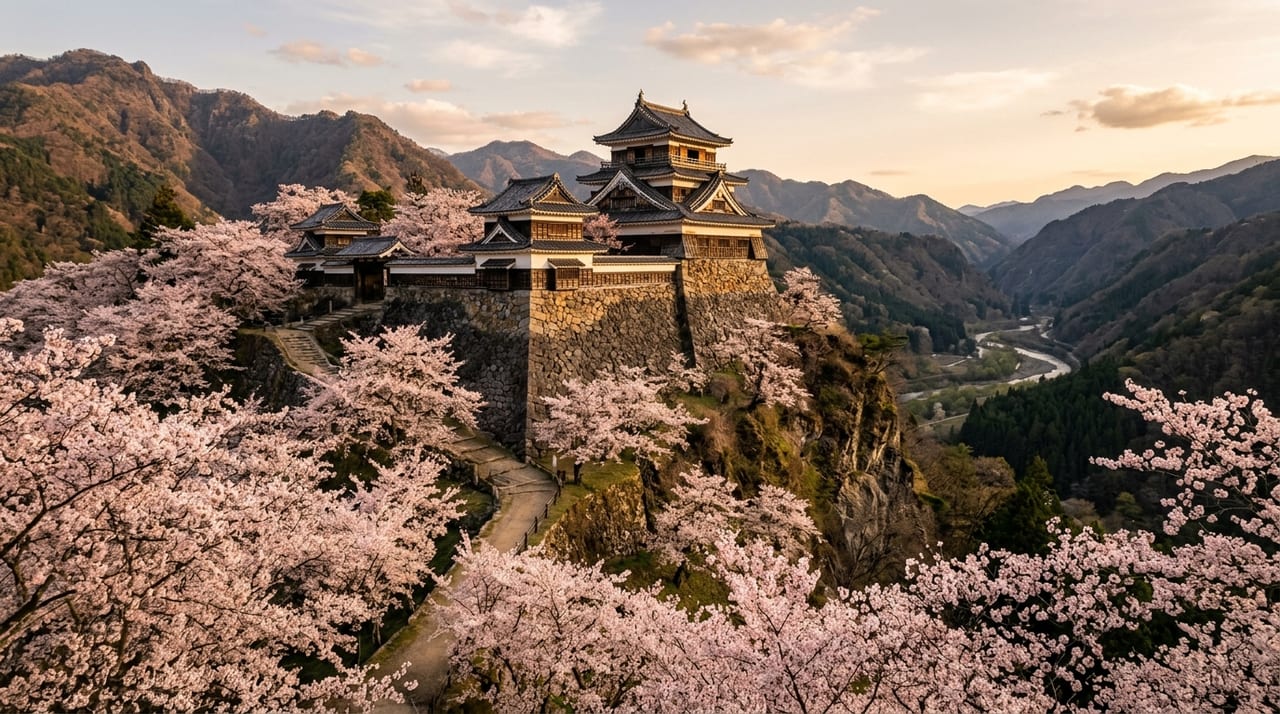
 * Image is for illustrative purposes only.
Furumiya Castle
古宮城
Furumiya Castle is a historic castle in the Chūbu region (1571 (Genki 2) to approximately 1575 (Tenshō 3), when it was abandoned). Its lord was Takeda Shingen (construction); Obata Matabē, Amari Saemon, Ōkuma Bizen-no-kami and others (garrison).
Overview
Overview and Location
Furumiya Castle is a Sengoku-period hirayama-jō located in Tsukude-Kiyooka, Shinshiro City, Aichi Prefecture, built on an independent hill about 25–30 meters high relative to its surroundings. It is said to have been constructed around 1571 (Genki 2) by Takeda Shingen to secure the Tsukude Basin, a traffic hub linking Mikawa Province with Shinano and Tōtōmi. It was selected as one of the Continued 100 Famous Castles of Japan (No. 150) in 2017.
Construction and the Takeda Invasion of Mikawa
The Tsukude area had originally been ruled by the Okudaira clan, on the Tokugawa side, who based themselves at Kameyama Castle. To check the Okudaira and Tokugawa Ieyasu, Takeda Shingen separately built Furumiya Castle as the forward base for the invasion of Mikawa. For its construction, the retainer Baba Nobufusa (Nobuharu) is said to have been ordered to lay out the enceinte (nawabari), and its structure is said to have a skillful layout resembling a compact version of Suwahara Castle in Tōtōmi Province.
Lords and Garrison Commanders
Although clear records of the castle's lords are scarce, tradition holds that Obata Matabē, Amari Saemon, Ōkuma Bizen-no-kami and others were stationed here as garrison. In 1573 (Tenshō 1), when Okudaira Sadayoshi and his son Nobumasa switched back from the Takeda to the Tokugawa, the situation in Tsukude became unstable. After Takeda Katsuyori was defeated at the Battle of Nagashino in 1575 (Tenshō 3), Furumiya Castle is thought to have been abandoned.
Structural Features
The castle area measures about 250 meters east–west and 200 meters north–south, and features many construction techniques characteristic of the Takeda, including rounded masugata-style gates, multiple layered earthen ramparts and horizontal moats, and numerous groups of vertical moats (tatebori). A notable feature is its multi-enclosure structure, divided into two groups of enclosures (kuruwa), east and west, separated by a central moat. Castle researchers highly regard it as a representative example of Takeda-style castle-building technique.
Connections to Swords and Arms
As the forward base of Takeda Shingen's invasion of Mikawa, Furumiya Castle is thought to have accumulated arms and swords brought in from Kai and Shinano. The Obata and Amari clans, said to have been stationed there, were both hereditary retainers of the Takeda army.
Current State and Highlights
The castle is now being developed as a Shinshiro City designated historic site, and its earthen ramparts, moats, and vertical moat groups are well preserved. The Tsukude Museum of History and Folklore displays materials on the surrounding mountain castles, and together with Furumiya Castle, visitors can trace the Takeda invasion route into Mikawa.
Connection to Swords
As the front line of Takeda Shingen's Mikawa campaign, Furumiya Castle likely received arms and swords from Kai and Shinano. The Obata and Amari clans said to have garrisoned it were hereditary Takeda retainers, suggesting the site transmitted Takeda military sword culture to the Mikawa frontier.
Highlights
- Continued 100 Famous Castle No. 150; Shinshiro City Historic Site
- Attributed to Takeda Shingen, laid out by retainer Baba Nobufusa
- Rounded masugata gates with layered earthworks and vertical moats
- Compact, technically sophisticated double-enclosure layout resembling Suwahara Castle
* Opening hours and admission fees are subject to change. Please check the official website before visiting.