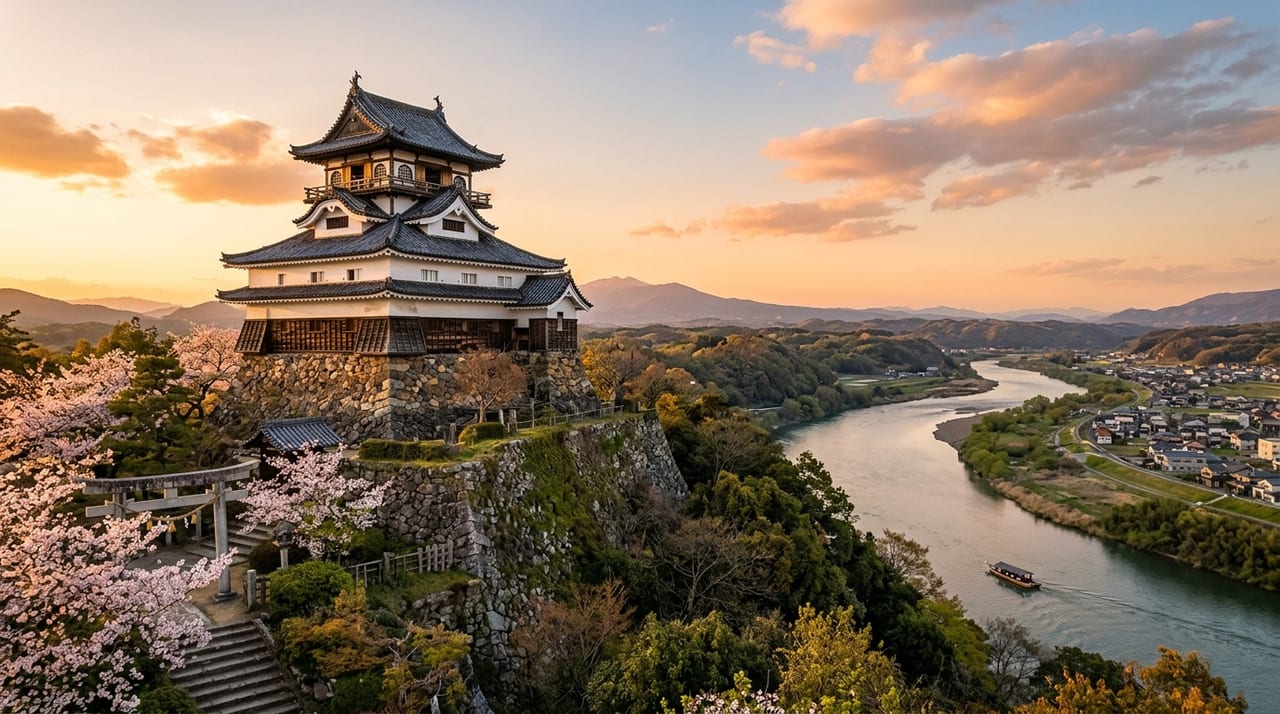
 * Image is for illustrative purposes only.
Inuyama Castle
犬山城
Inuyama Castle is a historic castle in the Chūbu region (Built in 1537 (Tenbun 6)). Its lord was Naruse Masanari / Naruse clan.
Overview
About the Castle
Inuyama Castle is a National Treasure stronghold on a low hill on the south bank of the Kiso River. As one of the oldest surviving keeps in Japan, it has exceptional historical value. In 1537 (Tenbun 6), Oda Nobuyasu, an uncle of Oda Nobunaga, built the castle at a key point along the Kiso River. Located on the border between Owari and Mino, the castle was the stage for numerous battles and sieges throughout the Sengoku period. In 1565 (Eiroku 8), Oda Nobunaga seized the castle as a foothold for his campaign against Mino. In 1584 (Tenshō 12), during the Battle of Komaki and Nagakute, Toyotomi Hideyoshi himself entered the castle and faced Tokugawa Ieyasu, who was encamped on Mount Komaki on the opposite bank.
Lords and Governance
That battle was a critical juncture that would decide the fate of the realm, and Inuyama Castle literally stood witness to a turning point in history. After the Battle of Sekigahara, the castle passed to Ogasawara Yoshitsugu in 1600 (Keichō 5). In 1617 (Genna 3), Naruse Masanari, tsukegarō (attached senior retainer) of the Owari Tokugawa family, became lord of the castle. From then on, the Naruse clan served as lords of Inuyama Castle until the late Edo period. Remarkably, the castle was managed as the private property of the Naruse clan until 2004 (Heisei 16). The fact that it was the last castle in Japan to remain in private ownership symbolizes the singular history of Inuyama Castle.
Architecture and Structure
The keep, with three stories, four levels, and two basement levels, retains strongly the primitive form of the bōrō-gata (watchtower-type) keep. The view from the watchtower section, with its railing (kōran), is superb. The vista overlooks the leisurely flow of the Kiso River and the Nōbi Plain, and it is so magnificent that Ogyū Sorai named the castle "Hakuteijō" (White Emperor Castle) after a poem by Li Bai. In spring, cherry trees bloom in full along the Kiso River, and in autumn, the keep's appearance against the autumn foliage captivates visitors. The castle town has been developed with old streetscapes that retain traces of the past, and visitors can also enjoy eating their way through the town and experiencing traditional crafts. Inuyama Castle is one of the five National Treasure castles. The "genuine weight of history" that its surviving keep exudes is something special that can never be experienced in a reconstructed keep.
Sightseeing and Experiences
Climbing the steep stairs of the keep and standing at the railing on the top floor, you see the same scene that Sengoku warlords once saw spread out before you. That experience is one of the most moving moments of any journey to Japanese castles. Inuyama is also famous for cormorant fishing (ukai) on the Kiso River. Watching the skill of the cormorant masters, lit by bonfires on summer nights, conveys the depth of a traditional culture that has continued since the Sengoku era. A journey that combines Inuyama Castle, cormorant fishing, and a stroll through the castle town is an ideal course for savoring the history and culture of Owari in concentrated form.
Culture and Crafts
Inuyama Castle is a castle that the Naruse clan protected for nearly 400 years. The very fact that one family defended one castle throughout that span is a rare story in Japan's castle culture. The castle is now owned by the Inuyama Castle Hakutei Bunko Foundation (public interest foundation), which balances preservation as a cultural property with public access. When Inuyama Castle was transferred from private ownership to the foundation in 2004, it attracted great attention throughout Japan. Inuyama is a gem of a town that concentrates the history of Owari.
Connection to Swords
The area of Owari and Mino where Inuyama Castle stands is one of the most important centers of sword production in Japanese history. Mino-den began when Kaneuji, one of the Masamune Juttetsu (Ten Disciples of Masamune), moved to Mino, and it grew into a major school of swordmaking within the Gokaden (Five Traditions). Centered on Seki (present-day Seki City), countless master smiths were active, including Kanemoto (Magoroku Kanemoto) and Kanesada (Izumi no Kami Kanesada). Their number is said to have exceeded three hundred at its peak. The greatest characteristic of Mino blades is their practicality. Embodying the ideal of a battle sword, "does not break, does not bend, and cuts well," Mino blades won overwhelming support among Sengoku warlords. The Sengoku period, when Inuyama Castle was the stage for repeated battles on the border between Owari and Mino, was also the era when demand for Mino blades reached its peak. Owari Province was the domain of the Owari Tokugawa family, the foremost of the Tokugawa Three Houses (Gosankke). Since the first lord, Tokugawa Yoshinao, the family had an exceptionally deep appreciation for swords. The Owari Tokugawa family collected famous swords from past and present, beginning with the group of tantō by Awataguchi Yoshimitsu. The quality of the collection was worthy of the prestige of the Three Houses. The route from Inuyama Castle through the Seki Kaji Denshōkan (Seki Swordsmith Museum) in Seki City to the Tokugawa Art Museum in Nagoya is a luxurious journey in which one can experience Mino-den and the sword culture of Owari in a single day. In Seki City, the Seki Cutlery Festival (Hamono Matsuri) is held every October, and demonstrations of traditional forging are also performed. The spirit of Mino-den is still passed down steadily in the cutlery industry of present-day Seki City. Visitors can see firsthand how the forging techniques of Japanese swords form the foundation of modern cutlery culture.
Highlights
- National Treasure keep — one of the oldest surviving watchtower-type keeps; the view from the railing is a spectacle worthy of the name "White Emperor Castle"
- Superb view of the Kiso River — a panoramic view of the Kiso River and the Nōbi Plain from the top floor of the keep
- Castle town strolls — streetscapes that retain the charm of the Edo period, with traditional crafts and food to enjoy along the way
- Haritsuna Shrine — an ancient shrine revered as the guardian deity of the castle and the venue of the Inuyama Festival
- Inuyama Festival (every April) — an Important Intangible Folk Cultural Property of Japan, featuring gorgeous yama floats and karakuri puppets
- Seki Kaji Denshōkan (Seki City) — a sword museum introducing the skills and culture of Seki swordsmithing, with an attached Japanese sword forging workshop
* Opening hours and admission fees are subject to change. Please check the official website before visiting.