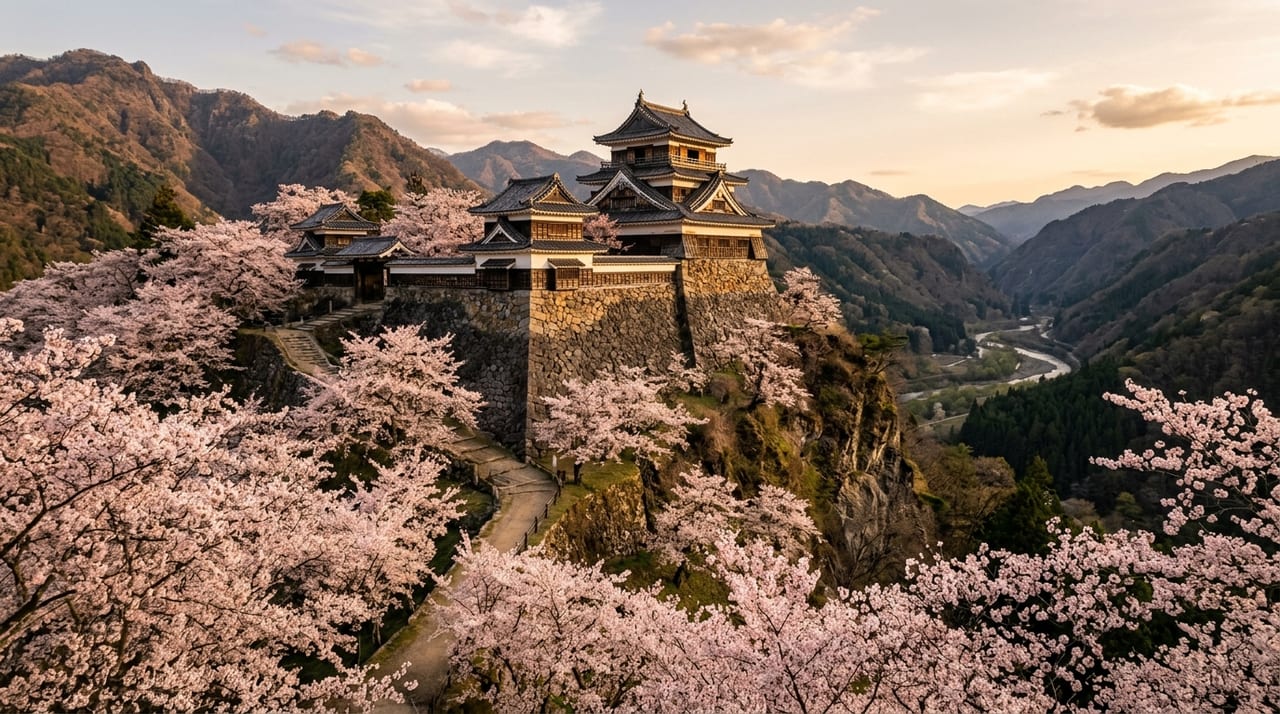
 * Image is for illustrative purposes only.
Takato Castle
高遠城
Takato Castle is a historic castle in the Chūbu region (Year of construction unknown (renovated by the Takeda clan in Tenbun 16 (1547))). Its lord was Takeda Shingen / Hoshina Masayuki.
Overview
About the Castle
Takato Castle is a hirayama castle built on a river terrace bounded by the Mibu River and the Fujisawa River in Ina, Nagano Prefecture. Takeda Shingen developed it as a key stronghold for controlling the Ina Valley. It was the castle of the Takatō clan, a branch of the Suwa clan that had governed the area since the Nanboku-chō period. In Tenbun 14 (1545), Takeda Shingen defeated Takatō Yoritsugu and brought the castle into Takeda territory. Shingen renovated Takato Castle so that it functioned as the political and military center of the Ina Valley. In Tenshō 9 (1581), Takeda Katsuyori installed his younger brother Nishina Morinobu as castle lord to strengthen the castle's defenses.
The Takeda Family's Final Fierce Battle
In the 3rd month of Tenshō 10 (1582), during the Kōshū Campaign (conquest of Kai), in which Oda Nobunaga sent a massive army against the Takeda, Takato Castle became the stage for the last siege that decided the survival of the Takeda family. Castle lord Nishina Morinobu met the Oda army of 30,000 with about 3,000 troops. After a day of fighting, all of the defenders were killed in battle or committed suicide. This battle is remembered as a historical event that embodies the samurai spirit of 'fighting to the death' to hold one's position, and the unyielding fighting spirit shown by the castle's garrison continues to move later generations deeply.
A Castle Famous for Cherry Blossoms
The Takato Castle ruins are now known throughout Japan as a famous cherry blossom spot called 'Tenka Daiichi no Sakura' (Finest Cherry Blossoms Under Heaven). In early April, about 1500 Kohigan cherry trees bloom, and the deep pink blossoms intertwined with the stone walls of the mountain castle create a spectacular view that draws many hanami visitors every year. The cherry trees on the castle ruins began when former domain retainers transplanted them from Sakura-no-baba in the castle town in Meiji 9 (1876).
Hoshina Masayuki and Takatō Domain
In the Edo period, Takato Castle became the seat of government of Takatō Domain. After the Hoshina clan and the Torii clan, the Naitō clan served as castle lords from Genroku 4 (1691) until the end of the Tokugawa shogunate. Hoshina Masayuki in particular was a half-brother of the 3rd shogun, Tokugawa Iemitsu. He went from lord of Takatō Domain to lord of Yamagata Domain and then to lord of Aizu Domain, and he is remembered as an enlightened lord.
Swordsmiths of Shinshū
From Shinano Province came Minamoto Kiyomaro and his elder brother Yamaura Saneo, who were from Akaiwa village (present-day Tōmi City) in Komoro Domain in the late Edo period. Kiyomaro is known, together with Suishinshi Masahide and Taikei Naotane, as one of the 'Edo Sansaku' (Three Great Smiths of Edo).
Connection to Swords
The connection between Takato Castle and swords can be understood through the history of Takeda Shingen and his family. A well-known sword associated with Shingen is the tachi inscribed 'Rai Kuninaga' (Important Cultural Property, held by Erin-ji Temple), which is said to have been worn by Shingen. Nishina Morinobu, the last castle lord of Takato Castle, fought against the Oda forces during the siege in Tenshō 10 (1582) and died in battle along with the castle garrison. Takatō Town History Museum, near Takato Castle Ruins Park, presents the history of Takato Castle and its castle town, and it also displays the Naitō clan armor of the lords of Takatō Domain.
Highlights
- 'Tenka Daiichi no Sakura' (Kohigan cherry) — early April, about 1500 deep pink trees coloring the stone walls, a spectacular view
- Takato Castle Ruins Park — a castle park with the honmaru, ninomaru, Ōun-bashi bridge, and Toiyamon gate maintained
- Takatō Town History Museum — introduces the history of Takato Castle and its castle town, and also displays Naitō clan armor of the lords of Takatō Domain
- Ejima Kakoi-yashiki — the residence site (restored) in Takato where Ejima, a senior lady-in-waiting of the Ōoku of Edo Castle, was exiled
- Cliffs of the Mibu River and Fujisawa River — views of the Ina Valley mountain landscape from the cliffs that formed the castle's natural defenses
* Opening hours and admission fees are subject to change. Please check the official website before visiting.