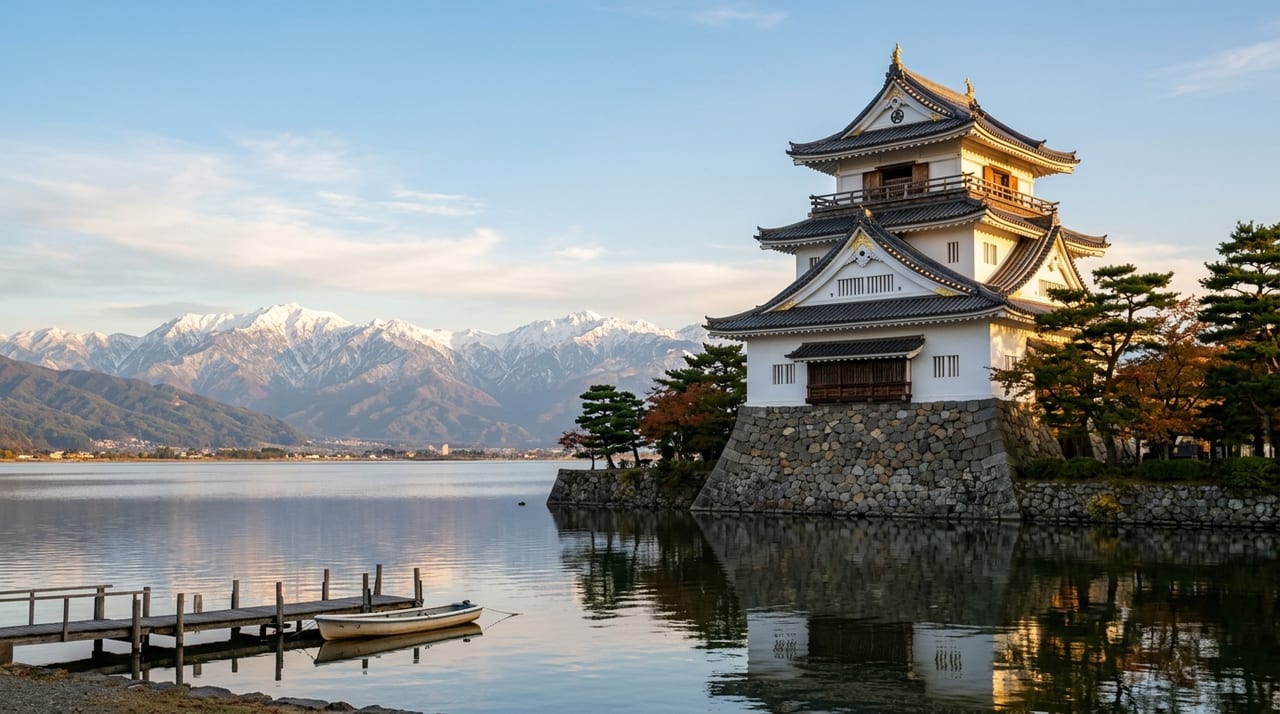
 * Image is for illustrative purposes only.
Takashima Castle (Floating Castle of Suwa)
高島城(諏訪の浮城)
Takashima Castle (Floating Castle of Suwa) is a historic castle in the Chūbu region (Built in 1592 (Bunroku 1)). Its lord was Hineno Takayoshi / Suwa Yorimizu / Suwa clan.
Overview
About the Castle
Takashima Castle was a water castle built in Bunroku 1 (1592) by Hineno Takayoshi, a retainer of Toyotomi Hideyoshi, on the shores of Lake Suwa. Named the "Floating Castle of Suwa" for its appearance as if floating upon the lake's surface, this elegant epithet became cherished throughout history. The layout of Takashima Castle, which ingeniously exploited Lake Suwa's vast expanse as a natural moat to maximum effect, exemplifies the masterwork of water-castle architecture. In antiquity, water channels were drawn from the lake into the castle, and the Honmaru, Ninomaru, and Sannomaru are believed to have formed island-like structures surrounded by water. Hineno Takayoshi, who directed the castle's design, was a figure deeply involved in numerous castle construction projects under Hideyoshi, and his fortification plan—which read Lake Suwa's topography and exploited it with exceptional skill—demonstrated his mastery. Because land reclamation on Lake Suwa in the early Edo period caused the shoreline to recede, present-day Takashima Castle now stands at a distance from the lakeshore, yet in its heyday it stood as a magnificent structure literally floating upon the lake.
Suwa Taisha and Faith
The land of Suwa is a sacred place that houses Suwa Taisha, one of Japan's oldest shrines. Suwa Taisha is the head shrine of over 25,000 Suwa shrines throughout the nation, with a history said to trace back to the Jomon period. The Suwa deity, Takeminakata-no-kami, was deeply venerated by samurai as a god of war and hunting, and prior to battle, warlords of the Sengoku period prayed for victory at Suwa Taisha. Takeda Shingen deeply revered Suwa Taisha, and it is said that the source of Shingen's military strategy—feared as the "Tiger of Kai"—lay in his faith in the Suwa deity. Suwa Taisha comprises four shrines: the Upper Shrine (Hongu and Maegū) and the Lower Shrine (Akimiya and Harumiya), positioned across Lake Suwa to form a unified sacred realm. This unique configuration of four shrines has no parallel anywhere in Japan and represents a precious testament to Japan's religious history, transmitting the memory of the Jomon period to the present day. Samurai revered the Suwa deity as a "god of war" and unfailingly visited Suwa Taisha before setting out to battle, praying for its divine protection.
History of the Takeda and Suwa Clans
The Suwa clan flourished from the Kamakura period onward as a prominent family of Shinano Province, holding dual authority—both spiritual and martial—as the Great Priest (Ōhōri) of Suwa Taisha. In Tenbun 11 (1542), Takeda Shingen attacked and destroyed Suwa Yorishige, bringing Suwa under Takeda control. This incident marked an important chapter in the Takeda clan's invasion of Shinano, laying the foundation for later campaigns such as the Battle of Nagashino and the battles at Kawanakajima. Suwa Yorishige's daughter, Suwa Goryōnin (called Koihime in Nitta Jirō's novel), became a concubine of Takeda Shingen, and their son Takeda Katsuyori became the heir to the Takeda clan. This blood relationship left a complex historical legacy in Suwa even after the Takeda clan's fall. The strategic vision of Takeda Shingen, symbolized by his battle standard "Furinkazan" (Wind, Forest, Fire, Mountain), was intertwined with his faith in the Suwa deity, and Suwa's warrior culture shone brightly under the patronage of the powerful Takeda clan. Even after the Takeda clan's destruction, the Suwa warrior family survived and achieved restoration as lords of Suwa Domain in the Edo period.
The Edo Period and Suwa Domain
Following the Battle of Sekigahara, the Suwa clan recovered their former domain and became lords of Suwa Domain (30,000 koku), governing the land until the late Edo period. Takashima Castle served as the political and cultural center of Suwa Domain, and the castle town developed industries in crafts and commerce. The buildings were demolished following the Meiji abolition of feudal domains, but in 1970 (Shōwa 45), the keep, turrets, gates and walls of the Honmaru were rebuilt. The current keep is a reinforced-concrete reconstruction whose details, such as its windows and roof, differ from the original keep, and its three-tiered form stands in the Honmaru. The castle town of Takashima developed as a center of commerce and crafts, with the castle town and the gate town before Suwa Taisha existing in unity, forming a distinctive urban structure. This townscape of Suwa, where warrior culture, the shrine, and commerce coexisted, presents a fascinating case study of the diversity of local cities during the Edo period.
Suwa's Nature and Swords
The Omiwatari—the phenomenon of Lake Suwa's ice cracking and rising up—is said to be the trail left when the male deity of the Upper Shrine of Suwa Taisha crossed the lake to visit the female deity of the Lower Shrine, and it has long been revered as a path of the gods. A visit to Takashima Castle is a journey to experience the profound warrior culture of Shinano, spanning from the age of Takeda Shingen through the Edo period. The interior of the castle keep serves as a museum conveying the history of the Suwa Domain. Takashima Castle stands as a place where the profound reverence for nature cultivated by Suwa's people through their annual witnessing of the Omiwatari at Suwa Taisha intersects with the warrior spirit kindled in the flames of sword-forging, quietly posing fundamental questions of Japanese culture to those who visit. Gazing upon the three-tiered keep while observing the silhouettes of mountains reflected in Lake Suwa, one may discern the shadow of the warrior soul.
Connection to Swords
Takashima Castle's connection to sword culture is told through Suwa's character as a sacred land of the god of war and through the warrior history of the Takeda and Suwa clans. Takeminakata-no-kami, the deity of Suwa Taisha, was revered by samurai as a god of war and hunting, and Takeda Shingen, who brought Suwa under his control in Tenbun 11 (1542), also deeply venerated the shrine. The treasure hall at the Honmiya of the Upper Shrine holds shrine treasures such as tachi and old documents, as well as an iron bell (sanagi no suzu) that Shingen is said to have rung in times of war. In the Edo period, Suwa Yorimizu returned to his family's former domain at Takashima in Keichō 6 (1601), and the Suwa clan kept Takashima Castle as their residence until the end of the shogunate. The interior of the reconstructed keep serves as a museum introducing the history of the Suwa Domain.
Highlights
- Takashima Castle tower (1970 reconstruction, Suwa domain history museum)
- Suwa Taisha (four shrine precincts — said to be one of Japan's oldest shrines, sacred to the god of war)
- Suwa Taisha Treasure Hall (Upper Shrine Honmiya — shrine treasures such as tachi and old documents, and an iron bell associated with Shingen)
- Lake Suwa 'Omiwatari' (ice ridges on the frozen lake surface, a sacred phenomenon with records dating from 1443)
- Katakura-kan bathhouse (Important Cultural Property, Roman-style communal bath from 1928)
- Lake Suwa fireworks festival
* Opening hours and admission fees are subject to change. Please check the official website before visiting.