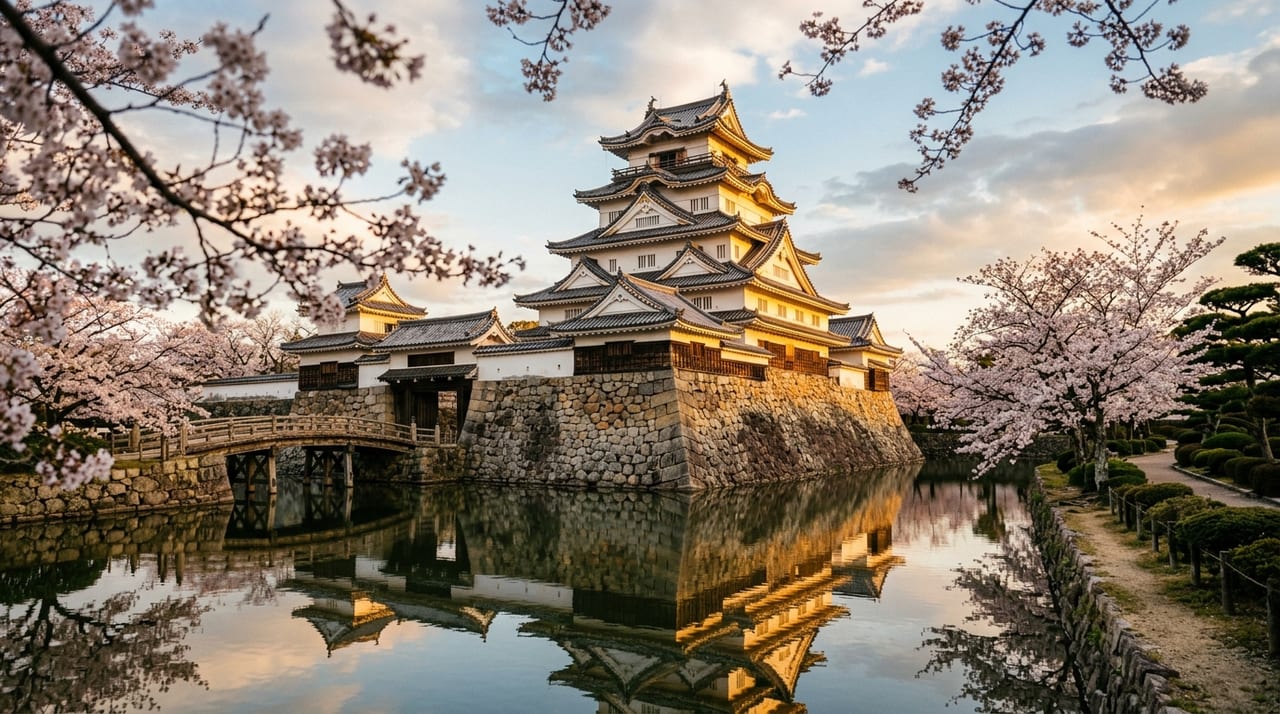
 * Image is for illustrative purposes only.
Nishio Castle
西尾城
Nishio Castle is a historic castle in the Chūbu region (Built ca. 1221 (Jōkyū 3)). Its lord was Ashikaga Yoshiuji / Honda Toshitsugu / Ogyu Matsudaira clan.
Overview
About the Castle
Nishio Castle is traditionally said to have been built around Jōkyū 3 (1221) by Ashikaga Yoshiuji, shugo of Mikawa. It is an old castle of Mikawa with deep ties to the Kira clan of the Ashikaga kinsmen, and it is a stage of history. Built at the southwestern edge of the Hekikai Plateau in the central-southern part of Mikawa Province, on the edge of the upland overlooking low-lying wetlands, the castle served as the residence of many warlords over its long history from the medieval period through the Sengoku and Edo periods. Nishio is also known worldwide as one of Japan's leading 'matcha producing regions.' As a castle town where the culture of the warrior class and the culture of the tea ceremony intersect in a distinctive way, it draws attention from both sword enthusiasts and tea ceremony enthusiasts. The grounds of Nishio Castle, with more than 700 years of history since the Kamakura period, are a place where the spiritual culture of the Mikawa warriors has accumulated, and the weight of that long history is condensed in the stone walls and moats of the castle ruins. Mikawa is also known as the birthplace of Tokugawa Ieyasu, and Nishio Castle has its own significance as one of the castles that embody this tradition of the Mikawa warriors.
Historical Changes
During the Sengoku period, the castle changed hands repeatedly amid the rivalry of the Imagawa, Oda, and Tokugawa clans, and it became an important base in the contest for control of Mikawa. After Toyotomi Hideyoshi's Siege of Odawara in Tenshō 18 (1590), Tokugawa Ieyasu was transferred to the Kantō region, and Mikawa became the domain of daimyō aligned with the Toyotomi. After the Battle of Sekigahara, Tokugawa fudai daimyō were successively enfeoffed at Nishio. From Meiwa 1 (1764) until the bakumatsu period, the Ōgyū-Matsudaira family (60,000 koku) served as lords of the castle and governed the domain. As a branch of the Matsudaira of Mikawa, the Ōgyū-Matsudaira family governed the Nishio domain on the strength of its kinship with the Tokugawa shogunal house. The struggles over Nishio Castle in the Sengoku period were deeply intertwined with major Mikawa events such as the Mikawa Ikkō uprising and the Battle of Okehazama, and the castle's history reflects the Sengoku history of Mikawa itself. In the Edo period, the Nishio domain developed agriculture and commerce within the shogunate's stable system of control and built steady prosperity as a castle town.
Architecture and Reconstruction
After the Meiji-era Abolition of Castles Edict (Haijō-rei), most of the castle's structures were lost. In Heisei 8 (1996), the Ushitora Yagura (three-storied yagura) and Chūjaku Gate of the Honmaru were reconstructed, and in Reiwa 2 (2020), the Ushitora Yagura and earthen walls of the Ni-no-maru were reconstructed. The castle ruins have been developed as Nishio City History Park, and the adjacent museum allows visitors to study the history of Nishio Castle and the Nishio domain in detail. In the reconstructions, Edo-period pictorial maps and the results of archaeological excavations were used to the fullest extent, with the aim of recreating as faithfully as possible the appearance of buildings lost after the castle was abandoned. Part of the moats and stone walls has been preserved in its original form, and by combining these with the reconstructed buildings, a space has been developed where visitors can experience the overall image of an Edo-period castle.
Matcha and Castle-Town Culture
Nishio is called 'Matcha Town' because, according to tradition, Shōichi Kokushi, founder of Jissō-ji, sowed tea seeds in Bun'ei 8 (1271). Full-scale tea gardens were established in the Meiji period, and today Nishio and Anjō cities together account for about 20% of the nation's tencha production. Tea leaves grown in Nishio's mild climate and abundant water are characterized by a deep sweetness and a vivid green color, and they receive the highest praise in the worlds of Japanese sweets, the tea ceremony, and food processing. The bond between warrior families and the tea ceremony was strong, and the daimyō of Nishio also enjoyed the tea ceremony and nurtured tea ceremony culture in the castle town. Today Nishio is popular with young travelers as a sacred site of matcha sweets, and visitors can enjoy a unique experience of 'warrior and matcha' travel combined with the castle ruins. There is a deep common ground between the tea ceremony's spirit of wabi and the bushidō spirit of clean resolve, and the combination of Nishio Castle and matcha culture can be seen as a rare example embodying the harmony of martial and refined arts in Japanese culture.
Ashikaga Traditions and Sword Culture
The existence of Nishio Castle in Mikawa, a land associated with the Kira clan of the Ashikaga kinsmen, is meaningful as a starting point for a journey to the source of Japan's medieval warrior culture. Just as the authority of the Ashikaga shogunal house was symbolized by the sword and blade, for the warriors of Mikawa the sword was a symbol of spirit that went beyond a mere weapon. Materials on Nishio Castle are on display at the Nishio City Museum of History (Nishio-shi Shiryōkan). For sword enthusiasts, visiting Nishio Castle has special meaning as a journey to experience the roots of Japan's warrior culture. Standing before the stone walls of the castle, said to have been built by Ashikaga Yoshiuji, visitors can feel on their skin the weight of 700 years of warrior culture, from the Kamakura period through the Muromachi and Sengoku periods and the Edo period to the present. In Nishio's air, where the castle ruins embodying the way of the Mikawa warriors meet the scent of matcha, a journey to rediscover the depth of Japanese swordsmanship is sure to leave an unforgettable memory for everyone who loves swords. As a place where visitors can touch the origins of Mikawa's warrior culture, rooted in the Ashikaga kinsmen, and gain a deeper understanding of the spiritual world of swords, the soul of the warrior, Nishio Castle will continue to welcome many visitors.
Connection to Swords
The connection between Nishio Castle and sword culture consists of three layers. First, the heritage of medieval warrior culture as a place associated with the Ashikaga kinsmen. Second, the practical sword culture of Mikawa in the Sengoku period. Third, the aesthetic sense of sword appreciation through the tea ceremony. From the Kamakura period through the Nanboku-chō and Muromachi periods, when Ashikaga Yoshiuji built the castle at Nishio, the Ashikaga shogunal house functioned as the highest authority on Japanese sword culture. Generation after generation, the Ashikaga shogunal house collected and preserved swords of the highest quality as gomotsu. The spiritual character of the land of Nishio strongly reflects the cultural tradition of the Ashikaga warrior house and has roots in a deep aesthetic sense toward swords. In the Sengoku period, Mikawa was the home base of the sturdy warrior bands known as 'Mikawa warriors,' and it is famous as the place that produced warlords including Tokugawa Ieyasu. The sincere and straightforward temperament of the Mikawa warriors is known as Mikawa katagi, and its integrity and loyalty were also embodied in sword culture. The point of contact between tea ceremony culture and sword culture also holds deep meaning in Nishio. In warrior society, the tea ceremony was not merely a hobby but performed advanced social functions: political negotiation, display of power, and proof of rank. Tea utensils and swords functioned as the two wheels of warrior aesthetics. The combination of tea utensils and swords possessed by Nishio's daimyō is historical testimony that tells the whole of the warrior way of life. The Nishio City Museum of History (Nishio-shi Shiryōkan) displays materials on Nishio Castle and the Nishio domain.
Highlights
- Ushitora Yagura and Chūjaku Gate — the Honmaru Ushitora Yagura and Ni-no-maru Chūjaku Gate, reconstructed in Heisei 8 (1996)
- Nishio City Museum of History (Nishio-shi Shiryōkan) — stands on the site of Hime-no-maru in the history park and exhibits materials on Nishio Castle
- Nishio, sacred site of matcha sweets — a leading tencha producing area in Japan, with matcha parfaits, matcha manjū, and matcha udon
- Nishio tea garden tour — beautiful tea field scenery and tea-picking experience (seasonal)
- Places associated with Kira Yoshinaka — Kira (Kira Town, Nishio City), the territory of Kira Kōzuke-no-suke in Chūshingura
- Isshiki eel — a specialty of Mikawa Bay, with nationally leading eel production in Isshiki Town near Nishio
* Opening hours and admission fees are subject to change. Please check the official website before visiting.