 * Image is for illustrative purposes only.
Yamanaka Castle
山中城
Yamanaka Castle is a historic castle in the Chūbu region (Founded around the Eiroku era (1558–1570)). Its lord was Hōjō Ujiyasu (builder) / Hōjō Ujikatsu (last lord).
Overview
About the Castle
Yamanaka Castle is a mountain castle of the Later Hōjō clan, located on the western foot of the Hakone mountains in Mishima, Shizuoka Prefecture, at an elevation of about 580 m. It functioned as the most important military stronghold controlling the Tōkaidō (the Hakone route). It is thought to have been built during the Eiroku era (1558–1570) on the instructions of Hōjō Ujiyasu. Later, in 1589 (Tenshō 17), before the confrontation with Toyotomi Hideyoshi, large-scale expansion and renovation work was carried out. However, while the expansion work was still unfinished, on the 29th day of the 3rd month of Tenshō 18 (1590), Toyotomi Hideyoshi's large army (67,000 men in total) descended upon Yamanaka Castle.
A Battle Decided in Half a Day
The garrison remaining in Yamanaka Castle numbered only 4,000 (according to one account, 3,000), and its numerical inferiority was clear. Yet the Later Hōjō commanders put up a valiant defense to the very end. The castle commander, Matsuda Yasunaga, fought bravely and fell in battle, and Mamiya Yasutoshi, who defended Daisaki-demaru, likewise met a heroic death. After a fierce battle lasting less than half a day, Yamanaka Castle finally fell. The brevity of this battle has been passed down to later generations as an example showing that, against the overwhelming strength and modern tactics of the Toyotomi forces, even the finest mountain-castle defenses had their limits.
The Wonder of the Shōji-bori
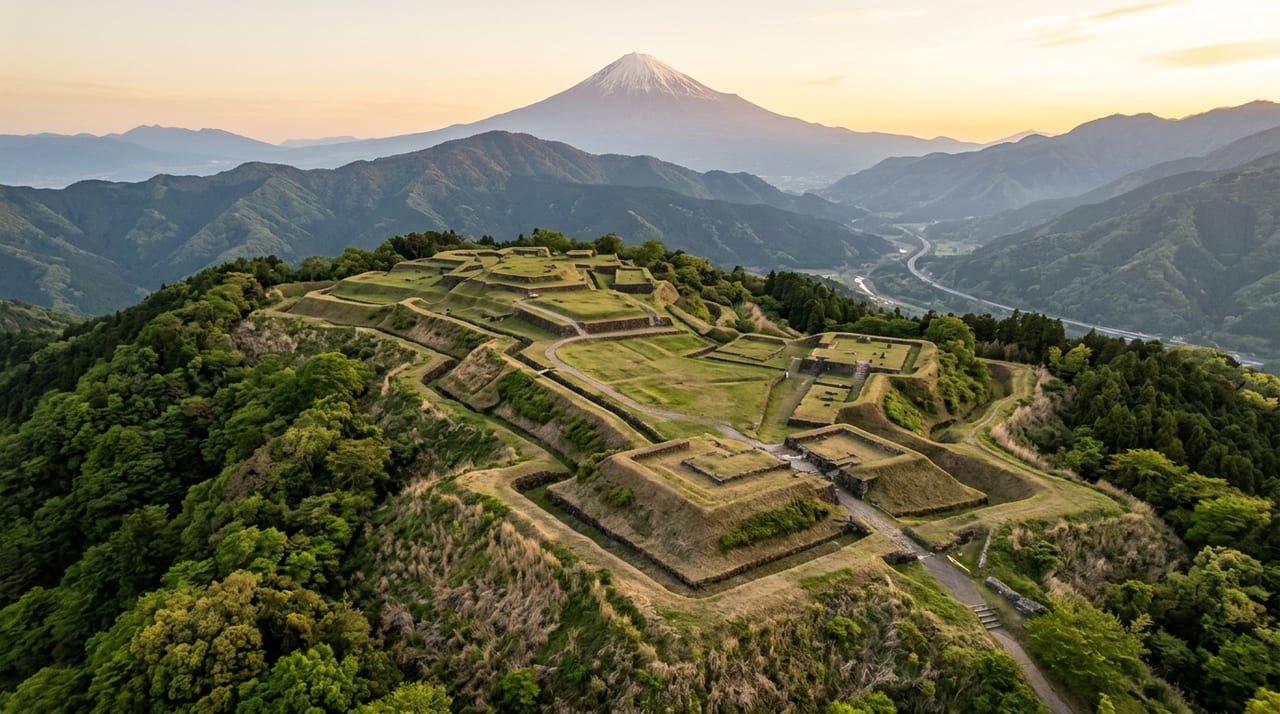
The greatest feature of Yamanaka Castle is its distinctive defensive works, the shōji-bori and the une-bori. The shōji-bori is a structure in which a lattice-like partition (shōji) is set up on the bottom of the moat. Because the loam layer (red soil) was exposed, the bottom was originally slippery, so intruding enemy soldiers would find it hard to climb. Today, the shōji-bori at the Yamanaka Castle ruins is maintained as a lawn and open to the public, and visitors can look down from above and take in the full picture of this original civil-engineering technique. The civil-engineering skill of the Later Hōjō is evaluated as having reached the highest level among castle construction of the Sengoku period, and the shōji-bori and une-bori of Yamanaka Castle are known to castle enthusiasts across the country as one of its masterpieces.
Views of Mount Fuji and Hakone
The view from the Yamanaka Castle ruins is magnificent, spreading a panorama among the finest in the Kantō and Tōkai regions, where Mount Fuji, Mount Ashitaka, and Suruga Bay can all be seen at once. On clear days, snow-capped Mount Fuji seems to loom right before one's eyes. Its majestic form, which must have inspired the Sengoku warriors, still moves the hearts of visitors today as an everlasting natural beauty.
Current State of the Castle Ruins
The Yamanaka Castle ruins are currently maintained by Mishima City as a national historic site. Major remains, including the shōji-bori, une-bori, Honmaru, Ni-no-maru, and Daisaki-demaru, are maintained as lawns and open to the public. The castle ruins are easily accessible from Mishima Station on the Tōkaidō Shinkansen, and are highly popular with castle enthusiasts as a mountain-castle site that can be visited as a day trip from Tokyo, Nagoya, or Osaka. Nearby, the hot-spring resorts of Hakone spread out. Strolling the castle ruins and then slowly soothing your fatigue in a hot spring is an ideal course for enjoying both the history and the nature along the Tōkaidō at the same time.
Connection to Swords
The sword culture of Yamanaka Castle and the Later Hōjō must be understood from the special cultural position of a daimyō house that managed the Tōkaidō, one of Japan's most important transport routes. The Later Hōjō based themselves in Sagami (Kanagawa) and ruled the Kantō. The Tōkaidō route around Hakone, where Yamanaka Castle stands, however, was an important boundary adjoining the Imagawa clan, which ruled Suruga (Shizuoka), and the Tōkai powers that would later become the domain of Tokugawa Ieyasu. In the sword culture of the Later Hōjō, the most important element is the deep connection with Sōshū-den (the sword tradition of Kanagawa). Sōshū-den is the supreme tradition of Japanese swords that produced the greatest master smiths of the Kamakura through Nanboku-chō periods, including Masamune, Sadamune, and Akihiro. Sagami Province, ruled by the Later Hōjō, was the very birthplace of Sōshū-den. Successive household heads Hōjō Ujiyasu, Ujimasa, and Ujinao held the land of Sagami, where the descendants of Sōshū-den smiths remained, and they were the warlords who received the benefits of that sword culture most directly. The valiant fighting of Mamiya Yasutoshi during the fall of Yamanaka Castle is passed down as a historical scene that embodies the spirit of Hōjō warriors and their sword culture. The battle of Yamanaka Castle, which fell in half a day, was a scene in which the Hōjō swords and the defenses of a mountain castle were overcome by Toyotomi's firearms, spears, and numbers. It is also an example that clearly shows the change in fighting style at the end of the Sengoku period. However, the spirit of the Hōjō warriors who kept fighting with swords in hand to the end resonates with the spirit of Sōshū-den's practical swords, which 'do not break and cut well.' Currently, the Mishima City Local History Museum (inside Rakujuen) displays excavated items from the Yamanaka Castle ruins, such as weapons, musket balls, and ceramics. The Yamanaka Castle ruins are a rare historic site where one can enjoy both the view of Mount Fuji and the distinctive shōji-bori at the same time, and it is a must-visit place for both sword enthusiasts and castle enthusiasts.
Highlights
- Shōji-bori and une-bori — the supreme masterpiece of the distinctive civil-engineering technique of the Later Hōjō, whose full picture can be seen at a glance thanks to the lawn maintenance
- Panorama of Mount Fuji and Suruga Bay — the finest view from the top of the castle ruins, the best along the Tōkaidō
- Daisaki-demaru — the frontline remains where Mamiya Yasutoshi fell in a heroic battle
- Mishima City Local History Museum (inside Rakujuen) — displays weapons, musket balls, ceramics and other items excavated at the Yamanaka Castle ruins
- Hakone hot springs (about 20 minutes by car) — a hot spring after strolling the castle ruins is a standard course of Hakone sightseeing
* Opening hours and admission fees are subject to change. Please check the official website before visiting.