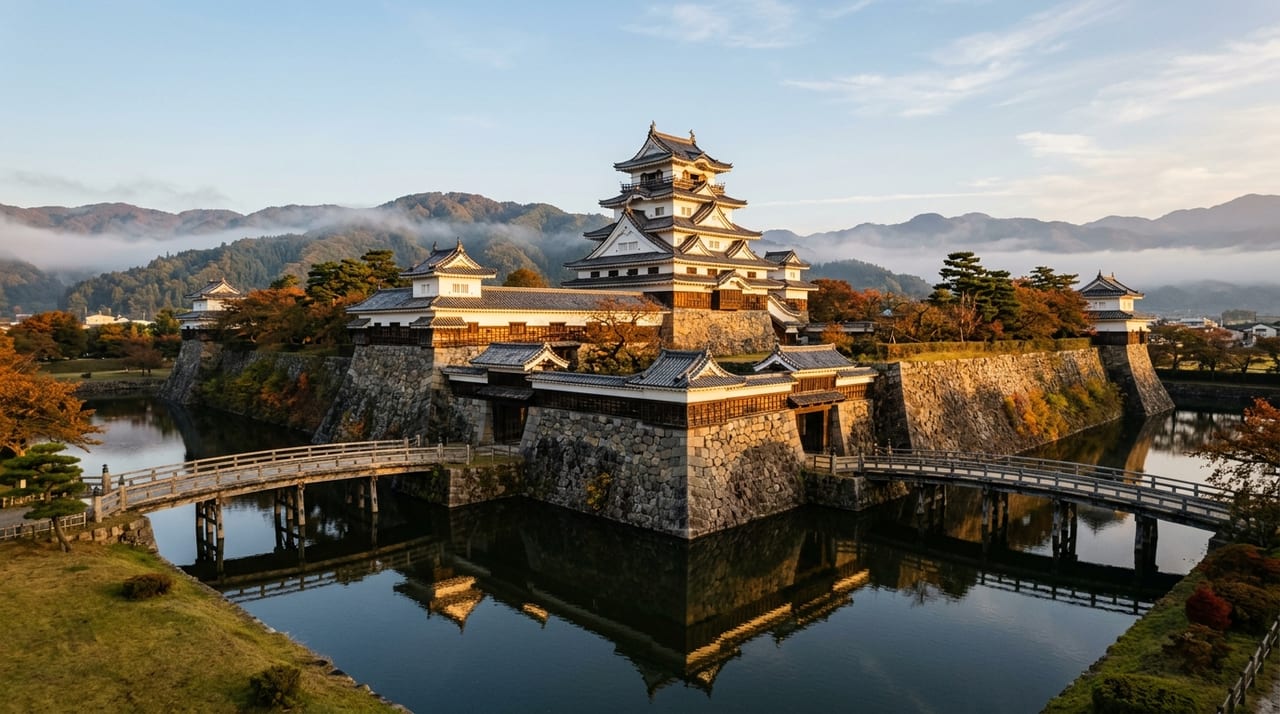
 * Image is for illustrative purposes only.
Matsushiro Castle (Kaizu Castle)
松代城(海津城)
Matsushiro Castle (Kaizu Castle) is a historic castle in the Chūbu region (Founded c. 1560 (Eiroku 3) by Takeda Shingen as a strategic base for the Kawanakajima Campaign (as Kaizu Castle). After the Battle of Sekigahara, Sanada Nobuyuki entered in 1622 (Genwa 8) and the castle was renamed 'Matsushiro Castle' by shogunal order in 1711 (Shotoku 1), becoming the seat of ten successive Sanada generations). Its lord was Takeda Shingen (built the castle) → Uesugi Kagekatsu (temporary occupation) → Sanada Nobuyuki (first generation of the Sanada family of Matsushiro domain) → Sanada clan (10 successive generations).
Overview
Matsushiro Castle (Matsushiro-jō) is a flatland castle located in Matsushiro, Nagano City, Nagano Prefecture. Its predecessor was Kaizu Castle (Kaizu-jō), built by Takeda Shingen as a base for the Battle of Kawanakajima (1553–1564). With the Chikuma River at its back, it had an enclosure-type layout (rinkaku-shiki) in which the second bailey surrounded the main bailey on three sides, and it was equipped with maru-umadashi and mikazuki-bori (crescent moats).
The Battle of Kawanakajima is famed as the greatest war of attrition of the Sengoku period, in which Takeda Shingen and Uesugi Kenshin clashed five times across northern Shinano (around the Nagano Basin). Kaizu Castle was the Takeda forward base in this campaign. It is especially known as the setting of the 'kitsutsuki (woodpecker) tactic,' in which, just before the Fourth Battle of Kawanakajima (Eiroku 4 (1561)), Kenshin is said to have detected Takeda troop movements from irregularities in the smoke of the castle's cooking fires and crossed the Chikuma River at night.
After the fall of the Takeda clan in Tenshō 10 (1582), Kaizu Castle was contested between the Oda and Uesugi clans. Sanada Nobuyuki, who had been granted Ueda after the Battle of Sekigahara, was transferred to Matsushiro with an increase in holdings in Genna 8 (1622). Nobuyuki fortified the castle and made it his seat (the name 'Matsushiro Castle' came later, by shogunal order in Shōtoku 1 (1711)), and from then on it was the seat of the Sanada clan for ten generations. The Sanada daimyo of Matsushiro domain continued stably as a 100,000-koku tozama (outside) daimyo through the Edo period, and Nobuyuki himself lived long, to age 93.
In the Meiji period the castle was abandoned and the domain abolished, but the castle ruins have been developed as a National Historic Site, and stone walls, moats, and wooden bridges have been restored. The nearby Sanada Treasure Museum houses armor, swords, furnishings, and ancient documents handed down in the Sanada family. The Sanada Residence (Shin-goten), a late-Edo-period palace outside the castle, and the Bunbu Gakkō domain school also remain, allowing visitors to experience samurai culture in its entirety.
Connection to Swords
The connection between Matsushiro Castle (Kaizu Castle) and Japanese swords runs through both the Battle of Kawanakajima, the greatest confrontation between Sengoku-period generals, and the Sanada clan, the samurai family most widely loved in Japan.
The Battle of Kawanakajima is handed down as a clash between two great generals, Takeda Shingen and Uesugi Kenshin, but the warriors who fought in it carried swords of the highest standard of the time. The Sanchōmō, a Bizen sword designated as a National Treasure and now held by Setouchi City, Okayama, is known as a beloved blade of Uesugi Kenshin and is a single sword that symbolizes his love of swords.
Sanada Nobuyuki was a warrior who loved the tea ceremony and also set up a tea room at his retirement residence. Armor, swords, and other items handed down in the Sanada family are held at the Sanada Treasure Museum in Matsushiro.
Highlights
- Matsushiro Castle Ruins (National Historic Site) — restored wooden bridges, stone walls, and water moats; experience the castle's transformation across successive lords, from Takeda to Sanada
- Sanada Treasure Museum and Sanada Residence — a treasure museum housing armor, swords, ancient documents, and other items handed down in the Sanada family, and a late-Edo-period palace outside the castle
- Bunbu Gakkō (domain school) — the domain school buildings of the Sanada Matsushiro domain survive, with the martial arts training hall and literary studies hall preserved
- Kawanakajima Ancient Battlefield (Hachimanpara Historic Park) — the main battlefield of the Fourth Battle of Kawanakajima, with statues of Shingen and Kenshin in single combat
- Zōzan Underground Bunker (Matsushiro Imperial Headquarters) — underground bunker remains excavated as the Matsushiro Imperial Headquarters at the end of the Pacific War
* Opening hours and admission fees are subject to change. Please check the official website before visiting.