 * Image is for illustrative purposes only.
Kasugayama Castle
春日山城
Kasugayama Castle is a historic castle in the Chūbu region (Northern and Southern Courts period (14th century) founding). Its lord was Uesugi Kenshin / Uesugi Clan.
Overview
About the Castle
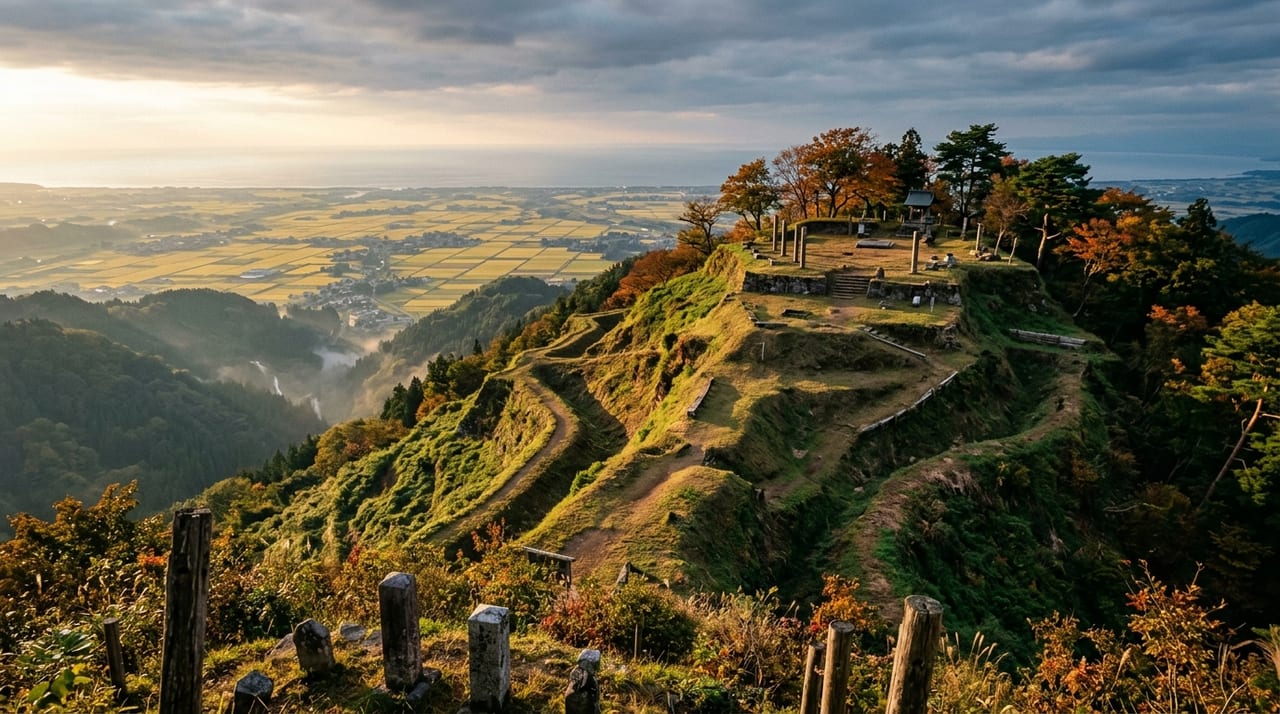
Kasugayama Castle was the residence of Uesugi Kenshin, known as the "God of War" and "Dragon of Echigo," and is counted among Japan's five great mountain castles and one of the largest mountain castles of the Sengoku period. The grand layout, which utilized Mount Kasugayama at an elevation of approximately 180 meters in its entirety as a castle fortress, is considered the masterpiece of mountain castle design that maximizes natural topography. The castle's origins trace back to the 14th century of the Northern and Southern Courts period, when the Uesugi clan, shugo (provincial governors) of Echigo, built it as a refuge fortress for their residence in the provincial capital; later the Nagao clan, their deputy governors, became lords of the castle, and after major rebuilding under Nagao Tamekage it became the seat of Nagao Kagetora (later Uesugi Kenshin).
Battles and Warfare
Kenshin is remembered as the most "righteous" of Sengoku-era warlords. In the 10th year of Eiroku (1567), when the flow of salt to Kai was cut off due to a salt embargo by the Imagawa and Hojo clans, Kenshin is said to have sent salt to his sworn enemy Takeda Shingen. This anecdote became the origin of the Japanese idiom "sending salt to one's enemy," immortalizing Kenshin's reputation as a righteous general. Kenshin held deep faith in Bishamonten and believed himself to be an incarnation of the deity. Before each sortie, he would invariably pray for victory at the Bishamonten Hall within the castle and take to the battlefield with a military banner inscribed with the character "Bi" (毘).
Architecture and Structure
He fought many battles over his lifetime, and his tactics in the Battle of Kawanakajima and the Battle of Tetorigawa are regarded as models in military history. Kenshin died unexpectedly at age 49 in the 6th year of Tensho (1578); the leading theory attributes his death to cerebral stroke. After Kenshin's death, a succession dispute (the Otate Disturbance) erupted between his adopted sons Kagekatsu and Kagetora, and Kasugayama Castle was buffeted by the storms of the Sengoku period. From the main citadel, one can look out over the vast granary plains of Kubiki and the horizon of the Japan Sea—imagining Kenshin gazing upon this landscape while assessing the state of the realm fills one with the weight of history.
History of the Castle's Construction
Kasugayama Shrine displays a bronze statue of Kenshin, and the "Kenshin Festival" is held grandly each August. Kenshin was also known as a general who deeply loved sake, and at Kasugayama Castle, he is said to have strengthened the bonds of his retainers through sake banquets. A military genius yet known for his integrity, Kenshin was a rare figure in the Sengoku world who upheld "righteousness," and his image continues to command respect from many to this day. Kasugayama Castle features no stone walls; it is a fortress constructed solely from natural terrain, embodying the aesthetic of mountain castle design.
Present-Day Aspect
The climb to the summit requires stamina, but upon reaching the hilltop, the same magnificent panorama Kenshin beheld spreads before you—an incomparable emotional experience. Joetsu City is also renowned as a sake-producing region, and the sake culture beloved by Kenshin lives on today through local breweries. Tasting local premium sake after touring Kasugayama Castle is a highlight of any visit. The approach to Kasugayama Castle features numerous points of interest, including the ruins of the Naoe residence, the Bishamonten Hall, and the Senkan Gate site, making the entire mountain feel like a history museum.
Connection to Swords
Uesugi Kenshin, who identified himself as an incarnation of Bishamonten, was one of the Sengoku period's strongest warlords, and his expertise in blades surpassed that of most daimyo of his era. The Uesugi clan's sword collection is regarded as the finest in both quality and quantity among Japan's daimyo families, with collection efforts beginning in Kenshin's time and enriched by successive daimyo. Among the famous blades Kenshin possessed, the most renowned is the tachi "Sanchōmō." This National Treasure tachi, attributed to the Bizen Ichimonji school, features a magnificent hamon of large choji-midare pattern that extends powerfully to the blade tip, earning its name from the landscape resembling feathers of a copper pheasant standing on end. In 2020, Setouchi City, Okayama Prefecture, purchased it for approximately 500 million yen, and its public display at the Bizen Osafune Blade Museum generated considerable attention. "Himetsuru Ichimonji" is another celebrated tachi transmitted through the Uesugi family, a Ichimonji-school masterpiece retaining a sound form with minimal polishing loss. Additionally, "Gokotai," a short blade (tanto) crafted by Awataguchi Yoshimitsu, is transmitted to have been bestowed upon Kenshin by Emperor Ogimachi during his 1559 ascent to the capital, and later inherited by the Uesugi family as one of Uesugi Kagekatsu's personally selected "Thirty-Five Blades of Lord Uesugi." The Uesugi family's blades served as political tools to deepen bonds between lord and retainers through bestowal among vassals. The legendary single combat between Kenshin and Takeda Shingen at the Battle of Kawanakajima stands as Japan's most famous historical episode of a duel between sword-wielding warlords. The scene of Kenshin, clad in a white head wrap and a pale-yellow armored surcoat, charging alone into Shingen's command post to deliver three sword strikes has been depicted countless times in woodblock prints and statuary. Some of the swords handed down in the Uesugi family are now preserved at the Yonezawa City Uesugi Museum and Uesugi Shrine (Yonezawa, Yamagata Prefecture). Yonezawa is where Kenshin's adopted son Kagekatsu was transferred after the Battle of Sekigahara, and visiting both Kasugayama Castle and Yonezawa Castle together allows one to trace the journey of the Uesugi family's sword collection.
Highlights
- Panorama from the main citadel—sweeping views of the Kubiki plain and Japan Sea, the landscape Kenshin surveyed while assessing the realm
- Bishamonten Hall—the sacred ground where Kenshin prayed for victory before sorties, the wellspring of the war god's faith
- Uesugi Kenshin statue (Kasugayama Shrine)—armored statue of Kenshin welcoming visitors
- Naoe residence ruins—former residence of Naoe Kanetsugu, chief retainer of Uesugi Kagekatsu, renowned for the "Ai" (愛) emblem on his helmet
- Joetsu City Buried Cultural Properties Center—exhibition facility introducing artifacts from Kasugayama Castle and its full scope
- Uesugi Museum (Yonezawa City)—home to Uesugi family heirlooms such as the tachi "Himetsuru Ichimonji" (Important Cultural Property)
* Opening hours and admission fees are subject to change. Please check the official website before visiting.