New Arrivals — Browse our catalog for the latest authentic Japanese sword arrivals. Browse →
1553–1564 (Tenbun 22 – Eiroku 7); Fourth Battle: October 1561 (9th month, Eiroku 4)
Kawanakajima, Shinano Province (present-day Nagano City, Nagano Prefecture)
Forces
Takeda Forces
Uesugi Forces
About 10 min read
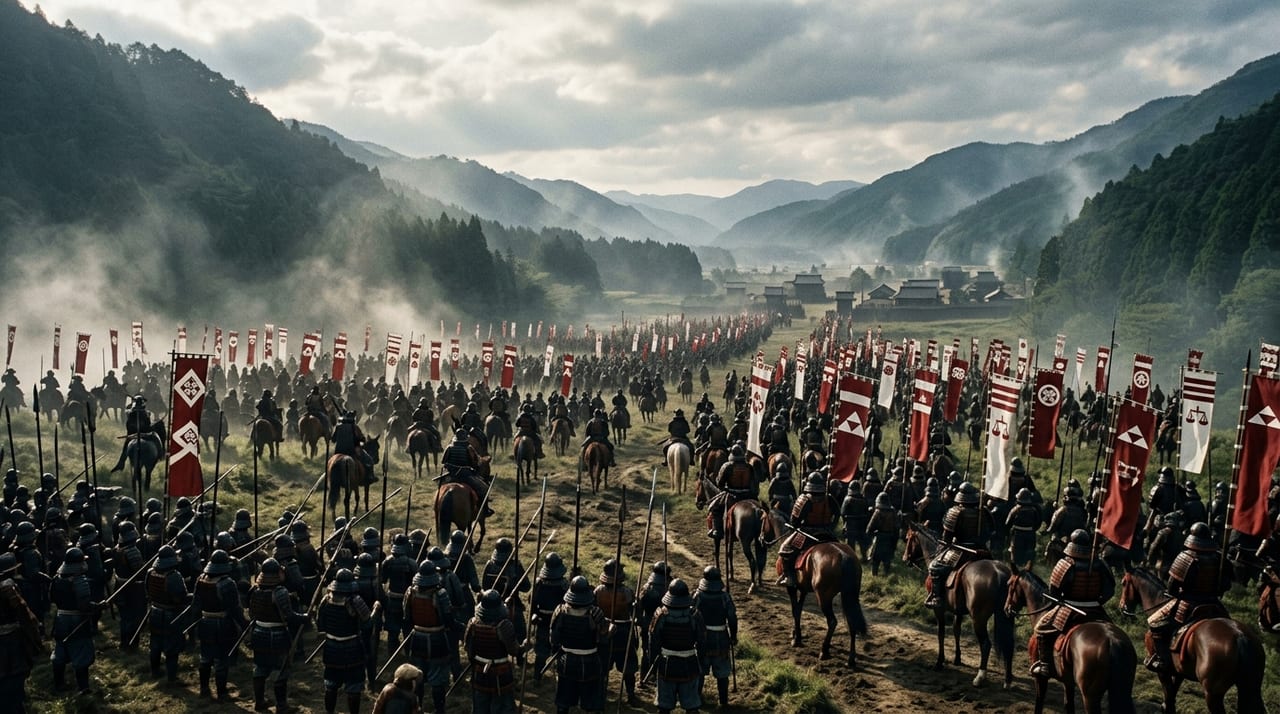
From Tenbun 22 (1553) to Eiroku 7 (1564), a series of five clashes between Takeda Shingen of Kai and Uesugi Kenshin of Echigo took place in northern Shinano Province, centered on Kawanakajima (present-day Nagano City, Nagano Prefecture). Collectively these engagements are called the "Battle of Kawanakajima." Of the five, the fourth battle, fought in the 9th month of Eiroku 4 (1561), was especially fierce, and when people today speak of the "Battle of Kawanakajima," they often mean this single engagement.
The two generals were rivals for dominance over Shinano, but their strategic aims differed. Takeda Shingen aimed to gain complete control of Shinano and advance northward, while Uesugi Kenshin (later Kantō Kanrei) sought to check Takeda's expansion by sheltering the defeated forces in Shinano, such as Murakami Yoshikiyo. The confrontation between the two generals, portrayed as fated rivals, was idealized by later generations as a clash of bushidō-style "righteousness" (gi) that went beyond a mere territorial dispute, and it is counted among the greatest contests in Japanese history.
In the 9th month of Eiroku 4 (1561), the two armies gathered at Hachimanbara in Kawanakajima with about 20,000 men on the Takeda side against about 13,000 on the Uesugi side. The Takeda army devised a plan known as the Woodpecker Stratagem (kitsutsuki senpō). This tactic, said to have been devised by Yamamoto Kansuke, was a two-pronged ploy: a detachment would make a surprise attack from behind on the Uesugi army encamped at Mount Saijo and drive it down onto the plain, where the main force lying in wait would trap it in a pincer attack.
However, Uesugi Kenshin detected this scheme, secretly descended from Mount Saijo at night, and launched a sudden assault on the Takeda main force in the dawn mist. The Takeda main force, having been waiting for the detachment to return, was thinly defended and fell into great confusion under the sudden fierce onslaught. Amid this chaos, Takeda Nobushige (Tenkyū), younger brother of Takeda Shingen, was killed, and the Takeda side suffered heavy losses.
The most dramatic story told about this battle is the legend of a "single combat" between Uesugi Kenshin and Takeda Shingen. Kenshin, mounted on horseback, is said to have charged alone into the Takeda headquarters and swung his sword down three times at Shingen, who was seated on a campaign stool (shōgi). Shingen is said to have blocked the blows with his war fan (gunbai). This legend spread through military chronicles of the Edo period. Although doubts remain about its historical accuracy, it continues to be passed down today as an episode that symbolizes the heroism of both generals.
The warlords who appeared in the Battle of Kawanakajima are each linked to famous swords that left their names in history.
As famous swords associated with Uesugi Kenshin, the National Treasure "Sanchōmō" (also read Yamatorige) and "Himetsuru Ichimonji" are well known, and they continue to convey Kenshin's martial prowess to the present day.
Incidentally, "Juzumaru Tsunetsugu" is known as a famous sword associated with Nichiren. Juzumaru Tsunetsugu is a tachi said to have been made by Aoe Tsunetsugu, a master smith of the Kamakura period. It is held at Honkō-ji in Amagasaki, the head temple of the Hokke-shū Honmon-ryū, and it is counted among the Tenka Goken (Five Great Swords under Heaven).
Furthermore, figures such as Sanada Masayuki (father of Yukimura), whom the Kōyō Gunkan records as having made his first battle in this engagement, and Yamamoto Kansuke, who died in battle here, color the Battle of Kawanakajima as a "story of swords" that goes beyond a mere military clash.
Across the five battles of Kawanakajima, the Takeda and Uesugi armies lost many officers and men, yet neither was able to secure a decisive victory. However, their prolonged attrition had a major impact on the external strategies of both houses.
Takeda Shingen could not fully secure his northward route because of the war of attrition at Kawanakajima, and as a result his advance toward the capital was delayed. In Eiroku 11 (1568), he turned to an invasion of Imagawa territory (invasion of Suruga), and in the 12th month of Genki 3 (January 1573) he defeated Tokugawa Ieyasu at the Battle of Mikatagahara. He died of illness in the 4th month of Genki 4 (1573). Uesugi Kenshin, too, abandoned his advance into Shinano and concentrated on expanding his influence into the Kantō, but he died suddenly in Tenshō 6 (1578).
It is also said that, in the end, the attrition at Kawanakajima thwarted the two heroes' dreams of unifying the realm. Had either the Takeda or the Uesugi escaped this war of attrition early, the rise of Oda Nobunaga might have been considerably delayed.
Through the bushidō spirit displayed by the two heroes, Takeda and Uesugi, who fought for righteousness and continued their struggle while acknowledging each other's ability, the Battle of Kawanakajima profoundly influenced later views of bushidō and sword culture. The fact that the swords of both generals are still carefully preserved throughout Japan shows that this battle is a cultural and spiritual heritage that goes beyond a mere historical engagement.
Takeda Nobushige
Shingen's younger brother, killed in the Fourth Battle
Yamamoto Kansuke
Takeda strategist, attributed with devising the woodpecker stratagem
Sanada Masayuki
Takeda retainer who participated in the battles
Takeda Shingen
Supreme commander of the Takeda Forces
Uesugi Kenshin
Supreme commander of the Uesugi Forces
「越後の龍」「軍神」と称された上杉謙信(1530〜1578年)は、戦国武将の中でも刀剣への関心が際立って深かった人物である。越後国に根付いた刀工文化、謙信が収集した名刀の数々、そして毘沙門天信仰と刀剣の関係を解説する。
2026-05-21
応仁の乱以降の戦国時代に激増した刀剣需要の中で、量産型の数打ち物(かずうちもの)と最高品質の名刀という二極化した需要に応えた刀工の実態と、孫六兼元ら名工の系譜、そして実戦経験から生まれた刀の形状変化を解説する。
2026-05-06
軍配(ぐんばい)とは何か。意味・語源・正しい読み方から、戦国武将が指揮に用いた実際の使い方、相撲の行司の軍配と「軍配を上げる」という言葉の由来、采配・鉄扇との違い、現代での所持規制までを解説する。
2026-04-26
武田信玄の軍師・山本勘助はどのような刀を帯びたのか。史料から読み解く勘助の刀剣観、戦国武将の佩刀様式、「甲陽軍鑑」に記された武田家の刀剣文化を考察する。
2026-04-21