What is a Gunbai — Meaning, Pronunciation, the Origin of "Gunbai wo Ageru," and the Differences from Saibai and Tessen
 * Image is for illustrative purposes only.
Table of Contents
Japanese Warriors Did Not Fight with Swords Alone
The image of a Sengoku warlord calls to mind "swords and armor," but in reality a warlord's equipment was diverse. Among the distinctive arms that combined "command and self-defense" were the gunbai, the tessen, and the saibai.
These are not swords, yet they frequently appear in the context of sword collecting and arms research, embodying the dual functions of "sword and command" in Japanese warrior culture.
What is a Gunbai — Meaning, Etymology, and Pronunciation
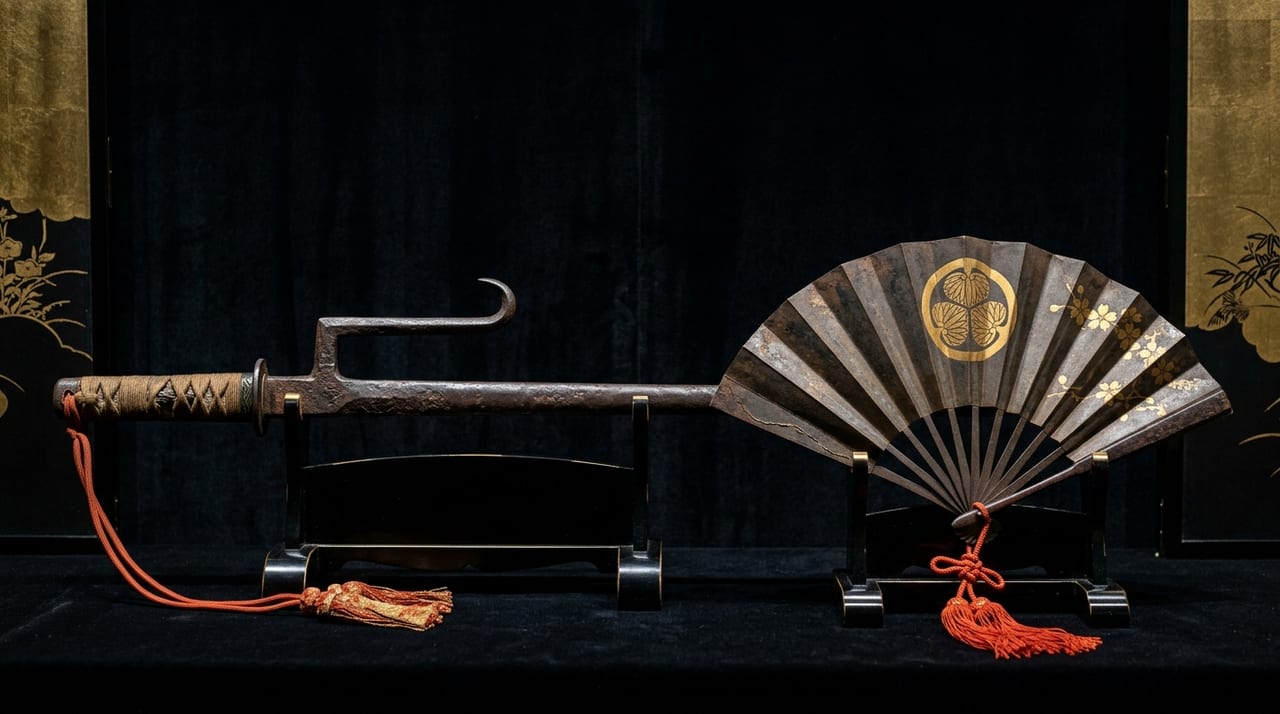
A gunbai is a round-fan-shaped command implement that warlords used to direct and deploy their forces; its formal name is "gunbai uchiwa." The standard reading is "gunbai," though it is sometimes pronounced "gunpai"; dictionary headwords list "gunbai" as the standard form.
The etymology is literally "distributing the army," meaning the ordering of troop positions and movements. Gunbai are frequently decorated with the sun and moon, the Big Dipper, the twelve zodiac signs, and the like; this was not mere decoration, but because a gunbai also served as a tool of onmyōdō and gunbai-jutsu for divining the auspicious timing and direction of a campaign. Gunbaisha (gunbai practitioners) of the Sengoku period fulfilled the role of a military strategist, reading the calendar, astronomy, and weather to advise on the timing of battle.
Gunbai — Symbol of a Commander's Wisdom
What is a Gunbai
A gunbai is a fan-shaped implement that Sengoku warlords and daimyo used for directing military operations. It is identical in form to the "gunbai uchiwa" carried today by sumo referees (gyoji) and was made of wood, metal, ox horn, and similar materials.
Etymology: "Gunbai" derives from "distributing the positioning of the army."
Types and Materials of Gunbai
| Type | Material | Features |
|---|---|---|
| Wooden gunbai | Timber such as ho and kiri | Lightweight, practical, most common |
| Iron gunbai | Iron or steel | Heavy; also functions as a defensive implement |
| Makie gunbai | Wood with lacquer and metalwork | Ceremonial, gift-giving, high artistic value |
| Whale-bone gunbai | Whale bone | Lightweight, expensive, rare |
Practical Combat Functions of the Gunbai
A gunbai was not merely a "pointer"; it had multiple practical combat functions:
- Troop command: Used to signal advances, retreats, and evasive movements to the left or right, in the same manner as flags and saibai
- Arrow deflection: Iron gunbai functioned as a defensive implement for deflecting incoming arrows and thrown stones
- Self-defense: Used as a striking weapon in close combat (the striking power of an iron gunbai is not to be underestimated)
- Ritual function: Under the influence of onmyōdō, the gunbai was also invested with ritual significance. There was a belief that "raising the gunbai brings victory."
Notable Episodes Involving Gunbai
The gunbai of Uesugi Kenshin: Uesugi Kenshin was known as the "god of war," and the gunbai he used is still held today at Uesugi Shrine.
The Battle of Kawanakajima (1561): In the famous scene of the direct confrontation between Takeda Shingen and Uesugi Kenshin, a legend survives that Kenshin slashed at Shingen from horseback and that Shingen "parried with his gunbai." This anecdote demonstrates that the gunbai functioned as an actual weapon.
Tessen — A Hidden Weapon in the Breast Fold
What is a Tessen
A tessen has the same shape as an ordinary folding fan, but its ribs (the fan's framework) are made of iron or steel. As the name "iron fan" (tessen) suggests, it is built exactly as described.
Types of Construction
Iron ribs only: The fan's ribs are iron while the fan face is ordinary paper or silk. In appearance it resembles a normal folding fan. This "disguised type" was suited for self-defense and assassination.
Fully metal: Even the fan face is made of metal plates, making it a complete weapon. This is the most typical form of tessen.
Reinforced outer-rib type: Only the oyabone (the two outer ribs) of an ordinary folding fan are made of metal. A practical form.
Practical Combat Use of the Tessen
The techniques of the tessen have been systematized as "sensujutsu":
- Striking: Used closed as a rod. The weight of the metal delivers powerful blows.
- Thrusting: Stabbing with a tessen whose tip (the tip of the outer ribs) has been sharpened.
- Blocking: Defense by catching a sword blade in a "V-block (trapping it between the two outer ribs)" or receiving it on the face of the fan.
- Blinding: Suddenly snapping the tessen open toward the opponent's face to obstruct their vision.
The Tessen and the "Status of a Portable Weapon" Among Warriors
In the Edo period, weapons shorter than a wakizashi could be carried even by people of lower status. In a situation where farmers, artisans, and merchants found "swords prohibited, fans permitted," the tessen spread as a "substitute self-defense weapon for the sword." Merchants, samurai wives, and people associated with the pleasure quarters also carried the tessen as a self-defense implement.
Saibai — The White-Plumed Command Baton
What is a Saibai
A saibai is a command baton used by Sengoku warlords, consisting of a bundle of white paper, wood shavings, or bird feathers attached to the tip of a handle. Together with the gunbai, it functioned as a "symbol of command and authority."
Etymology: "Saibai" is said to derive either from "sai" (selecting various things) and "hai" (arranging), or from "saibai" written with different characters meaning "arranging colors."
"Saibai wo Furu" in Modern Usage
The modern Japanese idiom "saibai wo furu" (to direct and manage affairs) comes from this saibai.
Combination with Swords — The Warlord's "Full Set"
The typical equipment carried by a Sengoku warlord:
| Equipment | Purpose | Size / Position |
|---|---|---|
| Tachi (or uchigatana) | Primary weapon | At the waist; worn suspended on the left hip |
| Wakizashi | Secondary weapon; self-defense | At the waist; thrust on the right |
| Tantō / pocket blade | Self-defense; ceremonial use | In the breast fold or sleeve |
| Gunbai | Command; self-defense | Carried in hand |
| Saibai | Command | Carried in hand or thrust at the waist |
This integrated "warlord's attire (equipment)" is depicted in detail in Sengoku picture scrolls and folding-screen paintings.
Possession Today — Legal Treatment
Gunbai and Saibai
Gunbai and saibai fall outside the regulations of the current Firearms and Swords Control Act (Jūtōhō). They may be freely possessed and displayed as collectibles.
Tessen
The legal treatment of tessen may vary depending on circumstances:
- Tessen as a traditional craft or art object: possession is generally permissible.
- Forms that may qualify as bladed weapons (e.g., when the tip is sharpened): if it constitutes a blade with a blade length exceeding 6 cm, carrying it without legitimate reason is prohibited under Article 22 of the Act for Controlling the Possession of Firearms or Swords and Other Such Weapons (Jūtōhō) (Act for Controlling the Possession of Firearms or Swords and Other Such Weapons (e-Gov Law Search))
- "Carrying without legitimate reason" may constitute a violation of the Minor Offenses Act.
Practical advice: Storing items at home for artistic or collecting purposes poses no problem, but it is prudent to avoid carrying them in public places.
The Gyoji's Gunbai in Sumo and the Origin of "Gunbai wo Ageru"
The most familiar context in which people today encounter a gunbai is professional sumo. The gunbai carried by the gyoji was inherited directly from the Sengoku warlord's gunbai uchiwa as a ceremonial implement. As kanjin sumo was organized during the Edo period, the gyoji came to use attire and a gunbai modeled on samurai custom.
At the tachiai, the gyoji coordinates the breathing of both wrestlers, and when the bout is decided, turns the gunbai toward the winning wrestler's side. From this, deciding victory, defeat, or superiority came to be expressed as "gunbai wo ageru" or "gunbai ga agaru." Everyday expressions such as "kare no shuchō ni gunbai ga agatta" are idioms born from the combination of the history of warlords issuing commands with the gunbai and the gesture of the gyoji rendering a decision. It should also be noted that when the gyoji's decision is disputed and overturned, it is called "sashichigae," likewise a word derived from the gunbai.
Summary — The World of Warrior Culture Beyond the Sword
The sword is the center of warrior culture, but the gunbai, tessen, and saibai were important "supporting players" that complemented the roles a sword could not fulfill — command, self-defense, and ceremony.
In nihontō collecting and arms research, turning one's attention to these associated weapons brings the full picture of warrior culture into sharper, three-dimensional relief. For sword enthusiasts, the gunbai and tessen are adjacent fields well worth knowing.