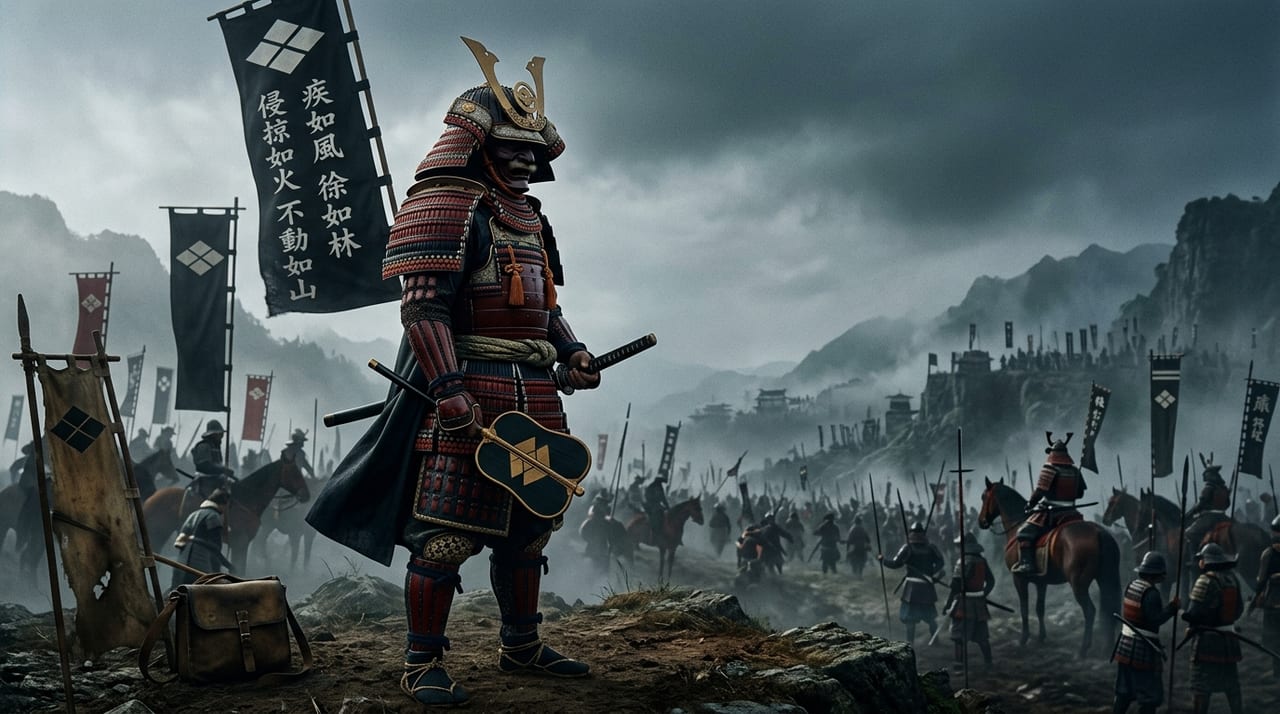
 * Image is for illustrative purposes only.
Takeda Shingen
武田信玄
Tiger of Kai
Description
The Birth of the Tiger of Kai
Takeda Shingen (Harunobu), said to have been born in the first year of Daiei (1521) at Yōgaiyama Castle in Kai Province, the mountain fortress serving as the backup castle of Tsutsujigasaki Yakata, is one of the strongest generals of the Sengoku period, known by the nickname "Tiger of Kai." Under the banner of "Fūrinkazan," taken from Sun Tzu's art of war ("swift as the wind, silent as the forest, fierce as fire, immovable as a mountain"), he led the Takeda cavalry, said to be the strongest in the realm, and swept across the battlefield.
The Fūrinkazan Army
Shingen's military achievements are too numerous to list. In his invasion of Shinano, he defeated the Suwa, Ogasawara, and Murakami clans one after another and built a vast domain that grew from a single province, Kai, to stretch across Shinano, Suruga, Kōzuke, and Tōtōmi. In the western campaign of the third year of Genki (1572), at the Battle of Mikatagahara, he crushed Tokugawa Ieyasu so thoroughly that he shook the alliance of Oda Nobunaga and Ieyasu. The Takeda cavalry's charge in this battle has been passed down as the strongest tactic of the Sengoku period.
The Battle of Kawanakajima
The contests between Shingen and Uesugi Kenshin at Kawanakajima are told endlessly as famous battles representative of the Sengoku period. In particular, the Fourth Battle of Kawanakajima in the fourth year of Eiroku (1561) was extremely fierce. The famous episode, in which Kenshin rides into Shingen's main camp himself and swings his sword downward while Shingen blocks it with his war fan, is a one-on-one duel recorded in the Kōyō Gunkan and other sources. Although it is not confirmed in reliable primary sources, it has been repeatedly depicted in historical novels and dramas.
Shingen's Sword
The "Tachi, signed Rai Kuninaga," said to have been Shingen's sword, was donated by Yanagisawa Yoshiyasu at the 133rd memorial anniversary of Shingen. It has been handed down at Erin-ji, Shingen's family temple, and is designated an Important Cultural Property. The Rai school was a group of swordsmiths based in Yamashiro Province, active from the late Kamakura period to the Nanboku-chō period. Warriors favored their sturdy construction suited to actual combat and their dignified form.
The Sengoku Legacy That Remained
In the fourth year of Genki (1573), Shingen fell ill during the western campaign and died on the way back to Kai. The place of his death is said to be Komaba in Shinano Province, though there are also theories that it was Namiai or Neba. He was aged 53. His will, "Hide my death for three years," is well known. After Shingen's death, the Takeda house declined rapidly and was destroyed by the combined forces of Oda and Tokugawa in the tenth year of Tenshō (1582). Many of the Takeda family's swords were scattered, but the tachi of Rai Kuninaga, said to be Shingen's, is still handed down at Erin-ji. Shingen's image, riding across battlefields under the Fūrinkazan banner, still moves people's hearts as the ideal of a Takeda warrior.
Notable Swords
- Tachi by Rai Kuninaga (traditionally said to have been Shingen's sword; held by Erin-ji, Important Cultural Property)