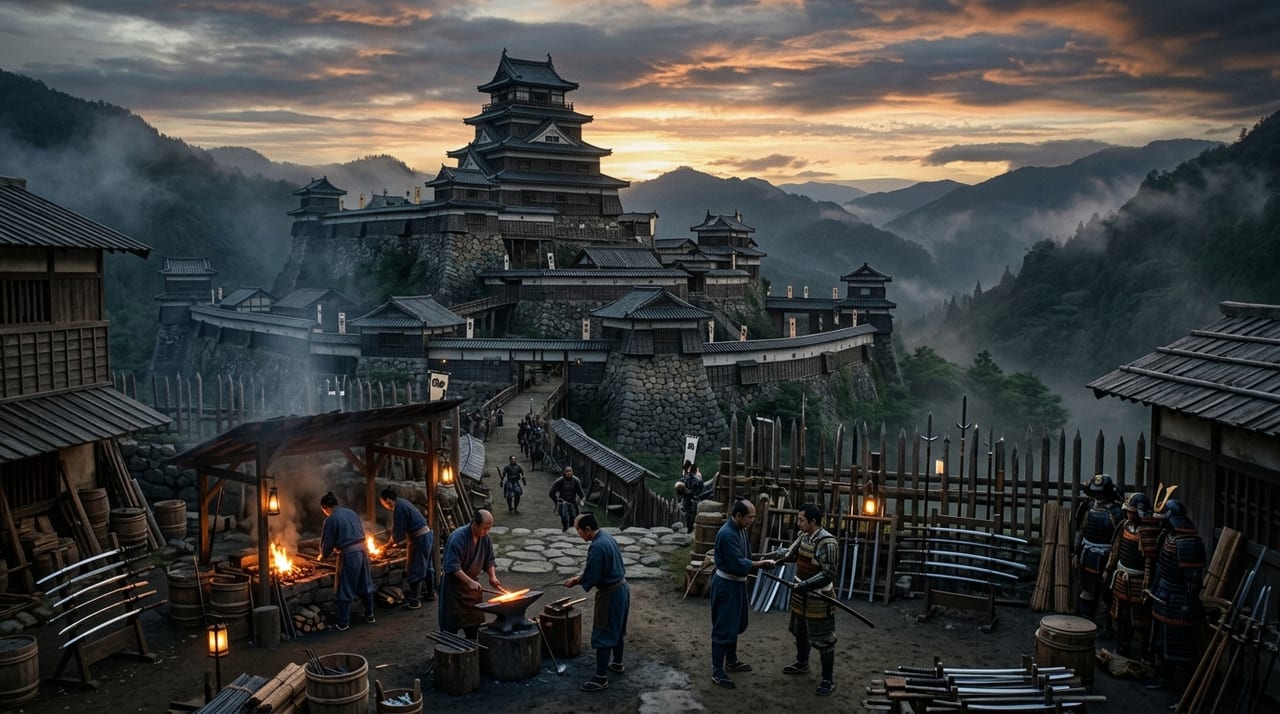
 * Image is for illustrative purposes only.
Sengoku Mass Production and Custom Swords
戦国期の量産刀と注文刀
The century and a quarter of the Sengoku period produced the most dramatic bifurcation in Japanese sword market history: industrial-scale mass production (kazuuchi-mono) for battlefield consumption alongside ultra-high-end custom commissions from powerful warlords. This simultaneous expansion of quantity and quality reshaped the entire sword economy and established market structures that persist to the present day.
Description
The Ōnin War and the Surge in Sword Demand
The Ōnin-Bunmei War, which began in the first year of Ōnin (1467) and lasted eleven years, opened a nationwide conflict and ushered in the Sengoku period, which lasted more than a century. The upheaval caused demand for bladed weapons such as swords, naginata, and spears to rise sharply, and demand for uchigatana (swords worn edge-up through the belt) rose most of all. Unlike the traditional tachi, the uchigatana is worn edge-up, thrust through the sash at the waist. It was a practical sword that foot soldiers could handle easily, and it suited Sengoku-period battle tactics, which relied on large numbers of infantry (ashigaru). Before the Ōnin War, the sword market centered on expensive custom orders, but it quickly shifted to a mass market centered on mass-produced swords.
Production System for Kazuuchi-mono
In major production centers such as Bizen and Mino, the production of mass-produced swords called kazuuchi-mono (mass-produced swords) began in earnest. Kazuuchi-mono were made through an assembly-line-style process in which several smiths divided the work and specialized in steps such as forging the jigane (base steel), quenching to form the hamon (temper line), polishing, and fitting the handle, which made production more efficient. In particular, around Osafune in Bizen, large groups of smiths clustered together, and many smiths, including Sukesada, Kiyomitsu, and Katsumitsu, established mass-production systems. Seki in Mino (Gifu) became a major production center for mass-produced swords known as seki-mono, and it remains the center of the cutlery industry today. Although these kazuuchi-mono were practical goods with simplified jigane and hamon, their basic forging quality was not to be underestimated, and many survive in sound condition after several hundred years.
High-Priced Commissioned Swords of Powerful Daimyō
Alongside the mass production of kazuuchi-mono, powerful daimyō continued to place high-priced orders with first-rank smiths. Military leaders such as Takeda Shingen, Uesugi Kenshin, Oda Nobunaga, Toyotomi Hideyoshi, and Tokugawa Ieyasu were all outstanding sword collectors, and each commissioned swords from specific smiths. The master of this era who deserves special mention is Sukesada of Sue-Bizen (late Bizen), who met demand while maintaining the quality of Bizen swords from the late Muromachi to the Azuchi-Momoyama period. Many swords bearing Sukesada's signature (mei) survive today, and the finest of them are rated even higher than Jūyō tōken (Important Swords).
Swords as Tools and Swords as Art
The Sengoku period was also the era when the distinction between the sword as a tool and the sword as art became clear. Kazuuchi-mono were treated essentially as consumables, close to disposable, while famous swords (meibutsu) were highly valued as spoils of war, rewards, and diplomatic gifts, and were carefully preserved. Nobunaga and Hideyoshi spent large sums seeking meibutsu because such swords proved their authority as rulers of the realm, so the artistic and political value of swords became inseparably linked. This tradition merged with the Edo-period notion that "the sword is the soul of the samurai," and it ultimately established the cultural status of the Japanese sword.
Bridge to Shintō (New Sword) Techniques
In the late Tenshō era, toward the end of the Sengoku period, Osafune was destroyed by great floods of the Yoshii River, and the Bizen smithing tradition was temporarily interrupted. Instead, daimyō across the country employed Mino smiths, who had mass-production systems in place. Mino smiths also migrated to the eastern and northern provinces, becoming the origin of regional swords in Echizen, Musashi, Shinano, Echigo, and elsewhere. This dispersal of smiths during the Sengoku period spread the regional diversity of Japanese swords throughout the country and became the origin of the regional smith cultures of the Edo period.
Characteristics of This Era
- Kazuuchi-mono mass production: Bizen Osafune and Mino Seki developed proto-industrial assembly-line smithing; standardized uchigatana supplied the foot-soldier armies of Sengoku warfare
- Sue-Bizen Sukesada school quality amid mass production: the Sukesada lineage maintained above-average standards within the high-volume market; their swords occupy a valuable middle ground between kazuuchi-mono and custom work
- Uchigatana replaces tachi as primary weapon: hip-thrust uchigatana (edge up) became standard infantry equipment; tachi relegated to ceremonial and cavalry use—a definitive transition fixing the modern sword form
- Named swords as political currency: great warlords used famous blades as diplomatic gifts, alliance seals, and reward tokens; the economic and political value of meibuttsu swords reached its Sengoku peak
- Smith migration and regional diversification: after the Yoshii River floods destroyed Osafune at the end of the Tenshō era, smiths moved to the provinces, seeding regional traditions; the origin of Edo-period geographic diversity