New Arrivals — Browse our catalog for the latest authentic Japanese sword arrivals. Browse →
December 10, 1578 (Tenshō 6/11/12)
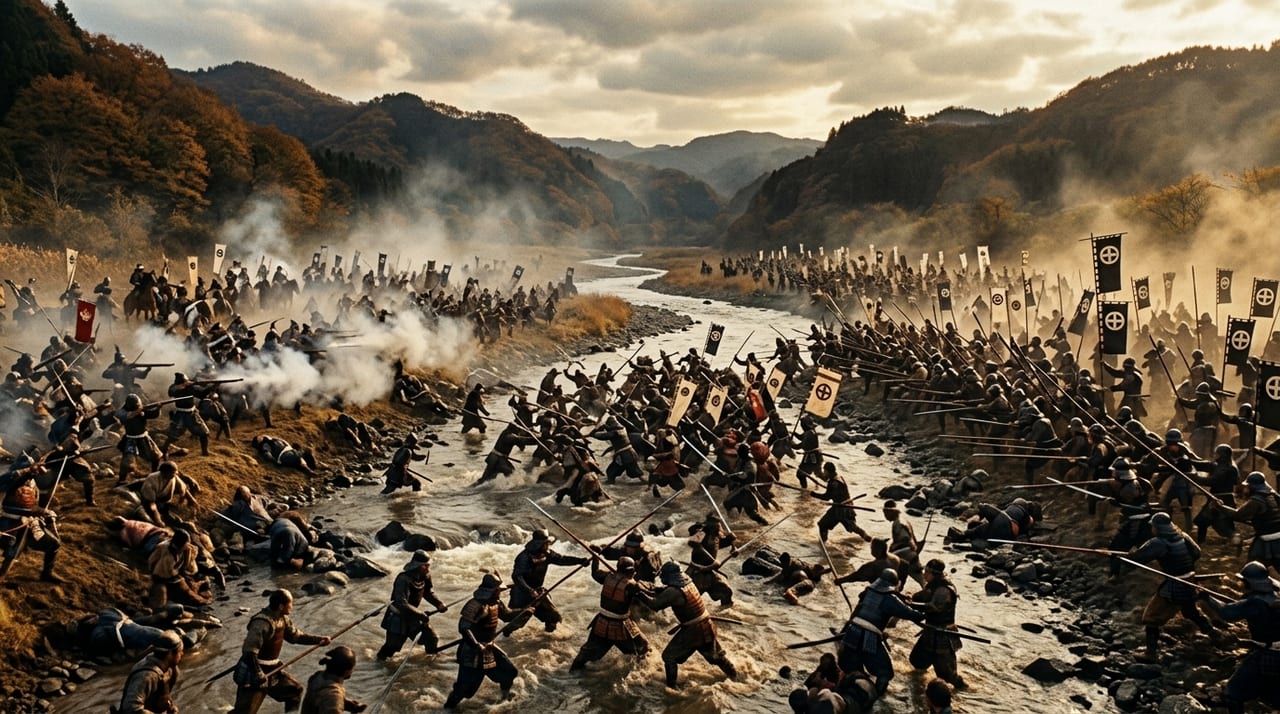
Takajō riverbank, Hyuga Province (present-day Kijō, Koyu District, Miyazaki Prefecture) and the Mimikawa River
Forces
Shimazu Forces
Otomo Forces
About 15 min read
In the 11th month of Tenshō 6 (1578), in Hyuga Province (present-day Miyazaki Prefecture) on Kyushu, the two great powers that defined Sengoku-era Kyushu, the Shimazu clan of Satsuma and the Otomo clan of Bungo, clashed head-on. Known as the "Battle of Mimikawa," this engagement ended in a decisive Shimazu victory and was a historic turning point that sharply upset the balance of the "Three Kingdoms of Kyushu" (the tripartite standoff of Shimazu, Otomo, and Ryūzōji). Because the decisive fighting took place on the riverbed of the Takajō River (Omaru River), it is also called the "Battle of Takajō River." The name "Battle of Mimikawa" took hold because the retreating Otomo army suffered catastrophic losses while crossing the Mimikawa River.
In the latter half of the 16th century, Kyushu was a land of rival domains, with three powers contending for supremacy: Otomo Sorin in the north, Shimazu Yoshihisa in the south, and Ryūzōji Takanobu in Hizen. Otomo Sorin (baptismal name Francisco) was known as a protector of Christianity and a patron of Portuguese trade, and he ruled a vast domain stretching from northern Kyushu into Bungo.
The Shimazu, meanwhile, had consolidated Satsuma and Ōsumi and extended their reach into Hyuga. Under Yoshihisa, they boasted a formidable army led by talented brothers, including Shimazu Yoshihiro, Shimazu Toshihisa, and Shimazu Iehisa. Shimazu Iehisa was especially known for his skill in field battle, a talent he later displayed in the defeat of Ryūzōji Takanobu at the Battle of Okitanawate (1584).
In Tenshō 5 (1577), the Shimazu drove Itō Yoshisuke out of Hyuga, and the Itō clan turned to Otomo Sorin for help. The following year, Sorin used the restoration of the Itō clan's former domains as his pretext and marched south into Hyuga with a great army. Sorin himself, however, did not take the front lines. He remained at Mushika (present-day Mushika, Nobeoka), behind the lines. Overall command was entrusted to Tawara Chikakata (Jōnin). Because he was a maternal relative rather than the most senior veteran of the house, his command left a lasting source of trouble for the cohesion of the Otomo army.
Facing the Otomo advance, the Shimazu front line was Takajō Castle (present-day Kijō, Miyazaki Prefecture). Its commander, Yamada Arinobu, together with Shimazu Iehisa and other reinforcements who had rushed to the castle, held out with a small force against the massive Otomo siege. The Otomo army made a frontal assault on Takajō Castle in Niiro-in but could not take it, and the front stalled.
During this time, Shimazu Yoshihisa led troops from Satsuma and Ōsumi northward, passed through Sadowara Castle, and took position at Neshirozaka, south of Takajō. Thus the stage was set: the main forces of the Otomo and Shimazu armies faced each other across the Takajō River.
After a preliminary skirmish, the decisive battle began on the morning of the 12th day of the 11th month of Tenshō 6 (1578) by the lunar calendar. On the Otomo side, no unified war council had been reached. Takita Shigekane and others crossed the river and began the attack almost on their own initiative, and the other units were dragged along behind them.
The Shimazu are said to have used their signature tactic, the "tsuri-nobuse." The central unit deliberately retreated to lure the enemy in (the "bait," tsuri), while units hidden on both flanks surrounded and annihilated them, a traditional Shimazu tactic. The Otomo army, which had crossed the river and pressed too deep, fell into the encirclement of the hidden troops. Under the fierce assault of Shimazu Yoshihiro and Iehisa, it collapsed completely.
The defeated Otomo army was driven north toward the Mimikawa River. Many soldiers and officers lost their lives, cut down while crossing the river or drowning in its waters. Otomo losses are said to have reached several thousand, making it one of the most disastrous defeats in the history of Sengoku battles.
What made the Battle of Mimikawa fatal for the Otomo clan was not simply the loss of troops, but the wholesale loss of the veteran commanders who had sustained the house. The principal dead were as follows.
- Takita Shigekane — a fierce warrior who opened the attack on the river crossing. Killed in the melee. - Saeki Korenori (Sōten) — a senior retainer who led the Bungo navy. Fell in battle along with his sons. - Yoshihiro Shigenobu — head of the Yoshihiro family, a distinguished commander and uncle of the later Tachibana Muneshige. - Saitō Shigezane — a long-serving senior vassal of the Otomo house and a brave commander who led the vanguard. - Tsunokuma Sekisō — the Otomo clan's gunbaisha (military diviner). He opposed this campaign and remonstrated against it, but his advice was not heeded. He is said to have gone to war with resolve and died in battle.
The end of the gunbaisha Tsunokuma Sekisō is also symbolic when considering the gunbai culture of the Sengoku period. A military diviner who read the astronomy and weather to judge whether a departure was auspicious perished alongside the house that pushed through a decision he had read as ill-omened. The Mimikawa was a battlefield where the spiritual culture of Sengoku warfare collapsed along with the army.
The Shimazu also cultivated a distinctive culture of swordsmanship. One of the wellsprings of the sword arts rooted in Satsuma was the "Taisha-ryū," and later the "Jigen-ryū" was established in Satsuma. Built on the principles of "strike first, win" and "kill with one blow," the Jigen-ryū was the prototype of the technique feared in the late Edo period with the saying "Dodge the first stroke of a Satsuma swordsman." Its spirit also resonates with the fierce charging spirit of the Shimazu army at the Mimikawa.
In terms of blades, the swords favored within the Shimazu house were the works of Satsuma smiths centered on the Naminohira school. Active from the late Heian period into the early Meiji era, the Naminohira school has the longest lineage of any sword-smithing school. Generation after generation, its smiths continued to make practical tachi and katana, inheriting the name "Yukiyasu," and these blades were worn at the hips of Shimazu samurai as they rode across the battlefields of Kyushu.
The Otomo house was keen on adopting firearms. It acquired the large cannon known as the kunikuzushi (a Portuguese breech-loading swivel gun), and it is said to have used several thousand firearms and the kunikuzushi in the siege of Takajō as well. Yet it was outmaneuvered by the Shimazu in open-field mobility and could not make use of its superiority in firepower. As the Battle of Nagashino (1575) showed, firearms are at their most valuable as weapons of defensive positions. The Otomo army, lured out and surrounded, had no battlefield on which to exploit that advantage.
Following the defeat at the Mimikawa, the power of Otomo Sorin plummeted rapidly. In the Otomo domains, which had lost their veteran commanders, local lords (kokujin) defected in succession, allowing Ryūzōji Takanobu of Hizen to expand. In Tenshō 14 (1586), Sorin met Toyotomi Hideyoshi at Osaka Castle to seek aid, and in the same year Shimazu forces invaded all the way into Bungo, the Otomo home province. This led to the Kyushu campaign of Tenshō 15 (1587). The Shimazu, who had at one point controlled nearly all of Kyushu, bowed to Hideyoshi's massive army and were pushed back to Satsuma, Ōsumi, and Morokata District of Hyuga.
The Otomo clan continued to exist under Toyotomi rule but never regained its former power. Sorin's son, Otomo Yoshimune, was stripped of his domain for his blunder in the Bunroku campaign, and the Otomo clan ended its history as a daimyo house.
The Battle of Mimikawa announced the dawn of the "age of the Shimazu" in the history of Kyushu. Even today, sites associated with the battle remain at the Takajō ruins and along the Mimikawa River basin in Miyazaki Prefecture. Where Otomo warriors fell, the swords of the Shimazu decided who would be the victors of history, a memory deeply engraved in Kyushu's warrior culture.
Shimazu Yoshihiro
Key Shimazu commander, primary architect of the Mimikawa victory
Shimazu Iehisa
Brother of Yoshihiro, brilliant tactician of the Shimazu clan
Ōtomo Sōrin
Otomo patron, Christian daimyo, declined after Mimikawa defeat
Toyotomi Hideyoshi
Later subjugated Shimazu in the 1587 Kyushu campaign
Chōsokabe Motochika
Contemporary Shikoku warlord whose campaigns paralleled Kyushu events