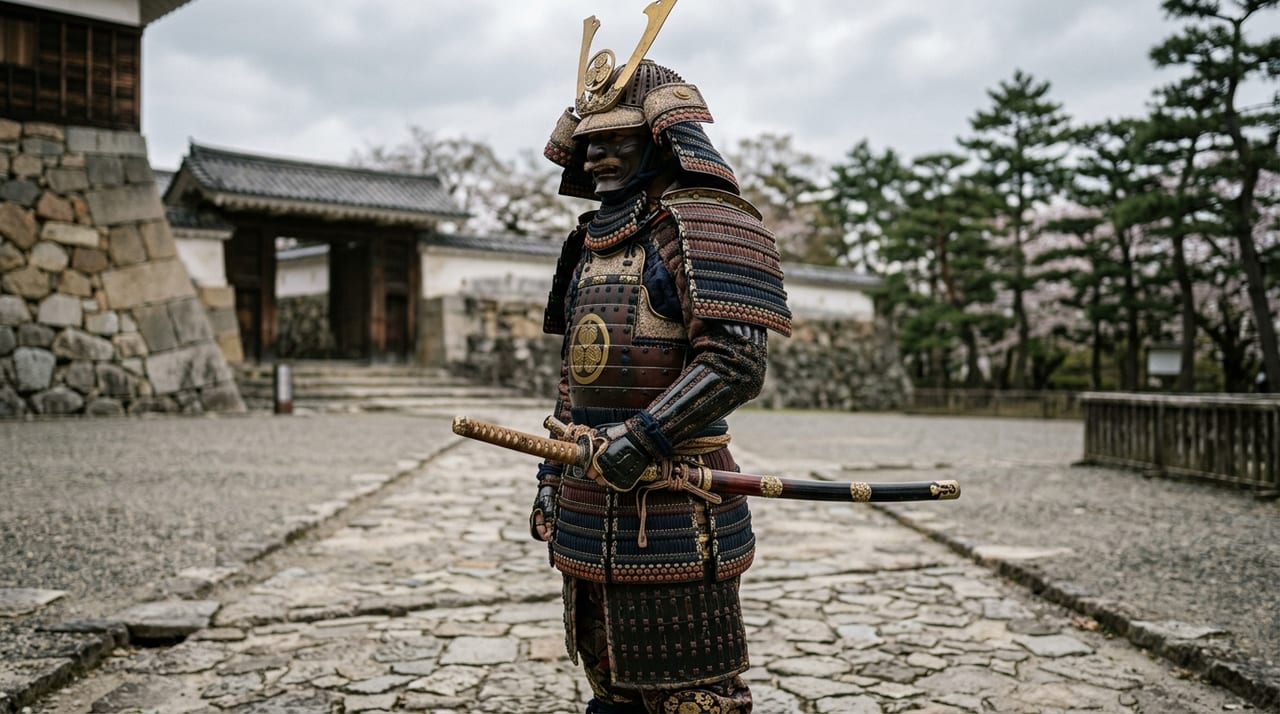
 * Image is for illustrative purposes only.
Ōtomo Sōrin
大友宗麟
The Christian Daimyō — The Sengoku Maverick Who Brought Western Culture and Firearms to Kyushu
- Era
- Sengoku Period
- Lifespan
- 1530-1587
Description
Ōtomo Sōrin, Lord of Kyushu
Ōtomo Sōrin (Yoshishige), born in Funai in Bungo Province (present-day Ōita City) in Kyōroku 3 (1530), was a Sengoku daimyō who built a vast domain in northern Kyushu, and is one of the most important daimyō in the history of Christianity in Japan. Having come into contact with Christianity through his meeting with Francis Xavier, Sōrin later became a Christian daimyō bearing the baptismal name 'Dom Francisco.' As an active embracer of Western civilization, including Nanban culture, Western medicine, and firearms, he occupies a distinctive position even within Sengoku history.
Firearms, Swords, and an Era of Transition
Sōrin's era was a fundamental turning point in Japan's weapons culture. Following the arrival of firearms in Tenbun 12 (1543), Sōrin was quick to recognize their military potential: he presented shogun Ashikaga Yoshiteru with firearms and gunpowder formulas, and he also asked missionaries to import saltpeter, the raw material of gunpowder. Furthermore, he obtained a cannon called 'Kunikuzushi' (a breech-loading Frankish cannon, furanki-hō), and his use of it at Nyūjima Castle (later Usuki Castle) in Tenshō 14 (1586) to defend the castle against the Shimazu army shows that Sōrin was an innovator who went beyond the framework of a merely traditional warlord. However, even in an age when the relative standing of swords began to decline with the spread of firearms, Sōrin deeply understood the cultural and spiritual value of the Japanese sword.
Swordsmiths of Bungo
Bungo Province, which Sōrin governed, was also a province with a lineage of swordsmiths stretching back to Sadahide and Yukihira, from the late Heian period through the Kamakura period.
Sōrin and Honebami Tōshirō
The sword most famously associated with Sōrin is 'Honebami Tōshirō,' said to be the work of Awataguchi Yoshimitsu. According to the Edo-period military chronicle 'Ōtomo Kōhaiki' and other sources, it was a sword that passed from the Ōtomo house to the Ashikaga shogunal house, where it was treasured. After it came into the hands of Matsunaga Hisahide in the Eiroku Incident, Sōrin bought it back, insisting that the Ōtomo house was its original owner. It was later presented to Toyotomi Hideyoshi by Sōrin's son, Ōtomo Yoshimune. It is currently designated an Important Cultural Property and is held by Toyokuni Shrine in Kyoto.
Defeat at the Battle of Mimikawa and Decline
At the Battle of Mimikawa in Tenshō 6 (1578), Sōrin suffered a crushing defeat at the hands of the Shimazu army, and the power of the Ōtomo house rapidly declined. This defeat also became a source of criticism of Sōrin's policies based on his Christian ideals, and it became a cause of friction with his retainers. In Tenshō 14 (1586), Sōrin had an audience with Toyotomi Hideyoshi at Osaka Castle and appealed for measures against the Shimazu. The following year, Tenshō 15 (1587), in the midst of Hideyoshi's Kyushu campaign, he died at Tsukumi in Bungo. His life was the story of one innovator who sought to fuse things that could not be reconciled: swords and firearms, and Japanese bushidō and the spirit of Christianity.
Notable Swords
- Honebami Tōshirō (a sword remade from a naginata, attributed to Awataguchi Yoshimitsu. After it fell into the hands of Matsunaga Hisahide in the Eiroku Incident, Sōrin is said to have bought it back; it was later presented by the Ōtomo family to Toyotomi Hideyoshi. Important Cultural Property, Toyokuni Shrine)