New Arrivals — Browse our catalog for the latest authentic Japanese sword arrivals. Browse →
May 4, 1584 (Tenshō 12/3/24)
Okitanawate, Hizen Province (near Kitamon-machi, Shimabara City, Nagasaki Prefecture)
Forces
Ryūzōji Forces
Shimazu-Arima Coalition
About 11 min read
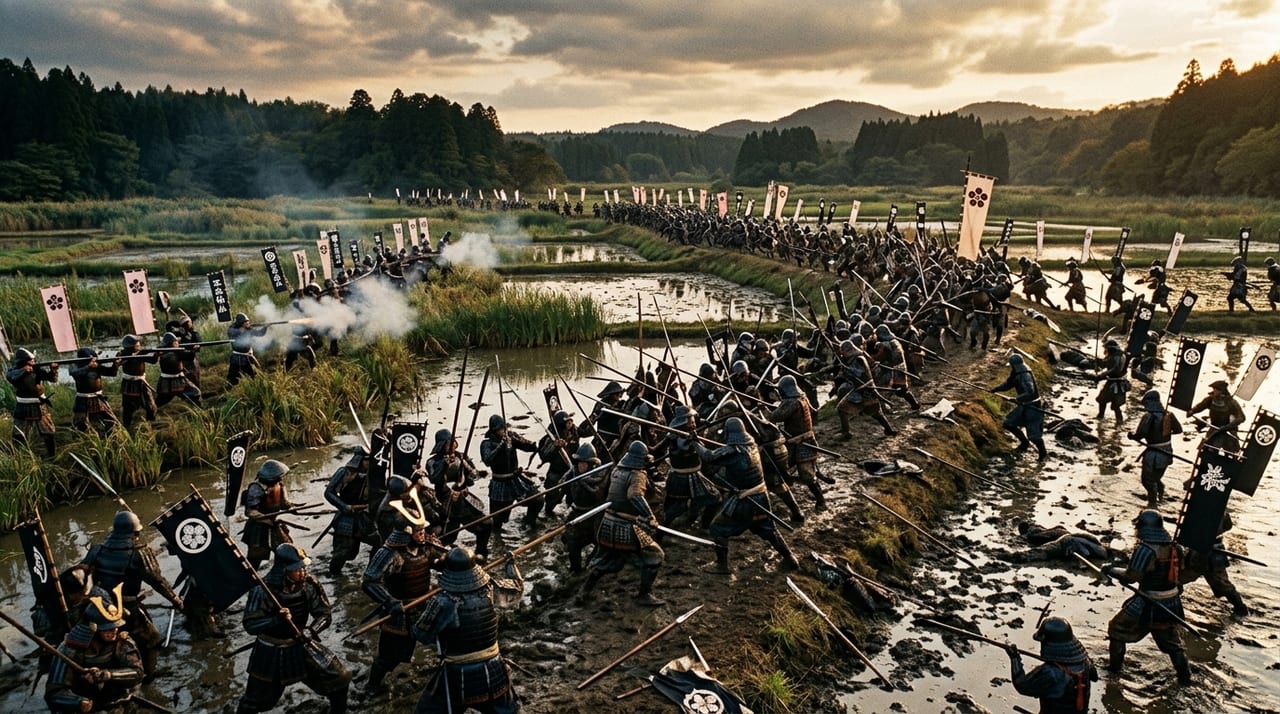
On May 4, 1584 (Tenshō 12/3/24), a decisive battle that would determine supremacy over Kyushu was fought on the narrow raised path through a marshland known as Okitanawate in Hizen Province. This battle, in which Ryūzōji Takanobu, feared as the "Bear of Hizen," was defeated by the skillful tactics of Shimazu Iehisa and killed in action, is an indispensable turning point in any account of the sword culture and military history of Sengoku-period Kyushu.
Ryūzōji Takanobu (1529–1584) was a Sengoku-period daimyō who ruled northern Kyushu from his base in Hizen Province (present-day Saga and Nagasaki Prefectures). Known as the "Bear of Hizen" and "Lord of Five Provinces and Two Islands," he occupied one of the three great powers of Kyushu, alongside Ōtomo Sōrin of Bungo and Shimazu Yoshihisa of Satsuma.
Takanobu's strength rested on a firm body of retainers and on tactics that made active use of firearms. In particular, he had a group of capable commanders led by Nabeshima Naoshige, and he deployed a wide range of tactics, from close combat with swords to long-range fighting with firearms.
Within Kyushu's sword culture, the Ryūzōji family held a distinctive position. The swordsmith the first-generation Tadayoshi (Hashimoto Shinzaemon), who would raise the reputation of Hizen-tō (Hizen swords), was born into a samurai family in the service of the Ryūzōji house. Having lost his grandfather and father in the Battle of Okitanawate, he turned to the craft of sword-making.
Shimazu Iehisa (1547–1587), who directed the Battle of Okitanawate, was a renowned general and the youngest of the Shimazu four brothers. Iehisa, whose record included crushing Ōtomo Sōrin's large army at the Battle of Mimikawa (1578), also deployed an unorthodox stratagem here to reverse an unfavorable situation.
Anticipating that the Ryūzōji army would advance in single file along the narrow raised path of Okitanawate, Iehisa made full use of the marshland terrain of the Shimabara Peninsula. On a narrow single road surrounded by marsh, the Ryūzōji's numerical superiority meant nothing. Iehisa concealed a unit of musketeers, and when the Ryūzōji forces became jammed on the narrow path, he threw them into confusion with a volley. Next, the ambush force and troops from the shore attacked the main Ryūzōji camp, and the disorganized Ryūzōji army was broken apart by sword attacks.
What stands out in this battle is the refinement of the Shimazu army's tactics, which combined firearms with swords. Firearms at long range disrupted the enemy's formation, and swords wielded at close range in hand-to-hand combat. This two-stage tactic was in contrast to the three-rank volley fire at Nagashino, which was a "denial of sword-based tactics." Instead, it "fused" sword tactics with firearms.
Ryūzōji Takanobu is said to have been unwell before the battle. In his later years, obesity prevented him from riding a horse, and according to a record he went to the battlefield in a palanquin (koshi). Nabeshima Naoshige (then Nobunari) urged him to draw the fight into a prolonged war of attrition, but Takanobu, who boasted an overwhelming force, did not heed this.
In the confusion of battle, Kawakami Tadakata of the Shimazu army approached Takanobu's palanquin and beheaded him. He died at the age of 56. The end of the "Bear of Hizen" took the humiliating form of a death inside his palanquin, yet it was also the pride of a warlord who never left the battlefield until the very end.
There is no concrete record of the sword Kawakami Tadakata is said to have used. However, the Satsuma-style swords used by Shimazu generals drew from the lineage of swordsmiths that preceded the "Satsuma shintō," known for their bold construction. The Shimazu house, which placed importance on actual combat, produced swords that were a typical example of "practical swords," prioritizing sharpness and strength over decoration.
After Ryūzōji Takanobu's death, the real power of the Ryūzōji house was seized by Nabeshima Naoshige, and it was eventually established as the Hizen Nabeshima domain. Within this change of regime, what deserves attention is the fate of Hizen's sword culture.
When the Edo period began, the swordsmith Tadayoshi (Hashimoto Tadayoshi) and his disciples in Hizen Province raised the name of Hizen-tō. The first-generation Tadayoshi, by Nabeshima command, studied with Umetada Myōju in Kyoto, and later received the title Musashi Daijō and changed his name to Tadahiro. The rise of Hizen-tō would have been impossible without the political stability of Hizen Province after the Battle of Okitanawate.
Shimazu's domination of Kyushu also took full shape after Okitanawate. After defeating the Ryūzōji, the Shimazu also pressured the Ōtomo clan and at one point came close to unifying all of Kyushu. However, with Toyotomi Hideyoshi's Kyushu Campaign (1587), the Shimazu surrendered, and Kyushu's sword culture was swept up in the wave of national unification.
The Battle of Okitanawate is a symbolic battle of Kyushu as "another Sengoku period." The Sengoku history of Kyushu, where the three powers of Hizen, Satsuma, and Bungo clashed, nurtured a unique sword culture different from the Sengoku history of the eastern provinces (Kantō and Tōhoku). The culmination of that culture is condensed on the battlefield of Okitanawate, and even today the land of Shimabara conveys that historical memory.
In the Shimabara Peninsula, where the Battle of Okitanawate took place, the history of the Ryūzōji and Shimazu battles continues to be passed down as local historical culture. In Kitamon-machi, Shimabara, a stone pillar marking the battlefield site stands.
Ryūzōji Takanobu, the "Bear of Hizen," became the loser, but from the land of Hizen that he governed, the sword culture of Hizen-tō was later born. While history tells the story of its victors, the Battle of Okitanawate teaches us that a rich culture of the defeated was blooming behind them.