New Arrivals — Browse our catalog for the latest authentic Japanese sword arrivals. Browse →
November 3, 1577 (23rd day, 9th month, Tenshō 5)
Tedorigawa River, Kaga Province (present-day Hakusan City to Nomi City, Ishikawa Prefecture)
Forces
Uesugi Kenshin's Forces
Oda Forces (Shibata Katsuie and others)
About 10 min read
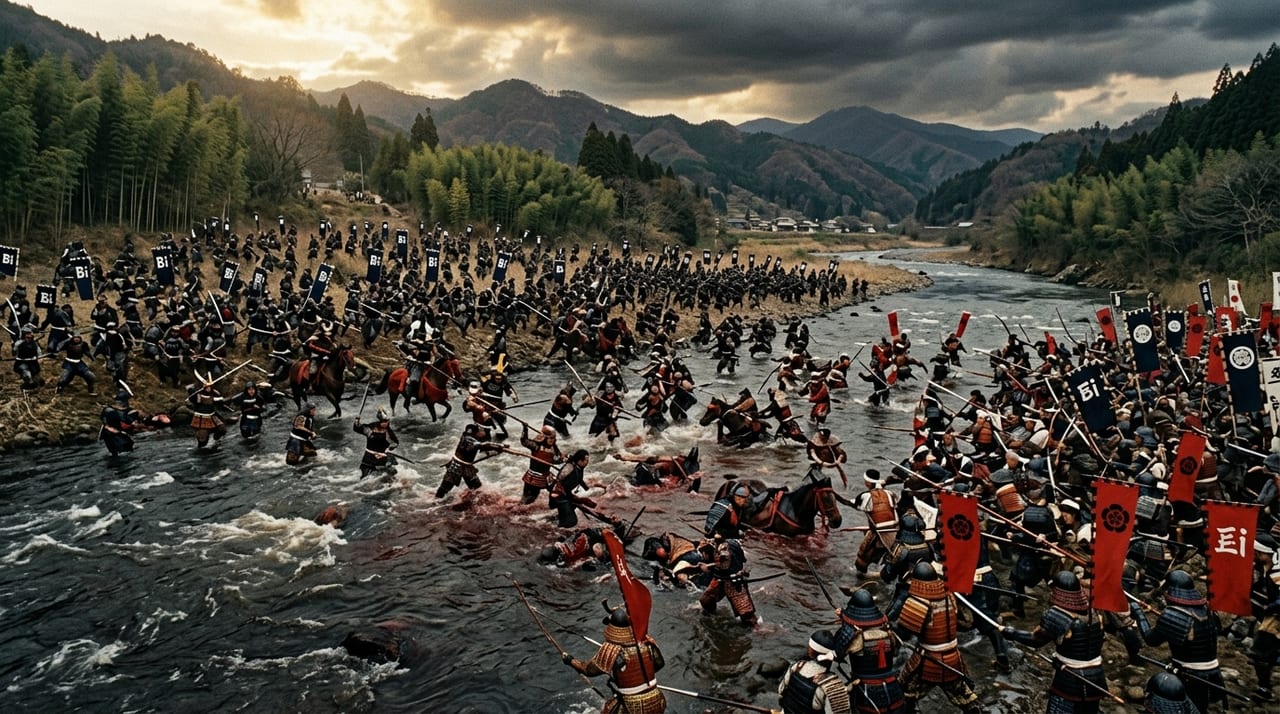
On 3 November 1577 (Julian calendar; the 23rd day of the 9th month of Tenshō 5), at the Tedorigawa River in Kaga Province (present-day area from Hakusan to Nomi, Ishikawa Prefecture), the Echigo army led by Uesugi Kenshin reportedly defeated the great army of Oda Nobunaga. This Battle of Tedorigawa was a great victory in Kenshin's last large-scale battle, and it was also the moment when the martial power of Kenshin, praised as the "Dragon of Echigo" and "God of War," reached its peak.
At the time, Nobunaga had to deal with three fronts in the course of unifying the realm: the western provinces (the Mōri clan), the eastern provinces (the Takeda clan), and Hokuriku (the Uesugi clan). That Uesugi Kenshin, a formidable enemy, applied pressure from Hokuriku and that Nobunaga suffered a crushing defeat at Tedorigawa would surely have heightened his sense of crisis. However, in the 3rd month of the following year (1578), Kenshin died suddenly. This "what if" of history, namely how the unification of Japan would have changed had Kenshin lived, continues to be told as an eternal mystery.
In 1576 (Tenshō 4), Uesugi Kenshin received requests from Ishiyama Hongan-ji and the Mōri clan to join the alliance encircling Nobunaga, and he settled on the intention to march on Kyoto (jōraku). That year, Kenshin led more than 20,000 troops into Noto and besieged the Hatakeyama clan's Nanao Castle.
Nanao Castle was the Hatakeyama clan's stronghold in Noto. Responding to a request for relief from Chō Tsugutsura, a senior retainer of the Hatakeyama side holding the castle, Nobunaga sent a large army of about 40,000 men into Hokuriku. Shibata Katsuie was its commander-in-chief, and Hashiba Hideyoshi, Takigawa Kazumasu, and Maeda Toshiie joined as leading generals. However, on the 15th day of the 9th month of Tenshō 5 (1577), Nanao Castle (in present-day Nanao, Ishikawa Prefecture) fell due to an inside betrayal by a pro-Uesugi faction within the castle.
The Oda army that had advanced into Kaga Province crossed the Tedorigawa River without knowing that Nanao Castle had fallen. Shibata Katsuie learned of the fall of the castle and of Kenshin's entry into Matto Castle only after the crossing was complete, and he ordered a retreat. However, on the night of the 23rd day of the 9th month, during that retreat, the army was pursued by about 8,000 Uesugi troops led by Kenshin himself.
There is no army more vulnerable than one that retreats with a river at its back. The Oda army suffered more than 1,000 killed and wounded, and it reportedly also suffered many drowning deaths in the swollen Tedorigawa. However, the "Shinchō Kōki" (Chronicle of Lord Nobunaga) contains no account of this battle, and the scale of the fighting is debated.
Shibata Katsuie and the others barely managed to withdraw, but the Oda losses were heavy. Hashiba Hideyoshi, moreover, had left his camp without permission before the battle, in conflict with Katsuie.
Several traditions concern the swords used by Uesugi Kenshin. Kenshin is counted among the strongest warlords of the Sengoku period alongside Takeda Shingen, and interest in the swords he used never wanes.
Two swords are especially famous as Kenshin's favorites: the "Kenshin Kagemitsu" and the "Sanchōmō" (also read Yamatorige). The Kenshin Kagemitsu is held by the Saitama Prefectural Museum of History and Folklore, and the Sanchōmō is held in Okayama Prefecture (Bizen Osafune Sword Museum). Both are known as famous swords associated with Uesugi Kenshin.
The "Kenshin Kagemitsu" is a superior tantō from the late Kamakura period, made by Kagemitsu, a renowned smith of Bizen Osafune. It is called the "Kenshin Kagemitsu" because Kenshin favored it. The Sanchōmō is unsigned, yet is said to be a work of the Fukuoka Ichimonji school of Bizen. Its name is reportedly derived from its richly varied hamon (temper line), which appears to bristle like the feathers of a mountain bird. Both are regarded as among the pinnacles of Japanese swords, and both are designated National Treasures today.
Kenshin regarded swords not merely as weapons but as sacred implements under the protection of Bishamonten. For Kenshin, who flew the "bi" banner and believed himself an incarnation of Bishamonten, the sword embodied the bond between gods and Buddhas and the samurai.
On the 9th day of the 3rd month of Tenshō 6 (1578), the year after the Tedorigawa victory, Uesugi Kenshin suddenly collapsed at Kasugayama Castle (present-day Jōetsu, Niigata Prefecture), and he died on the 13th day of the 3rd month of Tenshō 6 (1578). He was 49 years old. The cause of death is presumed to have been a stroke (cerebral hemorrhage).
Kenshin's death gave rise to a "what if" in history. Had Kenshin lived, and had he, having subdued Hokuriku, struck at Nobunaga's rear, the history of Japan's unification might have taken a completely different course. In fact, had Kenshin still been alive the year after the Tedorigawa battle, Nobunaga would have been driven into the worst situation, pincered from the east, west, and north.
After Kenshin's death, the Uesugi family split over a succession dispute, the Otate Disturbance (Otate no Ran, 1578–1579). Uesugi Kagekatsu emerged victorious, but the internal strife greatly weakened the military strength Kenshin had built up. For Nobunaga, Kenshin's sudden death was a heaven-sent blessing.
The Battle of Tedorigawa was the moment that most endangered Nobunaga's unification of the realm, and it will long be told as a battle that shone with the last glimmer of the age of the Japanese sword and the samurai.
Oda Nobunaga
Oda Nobunaga, whose army was devastated at Tedorigawa — Kenshin's greatest rival
Shibata Katsuie
Shibata Katsuie — Oda's senior general who was routed at Tedorigawa
Toyotomi Hideyoshi
Hashiba Hideyoshi, present at Tedorigawa; later escaped the threat of Kenshin's death
Uesugi Kenshin
Uesugi Kenshin — commander at Tedorigawa; the Dragon of Echigo who shattered Nobunaga's army
Maeda Toshiie
Maeda Toshiie, present at Tedorigawa; later established the Kaga domain