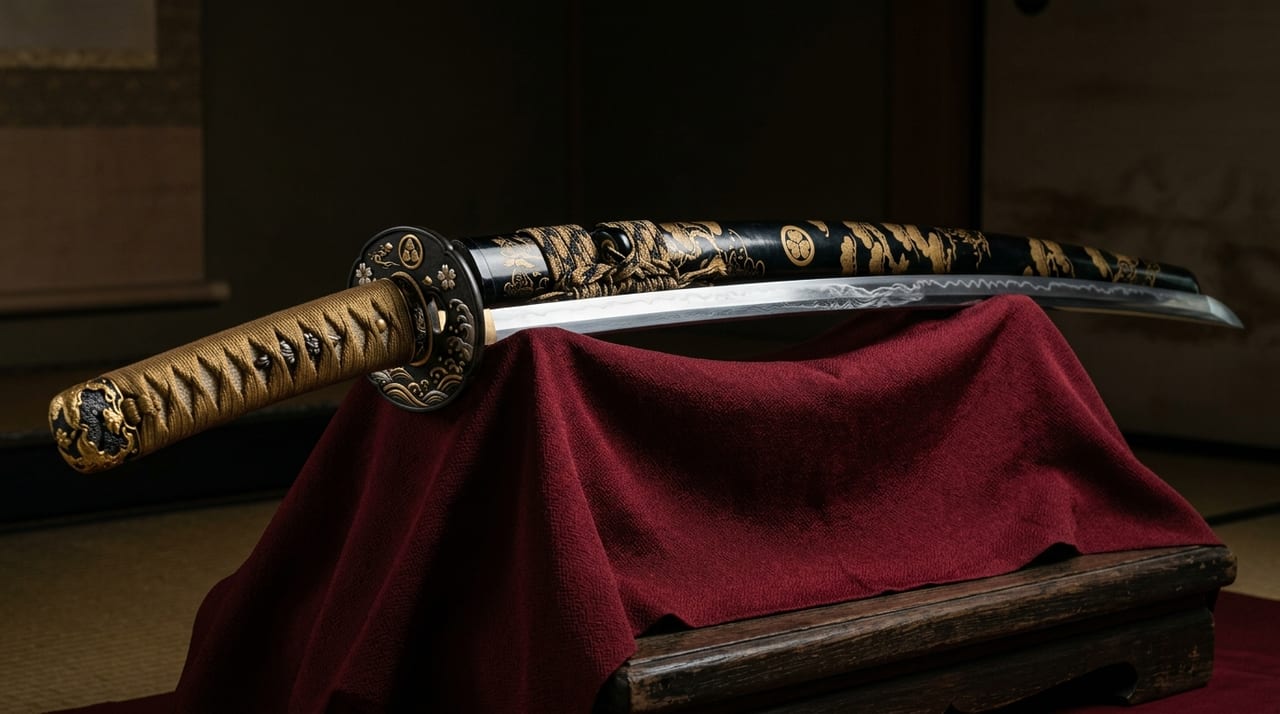
 * Image is for illustrative purposes only.
Uesugi Kenshin's Beloved Swords (Kenshin Kagemitsu / Sanchōmō)
上杉謙信の愛刀群(謙信景光・山鳥毛)
Also known as: Sanchōmō Ichimonji
Description
Uesugi Kenshin and Swords — The Symbol of the War God's Martial Power
Uesugi Kenshin (1530-1578) is a warlord who carved an immortal name into Japanese history as the "strongest warlord of the Sengoku period," the "Dragon of Echigo," and the "God of War" (gunshin). Within his military career and spiritual world, swords held a special meaning. Kenshin claimed to be an incarnation of Bishamonten and held a unique war philosophy that treated war not as a "war for profit" but as a "war for righteousness" (gi). The most symbolic material expression of this spiritual world, in which faith and military power fused, is the group of famous swords Kenshin loved. Kenshin's collection included several famous swords, among them the "Sanchōmō (also read Yamatorige) Ichimonji" and the "Kenshin Kagemitsu," which were passed down through generations of the Uesugi family as treasured heirlooms after his death. Today, the Sanchōmō is held by the Setouchi City Bizen Osafune Sword Museum in Setouchi City, and the Kenshin Kagemitsu is held by the Saitama Prefectural Museum of History and Folklore.
Sanchōmō Ichimonji — A Sword Treasured by the Uesugi Family
Among Uesugi Kenshin's beloved swords, the one that receives the highest acclaim is the Ichimonji long sword known as "Sanchōmō." The Sanchōmō is a National Treasure long sword said to have been made in the mid-Kamakura period by a smith of the Fukuoka Ichimonji school. It was given the name "Sanchōmō" because its complex and beautiful hamon (temper line) turmoil in the Ichimonji style is said to resemble the pattern of mountain bird feathers. The hamon includes jūka-chōji and is a large chōji midare that reaches the shinogi (ridgeline), clearly showing the flamboyant style of the Ichimonji school. The Sanchōmō is currently held by the Setouchi City Bizen Osafune Sword Museum in Setouchi City. The circumstances of its acquisition were widely reported as a contemporary news story raising the question of "balancing the regional attribution of cultural property with its economic value."
Kenshin Kagemitsu and the Legend of the Single Combat at Kawanakajima
Among the stories about swords connected to Uesugi Kenshin, the most famous is the short sword by Osafune Kagemitsu, known as the Kenshin Kagemitsu, which was Kenshin's personal sword. Kagemitsu (late Kamakura period) was a master smith of the Bizen Osafune school. This short sword bears the date Genkō 3 (1323), and according to the Uesugi family's sword register, it is listed as the companion short blade (sashizoe) to the Himetsuru Ichimonji that Kenshin always used. The short sword is currently held by the Saitama Prefectural Museum of History and Folklore and designated as a National Treasure. Also, in the Battle of Kawanakajima between Kenshin and Takeda Shingen, there is a famous anecdote that Kenshin rode alone into Shingen's headquarters and swung his sword (Shingen is said to have blocked it with his gunbai (war fan)). The sword Kenshin wielded in this single combat is said to have been the Azuki Nagamitsu. It has been passed down as one of the most dramatic legends of a famous sword being used in the moment, in Japanese sword culture. However, the historical authenticity of the single-combat anecdote at Kawanakajima is debated. While it remains within the realm of tradition, the narrative power of the combination "Kenshin, the war god's sword" continues to shine uniquely in Japanese sword culture.
The Formation and Transmission of the Uesugi Family's Sword Collection
The sword collection formed by Uesugi Kenshin was inherited by his adopted son, Uesugi Kagekatsu, and passed down throughout the Edo period as treasured heirlooms of the Uesugi family. Even after the family was transferred to the Yonezawa Domain (present-day Yonezawa, Yamagata Prefecture), the Uesugi family continued to maintain this collection as a family treasure. Even in the turbulent times of the late Edo period and the Meiji Restoration, the Uesugi family continued to protect important swords. The famous swords handed down in the Uesugi family were, from the modern era onward, divided among museums across the country and passed on there. The famous swords that Uesugi Kenshin, the "strongest warlord of the Sengoku period," selected with care have been granted the special authority of "a war god's aesthetic judgment," and interest in swords associated with Kenshin's name remains as high today as ever.
The War of Righteousness — Kenshin's War Philosophy and the Spirit of Swords
The most distinctive feature of Uesugi Kenshin was his unique war philosophy of rejecting wars for profit and fighting only wars for righteousness. The tradition behind the saying "to send salt to one's enemy," in which he is said to have sent salt to Takeda Shingen while the Imagawa and Hōjō were cutting off its supply, is the most famous expression of Kenshin's belief that "true strength comes from compassion and justice." Within this philosophy of righteousness, the swords Kenshin loved, especially supreme famous swords such as the Sanchōmō, held special religious and philosophical significance as "tools for the practice of righteousness" and "means of realizing the will of Bishamonten on earth." For Kenshin, the sword was not a "tool for killing and injuring" but "a material embodiment of the spirit of righteousness." This interpretation of the "spiritualization of the sword" holds an important place in the spiritual history of Japanese sword culture, as a precursor to the later ideology of bushidō (the way of the warrior).
The Cultural Significance of the Sanchōmō Today
After the modern era, the Sanchōmō left the Uesugi family, passed through private collections, and was deposited at the Okayama Prefectural Museum. In 2016, Jōetsu City (Niigata Prefecture) indicated a policy of purchasing it, and a citizens' council also moved to raise funds. However, they could not agree on a price with the owner, and they gave up on the purchase in 2017. Afterward, Setouchi City in Okayama Prefecture, the former home of the Fukuoka Ichimonji school, moved to acquire it. It collected funds for the purchase price through donations under the furusato nōzei (hometown tax donation) program (crowdfunding), achieved the acquisition in 2020, and it is now on public display at the Setouchi City Bizen Osafune Sword Museum. This controversy over the attribution of the Sanchōmō as cultural property sharply raises the contemporary question of where ownership should belong for a sword that is deeply tied to a specific historical figure and region. It brought to the surface, as a nationwide debate, the complex issue in Japan's cultural property policy of balancing regional cultural identity with economic reality. The fact that a single National Treasure sword still attracts great social interest today as a "symbol of regional pride and historical memory" is one of the clearest examples of how the Japanese sword continues to live on in contemporary society as the "core of historical and cultural identity," beyond being merely an art object.
Legends & Stories
The Duel at Kawanakajima: Japan's Greatest Sword Legend
Among the battles between Uesugi Kenshin and Takeda Shingen, the most dramatically told episode is the legendary 'duel' at the Battle of Kawanakajima in Eiroku 4 (1561). Kenshin rode alone into Shingen's main camp and, from horseback, swung his tachi down at Shingen. Shingen is said to have blocked the blow three times with his gunbai (war fan) and narrowly escaped. There are several traditions about the tachi Kenshin wielded in this duel, but the best known holds that it was Azuki Nagamitsu. Today's historians are skeptical about whether the duel is confirmed as historical fact, but the narrative of 'the god of war Kenshin challenging a hero of the age with the finest sword' is still told as the most typical expression of the theme of 'the inseparable bond between heroes and famous swords' in Japanese sword culture. The power of this duel legend goes beyond the confirmation of facts. The pairing of Kenshin, Shingen and Kawanakajima has become established, in Japanese pop culture (manga, games, film) too, as one of the greatest heroic moments in Japanese history, repeatedly recreated.
Bishamonten Faith and the Religious Significance of the War God's Sword
That Uesugi Kenshin considered himself an incarnation of Bishamonten and fought under a war banner bearing the 'bi' character is one of the most famous facts revealing Kenshin's religious worldview. Bishamonten is another name for Tamonten, one of the Four Heavenly Kings of Buddhism. He guards the north, governs treasure and martial strength, and is one of the Buddhist guardian deities most venerated in warrior society as a god of war. If Kenshin had deep faith in Bishamonten and understood himself as 'Bishamonten appearing in human form,' then his favorite sword was 'the sword of Bishamonten' and an embodiment of the religious conviction that 'the will of the divine is realized in the world through a concrete material object (the sword).' Within this religious narrative of 'the divine sword wielded by an incarnate god,' the national treasure tachi Sanchōmō Ichimonji (also read Yamatorige) carries the significance of a 'mythic and religious sacred relic' beyond a mere art object, and wears an eternal story together with Kenshin's name.
Righteousness, Salt, and the Philosophy of the Sword
The episode behind the Japanese proverb 'to send salt to one's enemy' most directly shows the core of Kenshin's war philosophy. When Imagawa Ujizane allied with Hōjō Ujiyasu to halt the shipment of salt into Takeda territory, Kenshin sent salt to the Takeda, saying that battles are won by strategy, not by rice and salt. This choice, which prioritized 'practicing righteousness' over gaining strategic advantage by 'causing the enemy suffering,' shows that Kenshin understood war as a 'moral act.' Within this philosophy of righteousness, Kenshin's swords functioned not as 'tools for killing' but as 'tools for protecting and realizing the spirit of righteousness.' His view of the sword, as the purest precursor of the bushidō idea that 'the sword is a means of realizing justice,' had a great influence on later generations. The fact that Sanchōmō, the finest famous sword, was in the hands of Kenshin, 'the warlord of righteousness,' gives this sword an 'ethical and spiritual story' beyond its 'artistic value.' Even today, appreciating Sanchōmō retains special significance as 'a dialogue with the highest expression of the Japanese martial spirit.'
The Uesugi Museum and Modern Legends of Kenshin
Today the Uesugi Museum in Yonezawa City, Yamagata Prefecture, holds a vast collection of cultural properties associated with Uesugi Kenshin, Uesugi Kagekatsu, Naoe Kanetsugu and others. The National Treasure Sanchōmō left the Uesugi family after the war and passed to a private collector. In 2020 it was acquired by Setouchi City, Okayama Prefecture, and is now held and displayed at the Setouchi City Bizen Osafune Sword Museum. Yonezawa City places Kenshin's memory at the core of its regional identity as 'the castle town of the Uesugi,' and continues to use the heritage of the hero Uesugi Kenshin in modern times as a regional brand of 'the spirit of righteousness.' The fact that in 2016–2017 it was Jōetsu City, the home base of Kenshin where Echigo Kasugayama Castle stands, rather than Yonezawa City, that moved to purchase the sword, shows that for the hero Kenshin the bond with Echigo (Niigata Prefecture) as 'the god of war of Echigo' feels stronger than the bond with Yonezawa as the seat of the Uesugi family's domain lords. The fact that a single tachi continues to stir up serious debate about regional identity and pride even today is the clearest evidence of the vitality that Japanese swords retain in modern society as the 'material core of historical memory.'