New Arrivals — Browse our catalog for the latest authentic Japanese sword arrivals. Browse →
May 19, 1546 (20th day, 4th month, Tenbun 15)
Kawagoe, Musashi Province (present-day Kawagoe City, Saitama Prefecture)
Forces
Hōjō Ujiyasu (Relief Forces)
Coalition of Uesugi Tomosada and Ashikaga Haruuji
About 11 min read
On the night of the 20th day of the 4th month of Tenbun 15 (1546) (May 19 in the Julian calendar), the 'Night Battle of Kawagoe' was fought around Kawagoe in Musashi Province (present-day Kawagoe City, Saitama Prefecture). Together with the Battle of Okehazama (1560) and the Battle of Itsukushima (1555), it is known as one of the 'three great surprise attacks of the Sengoku period,' a legendary battle. According to war chronicles, Hōjō Ujiyasu carried out a night surprise attack with only 8,000 troops to relieve Kawagoe Castle, which was surrounded by a massive army of 80,000, and defeated an enemy ten times as large in number. This victory established Hōjō supremacy in Kantō and greatly shifted the course of Sengoku-period Kantō history, leading to the later conflict with Uesugi Kenshin.
The Later Hōjō clan had steadily expanded its power in Kantō since Ise Moritoki (Hōjō Sōun) seized Odawara Castle in 1495 (Meiō 4). In the time of Hōjō Ujitsuna (the second head) and Hōjō Ujiyasu (the third head), it had built a firm power base centered on Musashi, Sagami and Izu provinces.
However, in 1545 (Tenbun 14), Uesugi Tomosada of the Ōgigayatsu Uesugi clan joined with Uesugi Norimasa of the Yamanouchi Uesugi clan, the Kantō Kanrei, and with Ashikaga Haruuji of the Koga kubō, to lay siege to Kawagoe Castle. Kawagoe Castle was a key stronghold for Hōjō control of Kantō, and its fall would have fundamentally shaken Hōjō supremacy in Kantō.
An army said to number about 80,000 surrounded Kawagoe Castle, and a long siege lasting more than half a year continued. Inside the castle, Hōjō Tsunashige (Ujiyasu's brother-in-law) defended it stubbornly even as its food supplies nearly ran out, but the limit was close.
Ujiyasu's available force was about 8,000. The besieging army numbered about 80,000, a difference of more than tenfold. Winning a conventional pitched battle was impossible.
To overturn this absolute disadvantage, Ujiyasu chose the tactic of the 'night surprise attack.' Sengoku-period armies tended to be defenseless at night. By striking during the hours of eating, sleeping and relaxing, the advantage of numbers could be temporarily neutralized.
Ujiyasu first sent envoys to make peace, convincing the enemy that the Hōjō had entered surrender negotiations. Having lulled them into complacency, he launched a lightning attack at night. The shift from this 'false peace' to 'surprise attack' was the greatest tactical masterstroke of the Night Battle of Kawagoe.
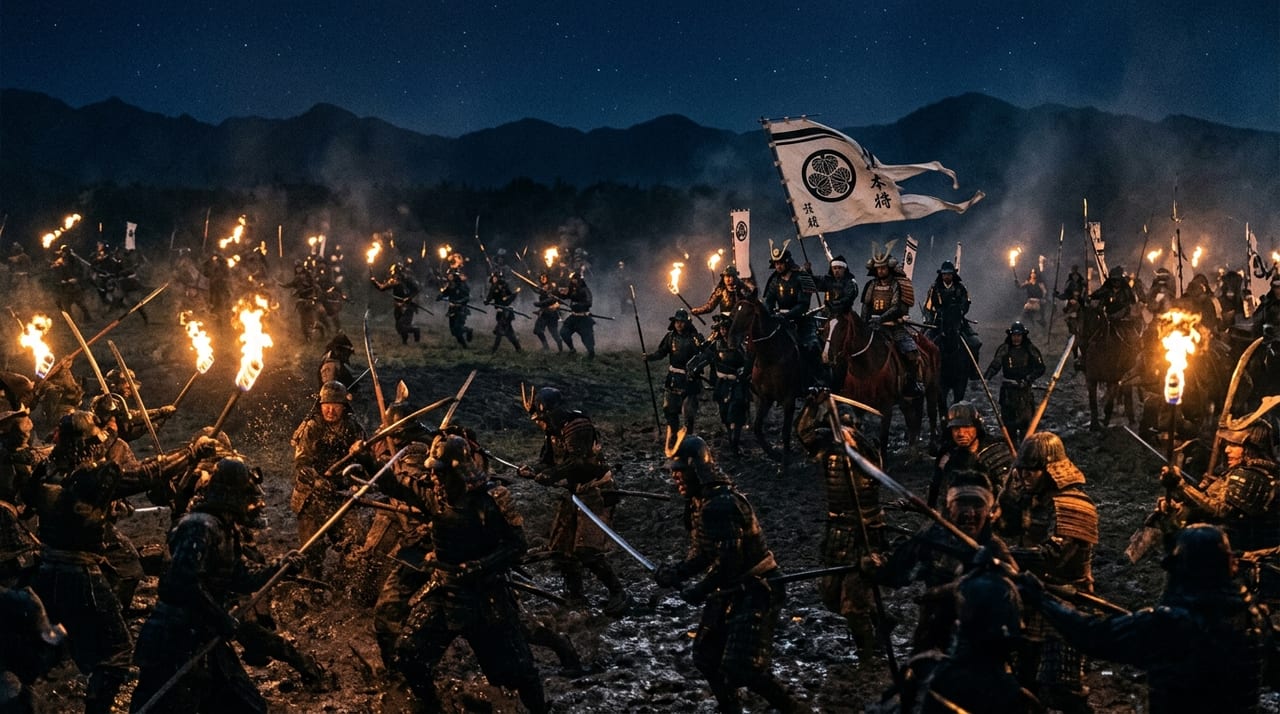
In the depths of the night of the 20th day of the 4th month of Tenbun 15 (1546), Ujiyasu divided his army into four units. Coordinating with Tsunashige inside the castle, he charged into the enemy encampments. The enemy, caught off guard by the attack in the darkness, fell into great confusion.
In a chaotic night battle, close combat, meaning white-blade fighting with swords and spears, rather than archery became the main form of fighting. The 8,000 elite Hōjō troops charged into the enemy encampments. The 80,000-strong combined army, which should have overwhelmed them with numbers, could not use its numbers in individual blade-to-blade combat and was defeated piece by piece.
Uesugi Tomosada was killed in the chaos of the fighting. Uesugi Norimasa escaped the great confusion and fled to Hirai Castle in Kōzuke Province. Ashikaga Haruuji was also routed and later surrendered to the Hōjō. In a single night's surprise attack, the siege that had lasted more than half a year was lifted, and the political map of Kantō was redrawn.
In night surprise battles like the Night Battle of Kawagoe, the Japanese sword became the most important weapon. Arrows cannot be replenished once they run out, and they are hard to aim at night. Firearms (matchlock guns) were also unsuited to a night surprise attack. Close combat dominated night battles, making it 'a battlefield where the true worth of the sword is displayed.'
The swords of the Sengoku period differed from the tachi of the Heian to Kamakura periods, and this was an age when the uchigatana was becoming mainstream. The uchigatana was worn edge-up, thrust through the belt at the waist, which made it easy to draw and suited fighting on foot and in melees. In disorderly, close-quarters fighting like the Night Battle of Kawagoe, the advantages of the uchigatana were fully displayed.
Clear historical records of the swords Ujiyasu is said to have used are scarce. However, the Hōjō had deep ties to swordsmiths in Sagami Province (present-day Kanagawa Prefecture) and Musashi (present-day Tokyo and Saitama), and it is presumed that they possessed many practical uchigatana made by swordsmiths from the regions around Kantō.
Uesugi Norimasa, defeated in the Night Battle of Kawagoe, retreated to Hirai Castle in Kōzuke Province. In Tenbun 21 (1552), however, he was driven out of Hirai Castle and later sought refuge with Nagao Kagetora (later Uesugi Kenshin) of Echigo Province. In Eiroku 4 (1561), Kagetora was to receive the Uesugi family name and the post of Kantō Kanrei from Norimasa.
The decades-long struggle for supremacy over Kantō between Uesugi Kenshin and Hōjō Ujiyasu was a direct result of the Hōjō victory at the Night Battle of Kawagoe. Kenshin, who clashed with Takeda Shingen at the Battle of Kawanakajima, also repeatedly sent troops into Kantō alongside his campaigns against the Hōjō. The Sengoku history of Kantō cannot be told without the turning point of the Night Battle of Kawagoe.
Furthermore, after Ujiyasu established control over Kantō centered on Odawara, the Hōjō continued to reign as the largest Sengoku daimyō in Kantō until the final stage carried out by Toyotomi Hideyoshi, the 'Odawara campaign (1590).' The significance of the Night Battle of Kawagoe in the Sengoku history of Kantō goes beyond a mere successful surprise attack: it was an epoch-making turning point.
Hōjō Sōun
Hōjō Sōun — founder of the Hōjō clan, grandfather of Ujiyasu, who laid the foundation for Kantō expansion
Hōjō Ujiyasu
Hōjō Ujiyasu — commander of the night battle who established Hōjō supremacy over the Kantō
Uesugi Kenshin
Uesugi Kenshin inherited the Uesugi cause after Kawagoe and fought Ujiyasu — the rivalry born from this battle
Uesugi Kagekatsu
Later Uesugi clan head; inheritor of the Uesugi-Hōjō rivalry born at Kawagoe