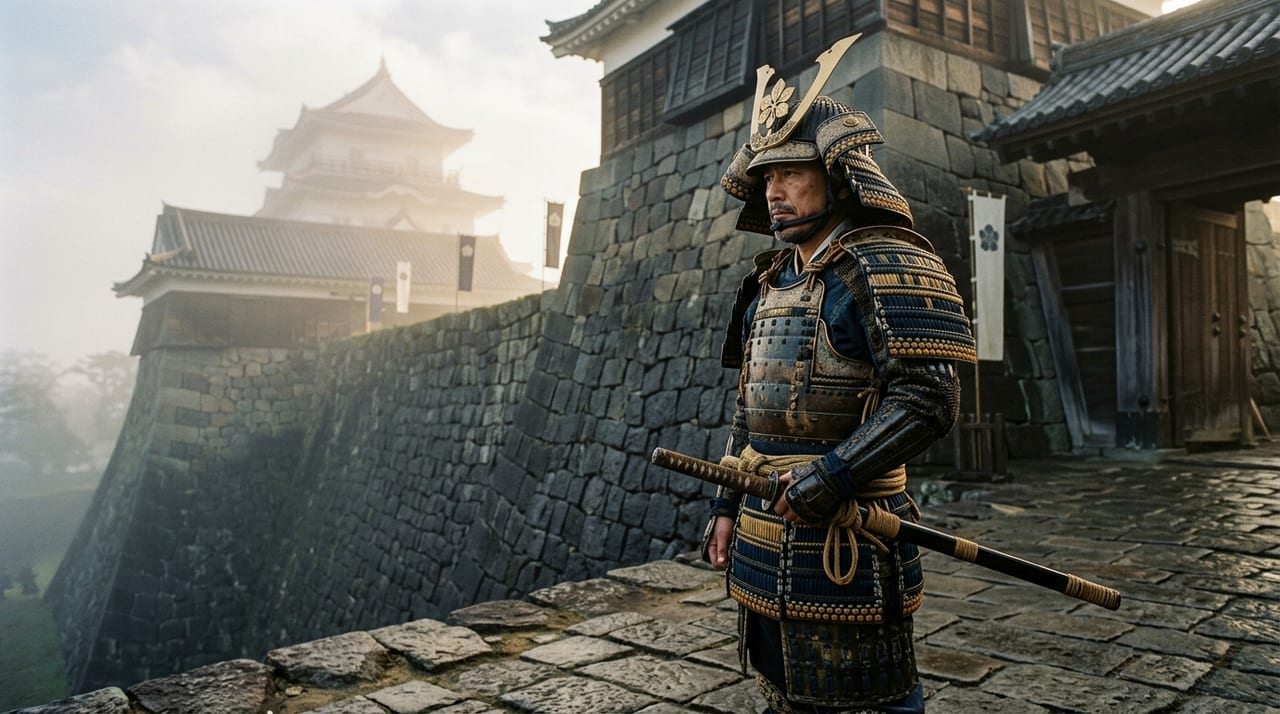
 * Image is for illustrative purposes only.
Hōjō Sōun
北条早雲
The First Sengoku Daimyō
Description
The Dawn of the Sengoku Period
Ise Sōzui (later known as Hōjō Sōun), born into the Bitchū branch of the Ise clan in either 1432 (Eikyō 4) or 1456 (Kōshō 2; the latter is considered more likely in recent years), holds a special place in Japanese history as the 'first sengoku daimyō.' After serving the Muromachi shogunate in Kyoto as a mōshitsugi-shū and hōkōshū, he rose to prominence by taking advantage of the internal strife within the Imagawa house. In 1493 (Meiō 2) he invaded Izu Province and eventually pacified it. Later historians have evaluated this event as the 'harbinger of the Sengoku period,' heralding the opening of the age of gekokujō, in which the realm was contested through a meritocratic approach that disregarded lineage and family status.
Pacification of Izu and Sagami
Having gained control of Izu, Sōun next advanced into Sagami Province. He is said to have seized Odawara Castle in 1495 (Meiō 4), although there are differing theories about the timing. In 1516 (Eishō 13) he destroyed the Miura clan and pacified all of Sagami. Sōun's strategic talent was not limited to conquest by force alone. He was also outstanding in the art of governance for winning the hearts of the people, such as setting the annual tax in Izu at 40 percent (shikō-rokumin). This became the starting point of the governance that produced the benevolent rule of the five generations of the Later Hōjō clan.
Nikkō Ichimonji and the Swordsmiths of Sōshū
The best-known sword associated with Sōun is the National Treasure 'Nikkō Ichimonji.' It is said that Sōun acquired a tachi that had been dedicated at Nikkō Futarasan, and from then on it was treated as a treasured sword of the Hōjō family. When Odawara surrendered in 1590 (Tenshō 18), Hōjō Ujinao presented it to Kuroda Josui as thanks for mediating the surrender. It is now held by the Fukuoka City Museum. In addition, the Kantō region has a lineage of swordsmiths of the Sōshū-den tradition dating back to the Kamakura period, and swordsmiths also worked in Odawara, the castle town of the Later Hōjō clan. The first-generation Tsunahiro is said to have been granted the character 'Tsuna' by Ujitsuna, the second head of the house.
The Twenty-One Articles of Family Precepts
The family precepts said to have been established by Sōun, the 'Twenty-One Articles of Lord Sōunji' (Sōunji-dono Nijūikkajō), are a famous document widely read as a guide to conduct for Sengoku warriors. Their contents cover a wide range of subjects, including courtesy befitting a warrior, the encouragement of learning, and the practice of frugality and thrift. The article that touches on swords is the article on swords and clothing, which teaches that swords and clothing should be governed by frugality and thrift. The Edo-period Hōjō Godaiki records that twenty of the twenty-one articles make not a single mention of the martial arts. These precepts were passed down through the five generations of the Later Hōjō clan and became the spiritual pillar of the samurai of Sagami.
The Foundation of the Later Hōjō Clan
The foundation of the Later Hōjō clan, built by Sōun, continued to develop over five generations: his son Ujitsuna, his grandson Ujiyasu, his great-grandson Ujimasa, and his great-great-grandson Ujinao. The Later Hōjō held sway over the Kantō region for approximately a century, and through their benevolent rule and formidable military strength they achieved stable governance. Odawara Castle developed into the strongest castle in the Kantō region as the main base of the Later Hōjō clan. Even during Toyotomi Hideyoshi's siege of Odawara in 1590 (Tenshō 18), it stood as an impregnable fortress and pinned down Hideyoshi's great army for roughly three months.
Final Years and Legacy
Sōun died in 1519 (Eishō 16). His age at death had traditionally been given as eighty-eight, but in recent years the theory that he was sixty-four has been considered more likely. It was once said that he rose from humble origins as a mere masterless samurai (rōnin). In reality, however, he was a member of the Ise clan, which served as chief of the shogunate's Mandokoro. His life, in which he passed through service as a mōshitsugi-shū and hōkōshū of the shogunate and became a sengoku daimyō controlling Izu and Sagami within a single lifetime, was truly that of a child of the Sengoku period. Sōun's legacy lies not only in the prosperity of the five generations of the Later Hōjō clan, but also in establishing the model of sengoku daimyō governance that united military force with benevolent rule. The sashidashi land survey he conducted in the area around Odawara in 1506 (Eishō 3) is regarded as the earliest example of a land survey carried out by a sengoku daimyō.
Notable Swords
- Nikkō Ichimonji (National Treasure. A tachi of the Fukuoka Ichimonji school from the Kamakura period. It is said that Sōun acquired it from the sword dedicated at Nikkō Futarasan, and it became a treasured sword of the Hōjō clan. At the surrender of Odawara, Hōjō Ujinao presented it to Kuroda Josui, and it is now held by the Fukuoka City Museum)