New Arrivals — Browse our catalog for the latest authentic Japanese sword arrivals. Browse →
Meiō 2 (1493)
Kyoto and Shōkakuji temple, Kawachi Province
Forces
Hosokawa Masamoto Faction
Ashikaga Yoshiki Faction (Old Shogunate)
About 11 min read
More than a decade had passed since the Ōnin War (1467–1477) ended. Although the fighting in Kyoto had subsided, the authority of the shogunate had fallen sharply. The former shogun, Ashikaga Yoshimasa, neglected government and immersed himself in building the Higashiyama culture, while succession disputes repeatedly shook the foundations of the Muromachi shogunate.
It was in this turmoil that the kanrei, Hosokawa Masamoto, rose to prominence. Masamoto inherited the legacy of his father, Katsumoto, and succeeded to the Hosokawa clan, which held immense power in the Kinai region. However, he was an unorthodox politician: he remained unmarried throughout his life, kept women at a distance, and devoted himself to Shugendō. Although he wielded such power that he was called "han-shōgun" ("half-shogun"), his political conduct was highly arbitrary.
Ashikaga Yoshiki (later Yoshitane), the shogun who succeeded Yoshihisa, did not content himself with being Masamoto's puppet and sought to build his own political strength. Yoshiki allied with the former kanrei, Hatakeyama Masanaga, to oppose Masamoto. This confrontation was the direct trigger for the political upheaval of Meiō 2 (1493).
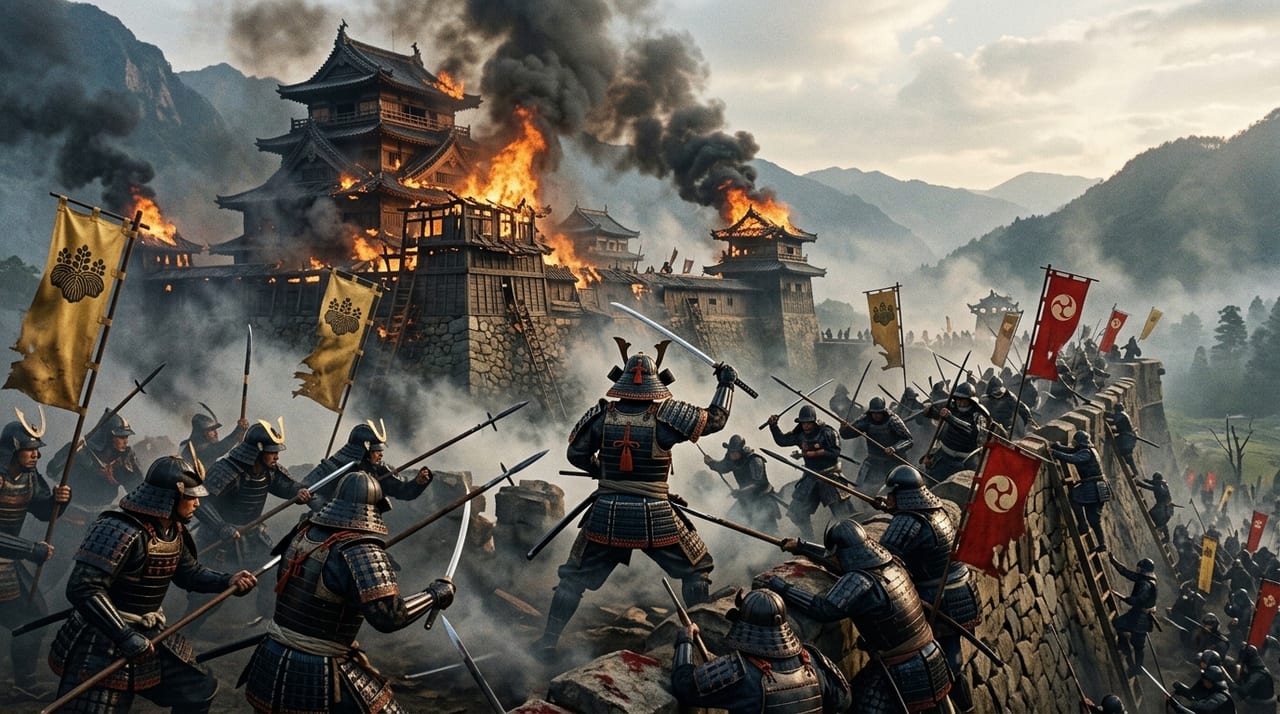
In the 2nd month of Meiō 2 (1493), Yoshiki personally led an army to Kawachi Province to attack Hatakeyama Yoshitoyo, the enemy of Masanaga. The shogun's absence from the capital was an opportunity that Masamoto quietly awaited.
While Yoshiki was fighting in Kawachi, Masamoto carried out a lightning-swift coup. He first subdued the pro-Yoshiki faction within the shogunate in Kyoto and effectively detained Yoshiki. He then destroyed Hatakeyama Masanaga, Yoshiki's backer. Isolated in Kawachi, Yoshiki had nowhere left to return.
Masamoto's method was meticulous and ruthless. Calculating the "vacuum" created by the shogun's absence, he secured control of Kyoto with minimal bloodshed. Yoshiki was taken to Kyoto and confined, and after escaping, he became a wanderer. He was later known as the "wandering shogun" (nagare-kubō) and moved from place to place. Supported by anti-Hosokawa forces, he twice attempted to regain the shogunate, but that is a different story.
Masamoto's next move was to install a new shogun. He chose Ashikaga Yoshizumi, a member of a different branch of the Ashikaga family from Yoshiki. Yoshizumi was selected for his obedience to Masamoto's will rather than for any political ability.
In the 12th month of Meiō 3 (January 1495), Yoshizumi formally assumed the shogunate. Real power, however, was entirely in Masamoto's hands. Court nobles and provincial daimyo in Kyoto formally acknowledged Yoshizumi as shogun, but everyone understood who the true ruler was. With the establishment of the precedent that a kanrei held the power to depose and install shoguns, the authority of the Muromachi shogunate suffered irreparable damage.
This upheaval was more than a mere power struggle. That a shogun had become a figure who could be replaced by the kanrei's appointment and dismissal shook the very order of the realm. Daimyo across the country read in this upheaval the tacit precedent that they need not obey the shogunate's commands.
Among historians, opinions differ on when the Sengoku period should be said to begin. Some scholars take the Ōnin War (1467) as the starting point, while others point to the Meiō Upheaval (1493) as the symbol of gekokujō, and researchers' views vary accordingly.
However, the significance of the Meiō Upheaval as a symbol of gekokujō is extremely great. The fact that a kanrei deposed a shogun embodied the Sengoku value that "power is justice." It was because this precedent existed that the "chain of gekokujō" that followed, including Saitō Dōsan's seizure of Mino, Matsunaga Hisahide's rebellion against the Miyoshi clan, and Oda Nobunaga's expulsion of the shogun, came to be justified.
Masamoto himself was assassinated in Eishō 4 (1507) by a retainer of his adopted son, Sumiyuki. Ironically, he too fell victim to gekokujō. Yet the ripples of the coup he launched in 1493 would bind Japan to a century of warfare.
Following the Meiō Upheaval, succession rivalry intensified within the Hosokawa clan as well. Masamoto had no children of his own, and three adopted sons, Sumiyuki, Sumimoto, and Takakuni, each asserted a claim to the Hosokawa succession. After Masamoto's death, an internal strife known as the "Ryō-Hosokawa no Ran" split the Hosokawa clan in two and further threw Kinai politics into chaos.
Taking advantage of this turmoil, the Miyoshi clan rose to prominence, and before long Miyoshi Nagayoshi came to possess strength surpassing that of the kanrei houses. The rise of the Miyoshi was also part of the "chain of collapsing authority" triggered by the Meiō Upheaval.
The seed that Hosokawa Masamoto had sown, the idea that a shogun could be deposed, devoured the Hosokawa clan itself and, in the end, blossomed into a poisonous flower that destroyed the Ashikaga shogunal house. If the Ōnin War was the opening of the age of warfare, the Meiō Upheaval marked the completion of the collapse of order.
The Meiō Upheaval also had an indirect influence on the history of the Japanese sword. The decline of shogunal authority and the division of the realm among daimyo shifted the demand for swords from quality to quantity. Artistic masterpieces demanded as offerings to the shogunal house continued to be forged, but to prepare for battles breaking out across the country, the production of practical kazuuchi swords surged.
In particular, the smith groups of Seki in Mino Province (present-day Seki City, Gifu Prefecture) built a mass-production system in response to this growing demand. Master smiths such as Kanemoto ("Seki no Magoroku") were active, and Mino blades, produced in quantity, spread widely from common foot soldiers to daimyo. The "age of upheaval" caused by the Meiō Upheaval was the turning point that redrew the map of the Japanese sword industry.