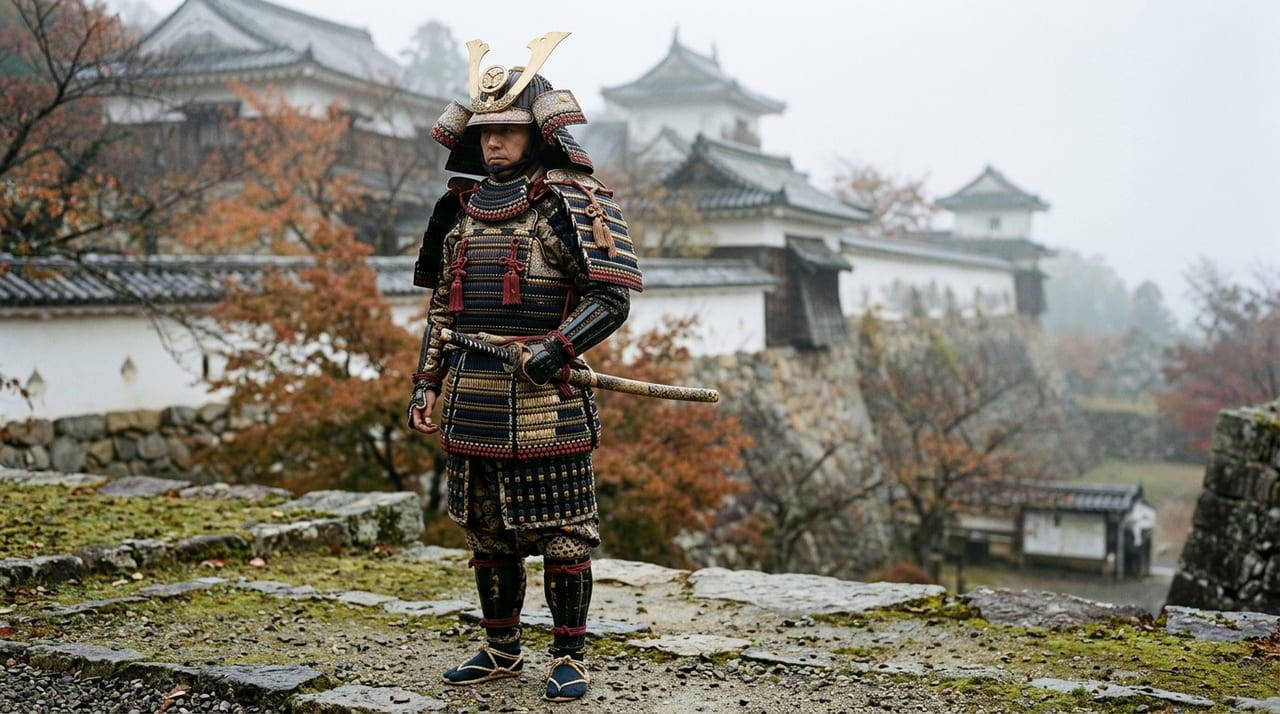
* Image is for illustrative purposes only.Ashikaga Yoshimasa
足利義政
Lord of Higashiyama — the aesthete shogun who built the Silver Pavilion while his world burned
Description
Political Failure and Cultural Flourishing
Ashikaga Yoshimasa was born in 1436 (Eikyo 8) as the son of Ashikaga Yoshinori, the sixth Ashikaga shogun, and became the eighth shogun in 1449 (Bunsa 6). Yoshimasa's reign is often evaluated as "a succession of failed policies." The confusion over the succession question led to the Onin War (1467–1477), and eleven years of warfare devastated Kyoto. While Yoshimasa is said to have lacked political leadership as shogun, he left an incomparable legacy as a cultural patron. Yoshimasa's Higashiyama culture positioned the wabi-sabi aesthetic at the core of Japanese culture, forming the spiritual foundation of much of modern Japanese culture.
Deep Knowledge of Swords
Yoshimasa was renowned as a sword connoisseur and was among the foremost sword collectors of the Ashikaga shoguns. Many celebrated blades transmitted as "shogunal collection swords" were organized and authenticated during Yoshimasa's era, establishing their rank as "official collection swords." Yoshimasa actively collected masterworks from the five Gokaden schools such as Asakutaguchi, Raijo, Ichimonji, and Osafune, and demonstrated high expertise in assessing their authenticity. He is said to have particularly favored short blades from the Soshu tradition by Masamune and Yukimitsu, and the affinity between the wabi-sabi aesthetic and the striking temper-patterns of Soshu tradition reveals Yoshimasa's keen aesthetic sensibility. The "appraisal certificate" system of sword authentication is said to have developed during Yoshimasa's era, contributing to the establishment of a value-assessment system for Japanese swords.
Higashiyama Retreat and the Silver Pavilion
After the Onin War ended, Yoshimasa ceded the shogunal position to his son Yoshihisa and began construction of a retreat in the Higashiyama district of Kyoto from 1482 (Bunsho 14) onward. This retreat later became known as Ginkakuji, the Temple of Empathetic Illumination (Jishoji). Here Yoshimasa brought together the arts—tea ceremony, Noh theater, flower arrangement, and dry landscape gardens—that would later be called Higashiyama culture. The shoin-style architecture of Ginkakuji, its dry landscape garden, and its moon-viewing mound are internationally recognized as symbols of Japanese aesthetic sensibility. Yoshimasa's cultural endeavors are highly valued by later cultural historians as more than compensating for his political failures. The sword too was positioned as part of this Higashiyama culture, and from the union of the shogun's aesthetic sensibility with samurai tradition arose a distinctive sword aesthetic.
Exchanges with No-ami and Artists
Yoshimasa's cultural activities were supported by artists and literati called the dosho-shu. In particular, No-ami (1397–1471) enjoyed Yoshimasa's absolute trust in painting, arranged flowers, and the appraisal of Chinese objects, and played a central role in the formation of Higashiyama culture. Through such exchanges with artists, sword appraisal was also refined as a kind of "way." Among Yoshimasa's circle were dosho-shu well-versed in swords, and the appreciation, evaluation, and systematic preservation of celebrated blades were conducted in an organized manner. It can be understood that the later tradition of sword appraisal and polishing by the Hon'ami family was nurtured in this cultural soil.
Yoshimasa as Guardian of Sword Culture
Yoshimasa's contribution to swords as a cultural collector held historical significance beyond mere personal taste. In an era when many celebrated blades were lost and dispersed through warfare, Yoshimasa protected masterworks as shogunal treasures and played a role in transmitting their cultural value to posterity. Even amidst the devastating destruction of Kyoto brought by the Onin War, a portion of the sword collection that Yoshimasa carefully assembled was transmitted to later times and is preserved today in museums throughout the country. As a politician, Yoshimasa cannot escape the stigma of failure, but as a guardian of culture and devotee of swords, Yoshimasa occupies an important place in the history of Japanese sword culture.
Wabi-sabi and Sword Aesthetics
The wabi-sabi aesthetic embodied by Yoshimasa is connected at a profound level to the aesthetic of Japanese swords. Withered beauty, radiance in stillness, perfection in imperfection—these are also the very essence of beauty in celebrated blades. The subtle variations in forge-texture, the quiet shimmer of temper-patterns, the tension and harmony created by curvature—the beauty of swords is precisely the embodiment of the wabi-sabi aesthetic that Yoshimasa cherished. The process by which the sword was elevated from "weapon" to "work of art" within Higashiyama culture represents one of the most important turning points in the history of Japanese sword culture.
Notable Swords
- Yoshimasa's shogunal collection tachi — select blades from the Five Traditions (Gokaden) preserved and authenticated by Yoshimasa as shogunal treasures, protecting priceless masterworks through the chaos of the Onin War
- Higashiyama御物 tanto — short blades of the Soshu tradition particularly favored by Yoshimasa, whose stark beauty resonated with the wabi-sabi aesthetic he cultivated at the Silver Pavilion