New Arrivals — Browse our catalog for the latest authentic Japanese sword arrivals. Browse →
From Onin 1–Bunmei 9 (1467–1477) onward
Kyoto (Muromachi Palace and Ashikaga shogunal storehouses)
Forces
Ashikaga shogunal family (original custodians)
Onin War factions and regional lords (recipients of dispersed objects)
About 11 min read
Ashikaga Yoshimasa (1436–1490) is often recorded in history as politically weak as the eighth Muromachi shogun. In the midst of the Ōnin War (1467–1477), an 11-year great rebellion, he was unable to exercise strong political leadership, and he finally passed the shogunal title to his son Yoshihisa and retired to Higashiyama (eastern Kyoto). Yet at the same time, Yoshimasa was one of the greatest cultural collectors in Japanese history, and the Higashiyama Gomotsu he built exerted an incalculable influence on later Japanese culture. The process of its dispersal also led to the concept of meibutsu in later chanoyu.
Higashiyama Gomotsu is the collective name for the collection of art and craft objects that the Ashikaga shogunal family accumulated over generations and that reached its peak in Yoshimasa's time. Its core was Chinese paintings (karamono) brought in through the kangō trade and other channels, and it also included tea utensils, flower vases, and writing implements. In Yoshimasa's time, the dōbōshū Nōami, who was in charge of managing and appraising the karamono, compiled the painting catalogue Gomotsu On-e Mokuroku (280 scrolls), and he also wrote the Kundaikan Sōchōki.
Yoshimasa was the central figure of Higashiyama culture, which was symbolized by the construction of the Higashiyama villa (later Jishō-ji = Ginkaku-ji), begun in 1482. The sense of wabi aesthetics that he refined became the foundation of later sadō, nōgaku, and garden culture. His collection was the material support that sustained this cultural world, and it embodied the authority of "the shogun as guardian of culture."
Higashiyama Gomotsu was not formed in a single generation. It is the result of karamono collecting by successive shoguns, including Ashikaga Yoshimitsu (1358–1408), the third shogun, and Yoshinori, the sixth shogun, accumulated over several generations.
Yoshimitsu, after bringing the Nanboku-chō turmoil to an end and establishing the authority of the Muromachi shogunate, built the Kinkaku-ji in Kitayama (1397) and adopted a policy of concentrating in himself the highest level of cultural authority in East Asia. Through the kangō trade with China (Ming dynasty), he imported large quantities of karamono. This cultural policy of Yoshimitsu laid the foundation for the later Higashiyama Gomotsu.
The later shogunal family also continued to collect karamono, and the works bore collector's seals such as "Tenzan" and "Dōyū."
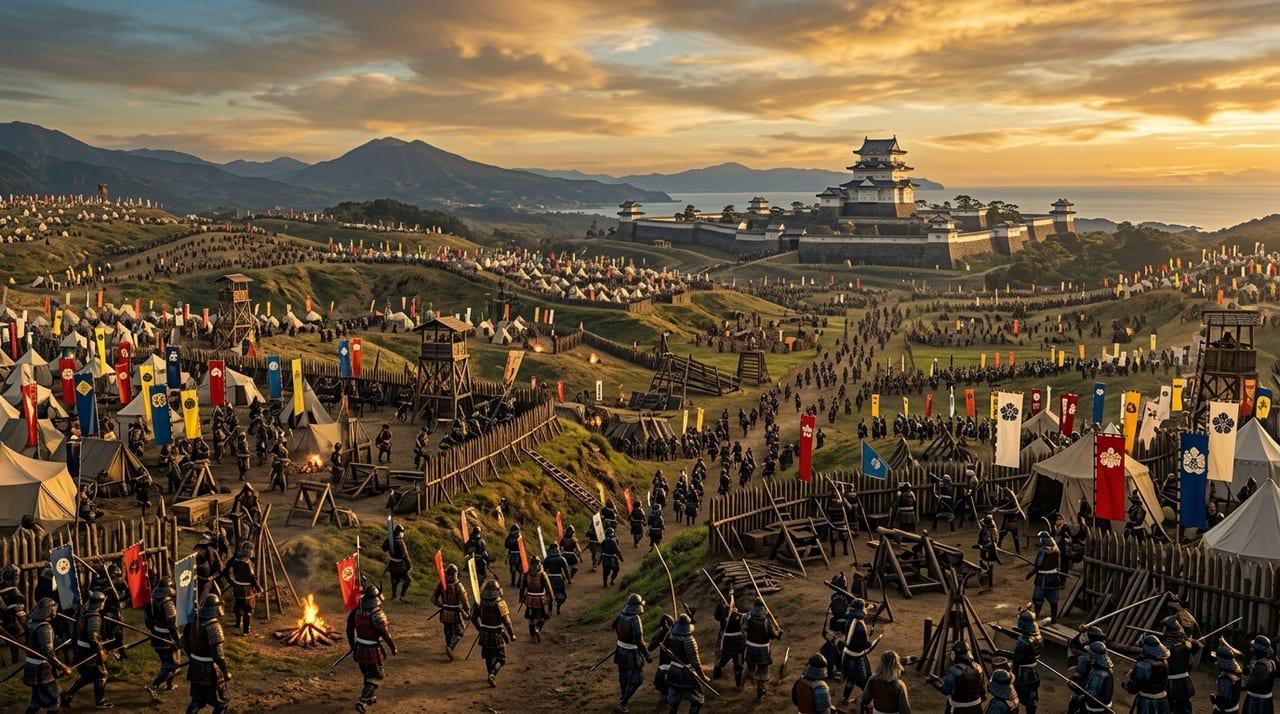
The Ōnin War, which broke out in Ōnin 1 (1467), was a great rebellion in which, triggered by the succession dispute of the Ashikaga shogunal family, the Eastern Army led by kanrei Hosokawa Katsumoto and the Western Army led by Yamana Sōzen fought for eleven years in Kyoto.
This war reduced much of Kyoto to ashes. The authority of the Muromachi shogunate fell to the ground, and daimyō across the country strengthened their moves toward independence. The Ashikaga shogunal family's gosho (Muromachi-dono) was not spared from the flames, and many of the Higashiyama Gomotsu stored in its storehouses were exposed to the danger of being seized, plundered, or sold.
From the midst of the war, some of the gomotsu passed into the hands of influential generals and merchants on both sides. It is also said that Yoshimasa himself sold some of the gomotsu when he fell into financial difficulty. Even after the war ended, the authority of the Muromachi shogunate was not restored, and throughout the Sengoku period that followed, the dispersal of the gomotsu accelerated. Meanwhile, Yoshimasa continued his cultural activities even during the war, and after it he built a villa in Higashiyama (later Ginkaku-ji) and enjoyed chanoyu, nō, and calligraphy and painting. Yoshimasa's life, in which political failure and cultural flowering strangely coexisted, must be understood together with the tragedy of the dispersal of the Higashiyama Gomotsu.
The dispersal of the Higashiyama Gomotsu was not merely a loss. It had a paradoxical aspect that nurtured the later view of meibutsu.
The objects that had been kept secret as gomotsu were bestowed on daimyō, or sold to dosō (pawnbrokers) because of the shogunate's financial difficulties, and so moved to various places, and their provenance and value became widely known. When the Azuchi-Momoyama period arrived, a trend arose among tea masters to revere Yoshimasa as the founder of chadō (chadō no so), and the tea utensils of the Higashiyama Gomotsu came to be prized.
The fact that Oda Nobunaga and Toyotomi Hideyoshi were absorbed in collecting art objects known as meibutsu-gari (hunt for famous objects) was also an inheritance of the idea of "meibutsu = proof of authority," which had persisted since the dispersal of the Higashiyama Gomotsu. Tea utensils that Nobunaga lost in the Honnōji Incident (1582) may, tracing their origins, also have included dispersed items of the Higashiyama Gomotsu.
More than 550 years have passed since the Ōnin War, and today many of the Higashiyama Gomotsu are dispersed and held by art museums, museums, and private collections across the country. Many of the surviving Higashiyama Gomotsu have been designated National Treasures or Important Cultural Properties. Works such as "Autumn Landscape" and "Winter Landscape," attributed to Emperor Huizong (National Treasure, held by Konchi-in), and "Shakyamuni Descending the Mountain" by Liang Kai (National Treasure, held by the Tokyo National Museum) are well known.
The dispersal of the Higashiyama Gomotsu, on the one hand, was a tragedy that dismantled the core of Muromachi culture. On the other hand, it also became an occasion for cultural value to be widely shared, as masterpieces freed from the monopoly of the shogunal family were transmitted throughout the country. The historical event of the dispersal of the Higashiyama Gomotsu is located at the point where these two aspects intersect: the loss of that lost authority, and the spread of the dispersed value.
Ashikaga Yoshimasa
Ashikaga Yoshimasa — the 8th shogun who brought the Higashiyama Gomotsu to its peak and was unable to prevent its dispersal during the Onin War
Ashikaga Yoshimitsu
Ashikaga Yoshimitsu — the 3rd shogun who established the Ashikaga collection's foundation, building the Golden Pavilion and systematically acquiring Chinese cultural objects
Hosokawa Katsumoto
Hosokawa Katsumoto — eastern army commander in the Onin War, one of the principal agents of the conflict that dispersed the Higashiyama Gomotsu
Yamana Sōzen
Yamana Sozen — western army commander in the Onin War, co-responsible for the conflict that scattered the Ashikaga collection
Oda Nobunaga
Oda Nobunaga — the warlord whose systematic collection of famous swords and tea objects (meibutsu-gari) directly continued the cultural logic established by the dispersal of the Higashiyama Gomotsu
Honami Kōetsu
Hon'ami Koetsu — the most famous member of the Hon'ami family, who maintained the appraisal tradition that tracked the dispersed Higashiyama Gomotsu swords