New Arrivals — Browse our catalog for the latest authentic Japanese sword arrivals. Browse →
6th month, Ōei 26 (1419)
Tsushima Province (present-day Tsushima City, Nagasaki Prefecture)
Forces
Joseon Korean Forces
Tsushima Sō Clan Forces
About 17 min read
The Ōei Invasion (Ōei no gaikō) was an incident in the Muromachi period in which, in the 6th month of Ōei 26 (1419), Joseon Korea launched a large-scale invasion of Tsushima. Japanese sources call it the "Ōei Invasion," while Korean sources call it "Gihae Dongjeong (the Gihae Eastern Expedition)." In Kyoto, people initially feared it might be a third Mongol invasion, and it dealt a major shock to both the Muromachi shogunate and the Sō clan of Tsushima. In this battle, the warriors of Tsushima met a great army of more than 17,000 men and, through their fierce resistance, brought the fighting to a stalemate. The Japanese swords wielded by the Tsushima warriors embodied the essence of bushidō in the face of an overwhelming disparity in numbers.
Throughout the Muromachi period, wokou (Japanese pirates) based in Kyushu, Tsushima, and Iki repeatedly raided the coasts of Korea and China. The wokou carried out plunder and kidnapping in many places, inflicting heavy damage on villages along the Korean coast. King Taejong of Joseon (r. 1400–1418) had continued negotiations with Tsushima as a countermeasure against the wokou, but in the 4th month of Ōei 25 (1418), Sō Sadashige, the shugo (military governor) of Tsushima who had worked hard to suppress the wokou, died of illness. Sō Sadamori, who succeeded him, was still young, and real power was held by Sōda Saemontarō, who was also a leader of the wokou. In the 5th month of the following year, Ōei 26 (1419), wokou raided Biin County and other places in Korea. The retired King Taejong, who held real power over the new Joseon king, King Sejong (r. 1418–1450), decided on a punitive expedition and dispatched to Tsushima an unprecedented army of 227 warships and 17,285 soldiers.
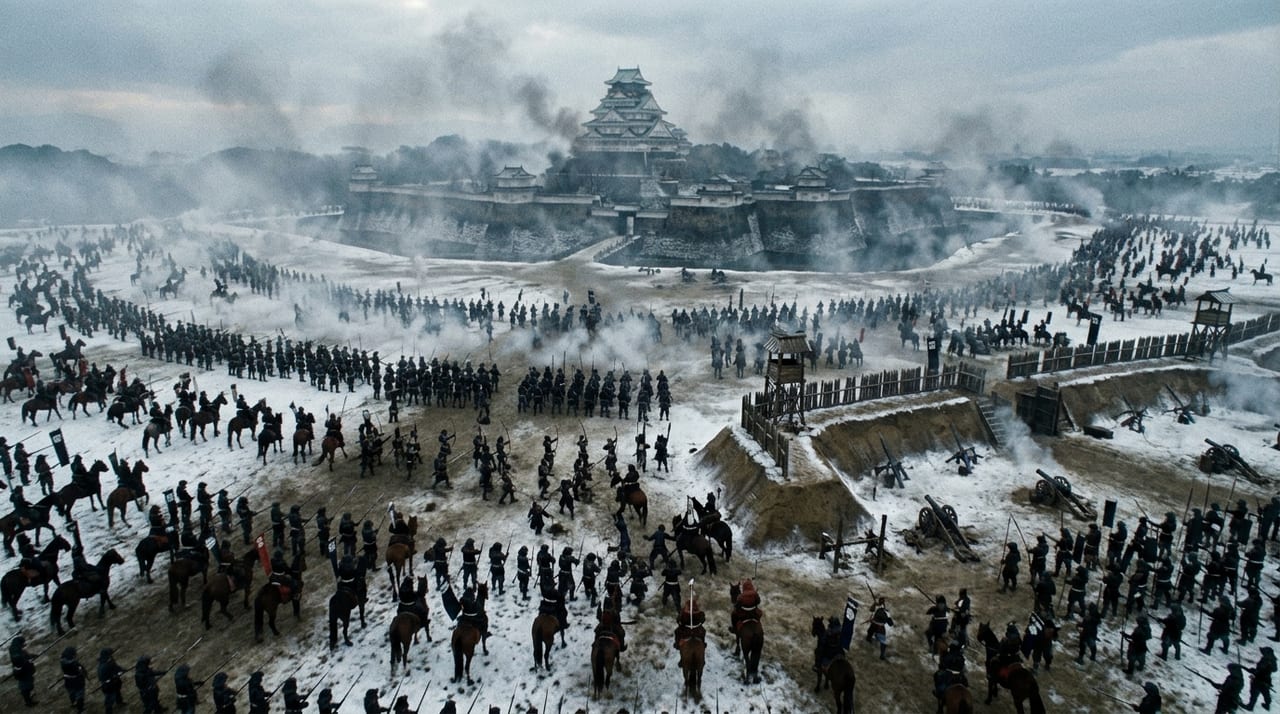
On the 20th day of the 6th month of Ōei 26 (1419), a vanguard fleet of the Korean forces appeared at Osaki-ura in Asō Bay, in central Tsushima. The main force followed and began landing, carrying out searches, plunder, and arson across the island. Their actions included seizing 129 vessels, burning 1,939 houses, beheading 114 people, and taking 21 captives, inflicting heavy damage across the island. However, the Battle of Nukadake on the 29th day of the 6th month was where the Korean forces were forced into unexpected difficulties. The Tsushima side also requested reinforcements from the Matsura league in Iki and, making use of the local terrain, placed an ambush in the steep mountains. The Korean left army led by Pak Sil, which had landed in Nii District, was defeated when it encountered this ambush at Nukadake. In this battle, more than one hundred Korean troops, including four officers, were killed in battle or fell to their deaths from cliffs. Despite their overwhelming numerical advantage, they encountered the fierce resistance of the Tsushima warriors, and the morale of the Korean forces was deeply shaken.
The Ōei era was a transitional period for swords, following the intense warfare of the Nanbokuchō period. During the turbulent Nanbokuchō period (the 14th century), many very long ōdachi were made, but in the 15th century, swordsmiths of Osafune in Bizen Province, Yamato, and Yamashiro returned once again to refined techniques, and the shapes of swords were also shifting from the Nanbokuchō-period ōdachi back to smaller, elegant tachi and uchigatana. Sō Sadamori's stand against the great Korean army at the head of the Tsushima warrior bands was a true display of the warrior ethos of a small, elite force, and it accords with the cultural background of the Japanese sword: "not relying on numbers, but competing through each individual's martial skill and the advantages of the terrain."
After the Battle of Nukadake, when the fighting reached a stalemate, Sō Sadamori sought a diplomatic resolution. Sō Sadamori negotiated with envoys of the Korean forces, warning them that "the stormy season is approaching, and if the army remains stationed here, it will be in danger," and, after giving this warning, proposed a ceasefire and the restoration of friendly relations. The Korean forces accepted this, and on the 3rd day of the 7th month, the entire army withdrew from Tsushima. The invasion lasted about thirteen days. Diplomatic negotiations between Japan and Korea afterward were difficult, but friendly relations were eventually restored, and in 1443 (Kakitsu 3), the Treaty of Kakitsu (Gyehae Treaty) was concluded. Under this treaty, the Sō clan of Tsushima formally obtained the right to exclusively manage diplomatic exchanges and trade with Korea, and Tsushima established a unique position as the "intermediary island" between Japan and Korea.
News of the Ōei Invasion also reached the Muromachi shogunate, and the shogunate of the fourth shogun, Ashikaga Yoshimochi, and the imperial court initially feared it might be a third Mongol invasion. However, the Muromachi shogunate had neither the military strength nor the will to actively counterattack on the Korean Peninsula, and the situation was brought to an end through the diplomatic efforts of the Sō clan. This incident exposed the limits of the Muromachi shogunate's military influence abroad. At the same time, it showed how a regional warrior group (the Sō clan) defended the nation's territory through its own diplomatic and military response, and for this reason it is regarded as an important event in medieval Japanese history. The valiant struggle of the Tsushima warriors has been passed down through later generations, remembered as an expression of the warrior spirit to fight fiercely and see the battle through even when outnumbered, and of the spiritual armament symbolized by the Japanese sword.
The Ōei era (1394–1428) was also an important turning point in the history of the Japanese sword. It was also the period when master smiths of Osafune in Bizen Province, including Morimitsu, Yasumitsu, and others, collectively known as the "Ōei Bizen," were active. Compared with the ōdachi of the Nanbokuchō period, Ōei Bizen blades became shorter with shallower curvature, changing into practical shapes that balanced portability and battlefield effectiveness. The hamon often show gunome and komidare patterns. The historical process by which the shape of the Japanese sword evolved from battlefield experience, fusing the warrior spirit and practicality of its era, was refined through verification on real battlefields such as the Ōei Invasion. As a symbolic event of an age in which the Japanese sword functioned not merely as an art object but as a weapon of actual combat, the Ōei Invasion also holds significant importance in the history of swords.
The Ōei Invasion is often compared with the Mongol invasions of the Kamakura period (the Bun'ei campaign of 1274 and the Kōan campaign of 1281). In the Mongol invasions, Kamakura warriors faced the Mongol forces' unfamiliar tactics of group formations, poisoned arrows, and tetsuhau (exploding projectiles), and they responded by departing from the Japanese bushidō custom of one-on-one combat in which warriors announced their names. This experience of the Mongol invasions is thought to have also influenced the evolution of the Japanese sword's practical shape. By contrast, in the Ōei Invasion, the Tsushima warriors countered the great Korean army with mountain guerrilla tactics that made the fullest use of the advantages of the terrain. The Japanese sword was a weapon suited to close-quarters combat in the narrow spaces of mountainous terrain, and it is most effective in situations where a small, elite group of warriors displays individual martial skill rather than a large army. The fighting of the Ōei Invasion is also an event that demonstrated that the Japanese sword, as a weapon embodying "individual martial skill over collective strength," achieves its full power within the geographical and cultural context of Japan. The memory of this foreign invasion was inscribed in the warrior culture of Kyushu and Tsushima in later ages, and became a spiritual legacy that nurtured vigilance against foreign threats and warrior pride.
The Sō clan of Tsushima had made Tsushima its base since the Kamakura period and, through mediating Japan–Korea trade, developed a distinctive warrior culture. The Sō clan's retainers were formidable warriors well acquainted with Tsushima's steep mountainous terrain and its intricate coastline. The Tsushima warriors who fought under Sō Sadamori in the Ōei Invasion were the quintessence of this Tsushima warrior culture. The fighting of the Ōei Invasion, in which a small elite force fought well against an overwhelmingly larger foreign army through terrain, surprise attacks, and spiritual superiority, is passed down as a concrete example embodying the ideals of Japanese bushidō: the fusion of the individual martial skill of warriors who wore Japanese swords with collective mobility. Descendants of the Sō clan continued to serve as lords of the Tsushima Domain during the Edo period, conducting Japan–Korea diplomacy, and the warrior culture of Tsushima was carried on until the Meiji Restoration.