New Arrivals — Browse our catalog for the latest authentic Japanese sword arrivals. Browse →
10th–12th month of Ōei 6 (1399–1400)
Sakai, Izumi Province (present-day Sakai City, Osaka Prefecture)
Forces
Muromachi Bakufu and Ashikaga Yoshimitsu's Forces
Ōuchi Yoshihiro and Rebel Forces
About 15 min read
The Ōei Rebellion took place from the 10th month of Ōei 6 (1399) to the 21st day of the 12th month of Ōei 6 (17 January 1400). It was a revolt in which Ashikaga Yoshimitsu, the third shogun of the Muromachi shogunate, and Ōuchi Yoshihiro, the greatest shugo daimyō of western Japan, clashed head-on with Sakai in Izumi Province as their main battlefield. Yoshihiro, who resisted the concentration of power in the shogunate, died in battle with an ōdachi in hand, and the conflict is recorded in history as one of the largest internal warrior wars before the Sengoku period, marking Yoshimitsu's establishment of shogunal authority. In this incident, the financial and military power of the Ōuchi clan collided head-on with the national authority of the Muromachi shogunate. It clearly shows the role of shugo daimyō as patrons of sword culture and the structural link by which political stability brought about the flowering of the art of the sword.
Ōuchi Yoshihiro (1356–1400) concurrently held the shugo posts of six provinces, Suō, Nagato, Iwami, Buzen, Izumi, and Kii, and was the most powerful figure in western Japan. Yoshihiro made many military contributions to the shogunate. He fought alongside Kyūshū tandai Imagawa Ryōshun against the Southern Court forces in Kyushu. In the rebellion of Yamana Ujikiyo (the Meitoku Rebellion) in Meitoku 2 (1391), he sent reinforcements to the shogunal army. He also contributed to the reunification of the Northern and Southern Courts in Meitoku 3 (1392). Through these achievements he earned Yoshimitsu's deep trust. The Ōuchi clan, based in Suō Province (present-day Yamaguchi Prefecture), amassed enormous wealth through trade with Korea, and its financial and military strength far surpassed that of the daimyō of the Kinai region. Yamaguchi, the Ōuchi base, was known in the Muromachi period as "Kyoto of the West." It flourished as an elegant city into which the court culture of Kyoto had been transplanted. However, Ashikaga Yoshimitsu was steadily carrying out policies to suppress powerful shugo such as the Yamana and the Ōuchi, in order to make the shogun's authority unique and absolute.
The late 14th century, when Ōuchi Yoshihiro was active, was a transitional period in which the turbulent Northern and Southern Courts era was shifting into the Muromachi period, and it is also a major turning point for sword culture. In the long internal wars of the Northern and Southern Courts period (1336–1392), centered on the Enbun and Jōji eras, broad-bodied, large, and bold tachi, ōdachi, and naginata came into fashion. Because large numbers of foot soldiers (ashigaru) were mobilized in battles of this era, tanto, uchigatana, naginata, and nagamaki for foot soldiers increased sharply alongside the tachi of mounted warriors. However, with the political stability of the Muromachi period, demand was rising again for tachi and uchigatana that valued refined technique and aesthetic perfection. The sword-smithing techniques of the Sōshū tradition (the Masamune line of Kamakura) spread throughout the country through the Northern and Southern Courts period. The works of Bizen Osafune smiths Chōgi and Tomomitsu from this era survive today as representative works of the Northern and Southern Courts period.
Yoshihiro, who felt the limits of Yoshimitsu's repeated pressure, had built up dissatisfaction with the shogunate. In Ōei 4 (1397), he refused to supply men for the construction of the Kitayama villa and incurred Yoshimitsu's displeasure. At the end of the same year, his younger brother Mitsuhiro died in the campaign against the Shōni clan, yet no decision was made on rewards for Mitsuhiro's son. Rumors also spread that the shugo posts of Izumi and Kii would be taken away from him. Through Imagawa Ryōshun's mediation, Yoshihiro concluded a secret pact with Kamakura kubō Ashikaga Mitsukane. While keeping in contact with Toki Akinao and with Miyata Tokikiyo, the son of Yamana Ujikiyo, he consolidated an anti-shogunate system. In the 10th month of Ōei 6 (1399), he led his army to Izumi Province, went down to Sakai, and built fortifications there. Turning Sakai into a fortress was the construction of a full-scale military base backed by the economic power of a western daimyō. Yoshimitsu responded at once. He mobilized a shogunal coalition army of more than 30,000 troops, led by Hosokawa Yorimoto, Akamatsu Yoshinori, Hatakeyama Motokuni, and Shiba Yoshiyuki. He first set up camp at Tō-ji temple in Kyoto and then at Yawata, and on the 29th day of the 11th month he began a full-scale assault on Sakai Castle.
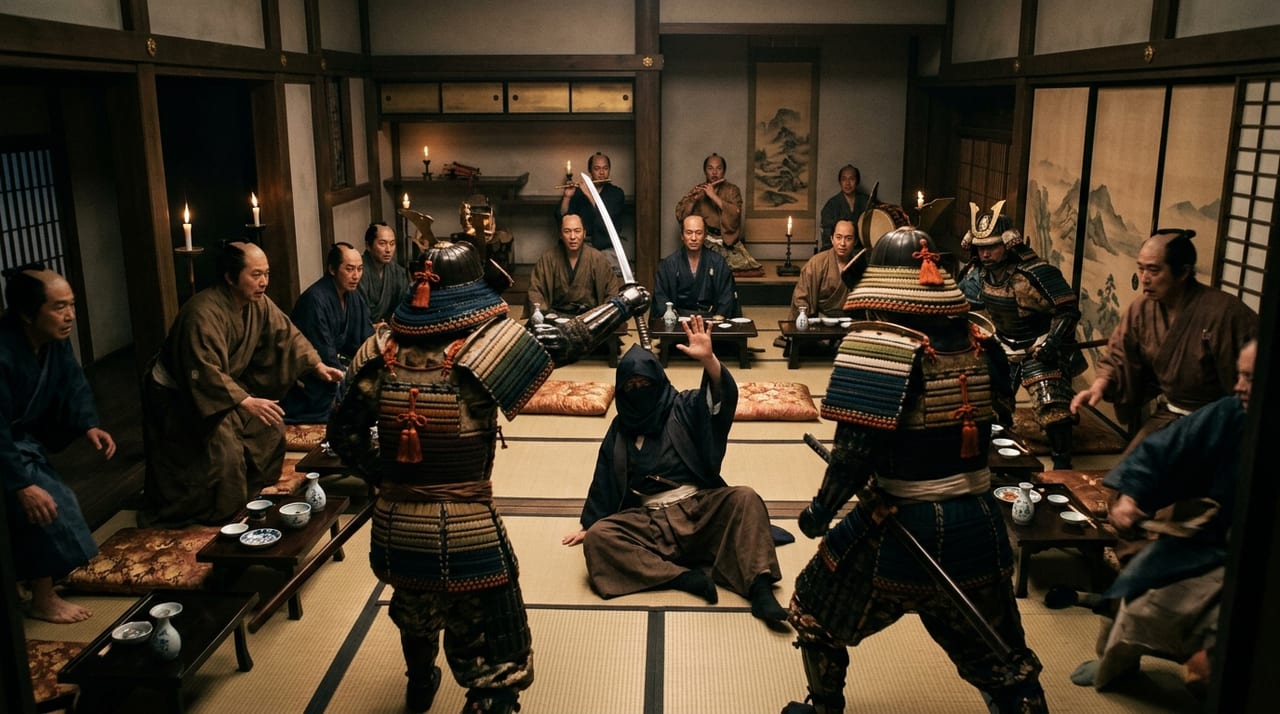
Facing the overwhelming difference in troop strength, Yoshihiro held Sakai Castle and fought a defensive battle lasting several weeks. However, in the early morning of the 21st day of the 12th month, the shogunal army launched a full-scale assault using fire attacks, and Sakai Castle neared the point of falling. Yoshihiro is said to have resolved that this would be his last battle, and to have personally swung an ōdachi and charged into the camp of Hatakeyama Mitsuie. The ōdachi is generally understood as a large tachi popular in the Northern and Southern Courts period, with a blade length of 3 shaku (about 90 cm) or more. Yoshihiro's choice of a final charge with an ōdachi in hand was a moment when the warrior's aesthetic of death and the symbolism of the sword intersected in the most dramatic form. This final scene is depicted in the war tale Ōei-ki, and it has been passed down as an episode embodying the Muromachi warrior spirit: "to live with the sword and die with the sword." With Yoshihiro's death, the rebellion was suppressed, and Yoshimitsu stripped and reorganized the Ōuchi clan's shugo posts.
As a result of the Ōei Rebellion, Ashikaga Yoshimitsu established overwhelming superiority over the powerful shugo daimyō, and the power structure of the Muromachi shogunate was decisively stabilized. This political stability brought a decisive change to sword culture. The "Kitayama culture" centered on the Kitayama villa (including Kinkaku-ji) that Yoshimitsu built in Kitayama (present-day Kita Ward, Kyoto City) established a unique aesthetic sensibility in which Zen Buddhism, court culture, and warrior culture fused. It gave rise to a cultural trend that valued the decorative and artistic qualities of swords. Shogunal houses and shugo daimyō of the Muromachi period became cultural patrons through commissions to swordsmiths, and they prized the works of smiths in the Sōshū tradition lineage, such as Hiromitsu and Akihiro, and of Bizen Osafune smiths such as Morimitsu, who represented the early Muromachi period. After Yoshihiro's death, his younger brother Ōuchi Moriharu and his son Ōuchi Mochiyo took over the family headship and maintained the Ōuchi clan's position as a trading daimyō. In the later era of Ōuchi Yoshitaka, it reached its peak as "Kyoto of the West, Yamaguchi." The Ōei Rebellion is an event that pre-Sengoku warrior society overcame as the final trial of "forming order through force," and it led directly to the establishment of the Muromachi-style sword culture that followed, in which the sword was a symbol of authority and a work of art. The reason the anecdote that Ōuchi Yoshihiro died wielding an ōdachi has continued to be told lies in the depth of the value Muromachi warrior society placed on "expressing one's life and honor through the sword." Yoshihiro's death was not merely the suppression of a rebellion. It was remembered as "the beauty of a warlord who died devoted to the sword," and it became one of the spiritual archetypes that later Sengoku warlords pursued as the ideal of a "splendid end." The Kitayama culture promoted by Ashikaga Yoshimitsu fixed an aesthetic sensibility that regards the sword not only as a weapon but as "a crystallization of art and authority," and it can be said to have laid the foundation for the "sword appreciation culture" that continued through the Muromachi, Sengoku, and Edo periods. The political stability and economic leeway Yoshimitsu gained by suppressing Ōuchi Yoshihiro's rebellion made this patronage of sword culture possible. Beyond a mere internal warrior conflict, the Ōei Rebellion is an event that deserves to be remembered for a long time as a historical event symbolizing the "chain between politics and beauty" in the history of Japanese sword art.