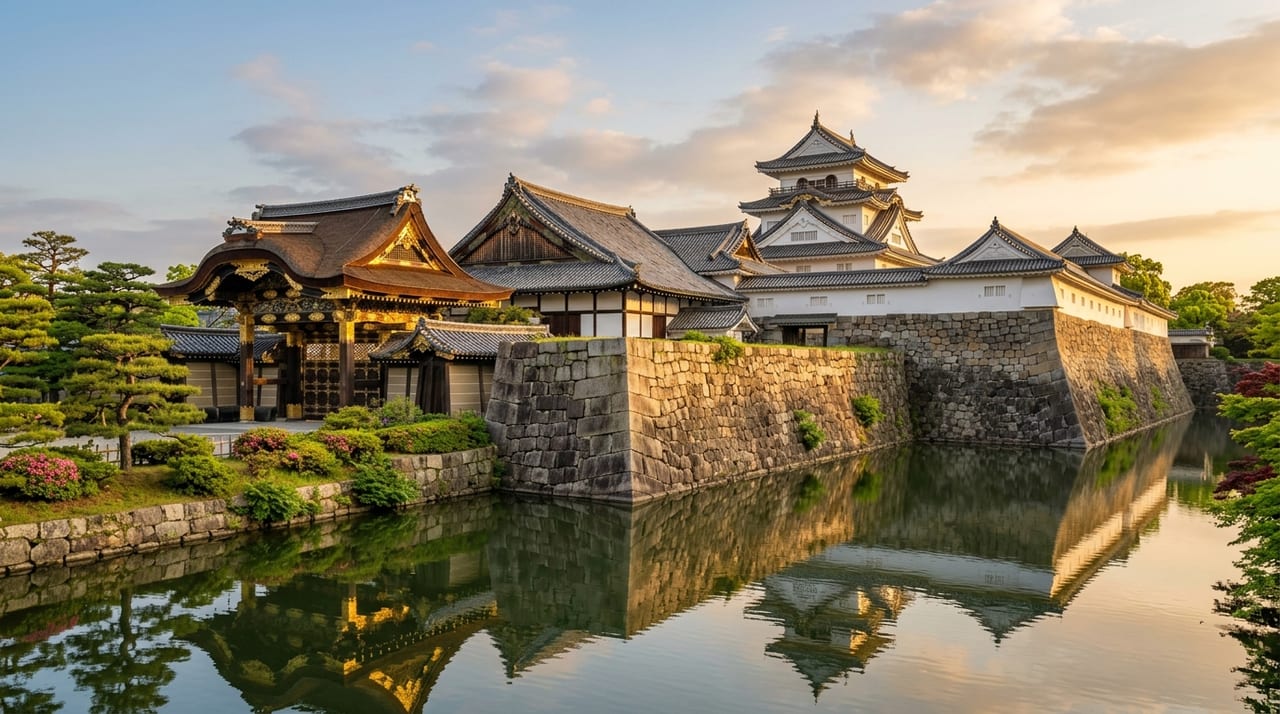
 * Image is for illustrative purposes only.
Nijō Castle
二条城
Nijō Castle is a historic castle in the Kansai region (Construction began in Keichō 6 (1601); completed in Keichō 8 (1603)). Its lord was Tokugawa Ieyasu / Tokugawa Shogunate.
Overview
The Tokugawa Family's Kyoto Base — The Founding and History of Nijō Castle
Tokugawa Ieyasu began building Nijō Castle in Keichō 6 (1601) and completed it in Keichō 8 (1603), the year he was appointed shogun (Seii Taishōgun). Afterward it served as the lodging for Tokugawa shoguns when they came up to Kyoto. Located near the Kyoto Imperial Palace, the castle was also a symbol of the prestige the Tokugawa shogunal house, the pinnacle of the warrior class, displayed toward the imperial court. Kyoto had earlier castles also called “Nijō Castle,” including one Oda Nobunaga built for Ashikaga Yoshiaki and Toyotomi Hideyoshi's Myōkenji Castle (neither on the current site). Ieyasu, however, built a new castle on the present site and developed it as a Tokugawa castle.
The castle has a rinkaku-shiki (enclosure-type) layout surrounded by outer and inner moats, with the Ninomaru and Honmaru enclosures. The two major palace complexes, the Honmaru Palace and the Ninomaru Palace, form the center of the castle. The surviving Ninomaru Palace (National Treasure) was built in the Keichō era and was extensively remodeled in preparation for the imperial visit of Emperor Go-Mizunoo in Kan'ei 3 (1626). It is renowned as the masterpiece of buke shoin-zukuri architecture. The wall paintings inside were produced by painters of the Kanō school and decorate the rooms with motifs symbolizing power and dignity, such as pines, hawks, and tigers. The uguisu-bari (nightingale floor), which makes a sound like birdsong when walked upon, is also well known and is said to have served as a security measure.
Taisei Hōkan — The Stage for the End of the Age of the Sword
The most important event in Nijō Castle's history is the Taisei Hōkan of the 10th month of Keiō 3 (1867). On the 13th day of the 10th month of Keiō 3 (1867), Tokugawa Yoshinobu, the last shogun, convened senior retainers of the domains then in Kyoto in the Ōhiroma of the Ninomaru Palace to deliberate on returning political power. On the following day, the 14th, he submitted the proposal to the imperial court. This event announced the end of the 265-year Tokugawa shogunate and at the same time marked the practical close of the era in which warriors wearing swords held the center of politics.
Nijō Castle quite literally witnessed the end of the age of the sword, the world of the warriors. The Ōhiroma of the Ninomaru Palace, where senior retainers gathered with swords at their waists, became the stage of the greatest political turning point in Japanese history and was the starting point for the Meiji Restoration and the Haitōrei that followed. When the Haitōrei (Meiji 9, 1876) forbade samurai from wearing swords, Nijō Castle came to be recorded in history as a castle that commemorates the end of the age of the sword.
Treasures of Castle Architecture — Ninomaru Palace and Karamon
The Ninomaru Palace consists of six buildings in the shoin-zukuri style, connected in sequence: the Tōzamurai, Shikidai, Ōhiroma, Sotetsu-no-ma (Cycad Room), Kuro-shoin (Black Study), and Shiro-shoin (White Study). Its interior design is precisely crafted according to rank. The Jōdan-no-ma (upper-level chamber) of the Ōhiroma, where the shogun received audiences, is especially grand, and its entire space is covered with shōheiga (wall and sliding-screen paintings) by Kanō Tan'yū and other painters.
The Karamon (Important Cultural Property) is a magnificent gate located at the main entrance of the Ninomaru Palace. Its gorgeously colored carvings of “Pine, Bamboo, and Plum with Crane” and “karajishi (Chinese lions)” embody the dignity of the Tokugawa shogunal house, the rulers of the realm. Its lavish design, influenced by the Momoyama style, is one of the peaks of Japanese architectural beauty, and its fine carved details never grow tiresome no matter how many times one looks at them.
Sword Culture of Nijō Castle — Kyōhō Meibutsuchō and the Famed Swords of the Realm
By its nature, Nijō Castle is closely linked to the sword culture of the shogunal house. The Tokugawa shogunate was the greatest patron of Japanese swords, collecting and preserving swords of renowned quality from each era. The Kyōhō Meibutsuchō, compiled in the Kyōhō era (early 18th century) at the order of the eighth shogun Yoshimune, is a comprehensive catalogue of the famous swords of the realm.
Gardens and Cherry Blossoms — The Many Charms of a World Heritage Site
The Ninomaru Garden (Special Place of Scenic Beauty) is a strolling garden said to be the work of Kobori Enshū. Its pond holds three islands, Hōrai-jima, Tsuru-jima, and Kame-jima, displaying the grandeur of a daimyo garden. It is highly regarded as a typical garden of the Edo period and shows a beautiful face in every season. In spring, about 300 Someiyoshino and Haishidare-zakura cherry trees bloom within the castle grounds, and the combination of the National Treasure palace with the cherry blossoms draws crowds as the finest spring scene in Kyoto.
Registered as a World Cultural Heritage Site in 1994, the castle enjoys high international recognition and attracts many visitors from Japan and abroad. Nijō Castle is not merely a tourist destination; it remains a “living museum” that concentrates Japan's warrior culture, sword culture, and political history.
Connection to Swords
As the Tokugawa shogunal base in Kyoto, Nijō Castle was one of the central stages of Japanese sword culture. Each time a shogun came up to Kyoto, the senior retainers of the domains attended the castle with swords at their waists and held audiences in the Ōhiroma of the Ninomaru Palace. This scene is a picture of the political center of the age when warriors wore swords, and the architectural spaces preserved in the castle carry that memory to the present.
The Tokugawa family was the greatest patron of Japanese swords. In particular, the Kyōhō Meibutsuchō, compiled in the Kyōhō era (1716–1736) at the order of the eighth shogun Yoshimune, is a comprehensive catalogue of the famous swords of the realm and contributed to establishing the authority of sword appraisal.
The Taisei Hōkan (1867) was the moment the age of the sword formally came to an end at Nijō Castle. The Haitōrei (1876) later forbade samurai from wearing swords, and Japanese swords changed from weapons into art objects and cultural properties. As the place that most symbolically embodies this historical turning point, Nijō Castle holds special meaning for sword enthusiasts.
Today, Nijō Castle holds events such as the “Nijō Castle Sakura Matsuri” in spring, and night illuminations are also held.
Highlights
- Ninomaru Palace (National Treasure) — the finest example of buke shoin-zukuri architecture, a grand complex of six linked buildings with Kanō school wall paintings
- Karamon (Important Cultural Property) — a gate in the Momoyama style, with exquisite carving and kazarikanamono (ornamental metal fittings) that catch the eye
- Ōhiroma of the Taisei Hōkan — the historic stage where Tokugawa Yoshinobu declared the end of the 265-year shogunate
- Ninomaru Garden (Special Place of Scenic Beauty) — a strolling garden said to be by Kobori Enshū, with three islands: Hōrai-jima, Tsuru-jima, and Kame-jima
- Cherry blossom festival (spring) — about 300 cherry trees in harmony with the National Treasure buildings, the finest spring scene in Kyoto
- World Cultural Heritage (registered 1994) — internationally recognized as one of the treasures of “Historic Monuments of Ancient Kyoto”
* Opening hours and admission fees are subject to change. Please check the official website before visiting.