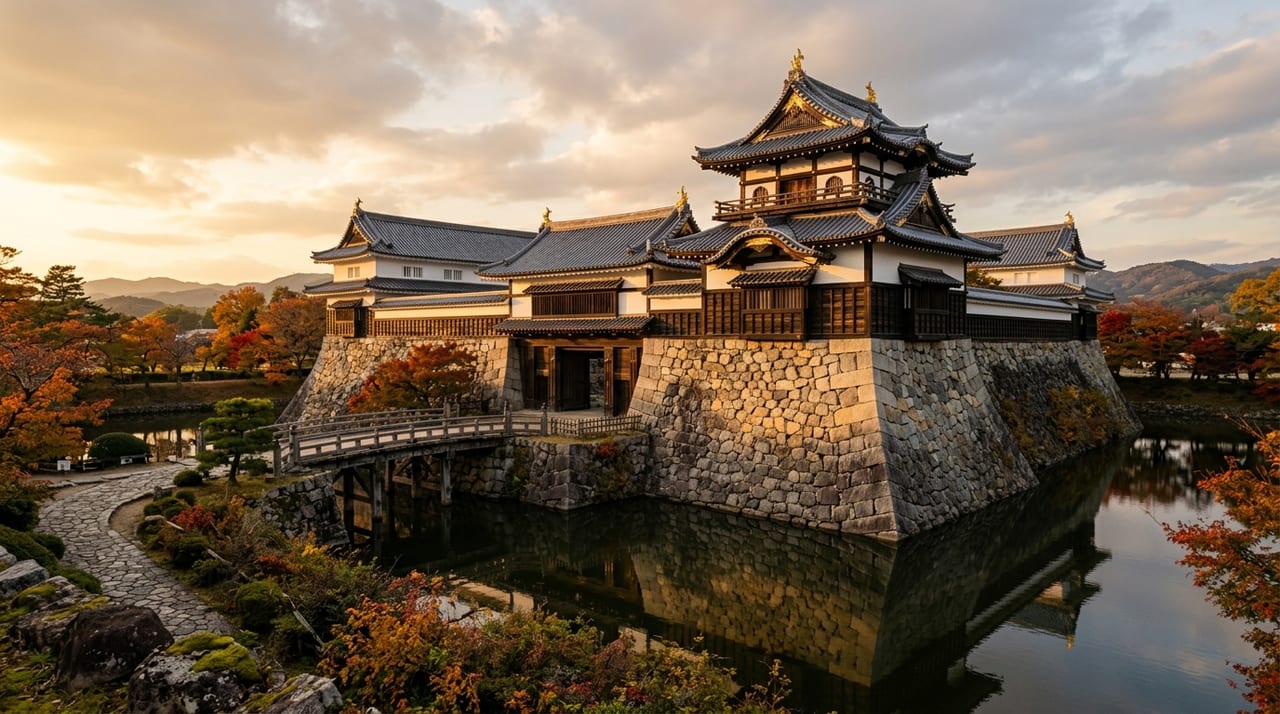
 * Image is for illustrative purposes only.
Minakuchi Castle (Hekisui Castle)
水口城(碧水城)
Minakuchi Castle (Hekisui Castle) is a historic castle in the Kansai region (Built in 1634 (Kan'ei 11)). Its lord was Tokugawa Iemitsu (shogunal travel palace) / Kato Akitomo (first domain lord).
Overview
About the Castle
Minakuchi Castle is a distinctive castle built in Kan'ei 11 (1634) in Kōka, where the Tōkaidō post town of Minakuchi is located, as a lodging castle for the occasion of the third shogun Tokugawa Iemitsu's ascent to Kyoto (official visit to Kyoto). The shogun's ascent to Kyoto was a grand ceremony demonstrating the bakufu's authority. As a shogun's lodging castle built under direct bakufu control, Minakuchi Castle had Kobori Masakazu (Enshū) serve as construction commissioner, and a lavish palace modeled on the palace of Nijō Castle was built within the castle. However, the castle was used as the shogun's lodging only once, for Iemitsu's ascent to Kyoto.
Kōka and the Iga Passage
Kōka, where Minakuchi Castle is located, is a region known worldwide as a ninja homeland alongside Iga. Kōga ninja (Kōga-shū) were employed by daimyo across the country from the Muromachi through Sengoku periods as specialists in intelligence and military maneuvers, and their techniques formed a comprehensive martial arts system encompassing swords, throwing stars, poisons, and disguise. When Tokugawa Ieyasu carried out the "Iga Passage" (Iga-goe) immediately after the Honnō-ji Incident, the Iga and Kōga ninja are said to have protected Ieyasu's party at the risk of their lives, and because of this connection, Kōga samurai were valued by the bakufu in the Edo period.
Minakuchi Domain and the Katō Clan
After Iemitsu's ascent to Kyoto, Minakuchi Castle was managed as a banjō (guard castle) by a castle warden appointed by the bakufu, and in Tenna 2 (1682), Katō Akitomo entered as lord of the Minakuchi domain with 20,000 koku. Except for the period from Genroku 8 (1695) to Shōtoku 2 (1712), when the Torii family served as domain lords, the Katō family continued as domain lords until the end of the Edo period. Although modest in scale, Minakuchi Castle held the dignity of a shogun's lodging castle, and its stone walls, moats, and layout embodied the finest of the bakufu's direct construction techniques. At the Minakuchi Castle ruins, stone walls and moats remain in good condition, and the Minakuchi Castle Museum, opened in 1991, conveys the history of the shogun's lodging castle through the Inui yagura (corner turret), which had been relocated to a private residence and was later moved back and reconstructed.
Kōka Culture and the Tōkaidō
Minakuchi flourished as a castle town and as the 50th of the 53 post stations of the Tōkaidō, Minakuchi-juku, and was also a lively highway town where Ōmi merchants, daimyo on alternate attendance (sankin-kōtai), and travelers making pilgrimages to Ise came and went.
Connection to Swords
The connection between Minakuchi Castle and swords is rooted in the multilayered samurai culture behind this castle. Built as a shogun's lodging castle for Shogun Tokugawa Iemitsu's ascent to Kyoto, Minakuchi Castle is directly tied to the Tokugawa shogunal house. Minakuchi is located in Kōka, known as the home of the ninja. The Katō family, which entered Minakuchi Castle, is descended from Katō Yoshiaki, one of the Seven Spears of Shizugatake (Yoshiaki's grandson, Katō Akitomo, was the first domain lord). The Minakuchi Castle Museum holds exhibitions on the history of Minakuchi Castle as a shogun's lodging castle, and combined with Kōka City's ninja house (Kōka-ryū Ninjutsu Yashiki), it allows visitors to experience at once two different aspects of weapon culture: the swords of the samurai and the tools of the ninja.
Highlights
- Minakuchi Castle ruins (stone walls and moat) — precise stone walls and water moat of a shogun's lodging castle under direct bakufu control
- Minakuchi Castle Museum (reconstructed Inui yagura) — exhibits the history of Minakuchi Castle as a shogun's lodging castle
- Kōka-ryū Ninjutsu Yashiki — ninja house built in the Genroku era as the former residence of Mochizuki Izumo-no-kami, the leading figure of the Kōka Gojūsan-ke (fifty-three Kōka families) (a constituent cultural property of Japan Heritage)
- Kōka no Sato Ninjutsu Mura — shuriken throwing experience, ninja museum, and history of the Kōka ninja
- Tōkaidō Minakuchi-juku post town streetscape — the townscape of Minakuchi, which retains the atmosphere of an Edo-period post town
- Tarao Clan Jin'ya Ruins — residence of the Tarao family, which hereditarily served as tenryō (bakufu-held land) magistrates in Ōmi and the Kinai (Tarao Mitsutoshi assisted Ieyasu's Iga Passage)
* Opening hours and admission fees are subject to change. Please check the official website before visiting.