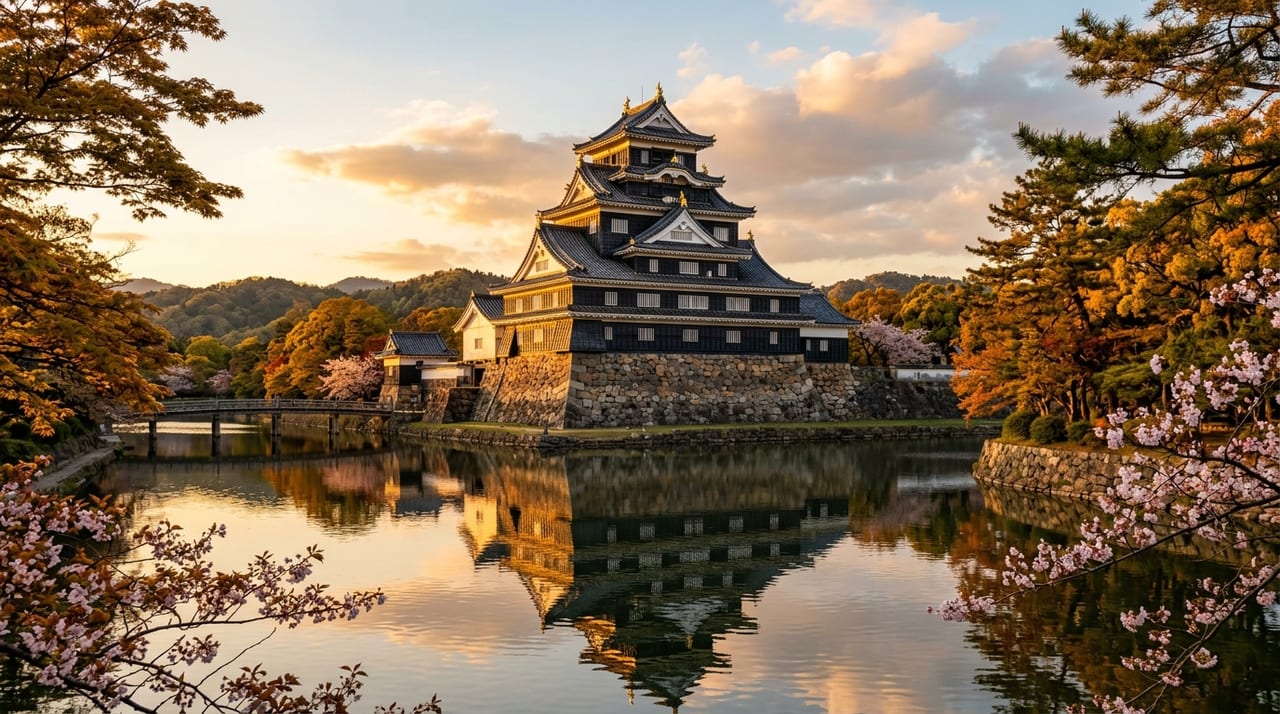
 * Image is for illustrative purposes only.
Kuroi Castle
黒井城
Kuroi Castle is a historic castle in the Kansai region (Nanboku-chō to Azuchi–Momoyama period (built in 1335; fell on the ninth day of the eighth month of 1579; decommissioned around 1584)). Its lord was Akamatsu Sadanori (builder), the Ogino family, Ogino Akikiyo, Akai (Ogino) Naomasa, Akai Tadaie and Yukiie, Saitō Toshimitsu (at the lower residence), and Horio Yoshiharu.
Overview
Overview
Kuroi Castle was a linear-bailey mountain castle on Mt. Inokuchi (elevation 356 m) in Kasuga-chō, Tanba, Hyōgo Prefecture. Beyond the main citadel at the summit, forts were strung along the surrounding ridges to form a single great fortress. It is known as the seat of the Akai (Ogino), who dominated western Tanba in the late medieval period, and above all as the castle of Akai Naomasa, feared as the "Red Demon of Tanba."
Founding and the Akai (Ogino)
Tradition holds that in 1335 Akamatsu Sadanori was granted Kasugabe-no-shō in Hikami District and built a simple castle at the summit. After roughly 120 years of Akamatsu rule, the local Ogino family gradually took control of Kasugabe. In 1554 Ogino Naomasa, a kinsman, killed the castellan Ogino Akikiyo and seized the castle, then led the Akai in expanding across western Tanba; the episode is said to lie behind his sobriquet Akuemon, "Uemon the Wicked." In 1565 he defeated the Tanba deputy governor Naitō Munekatsu, making Kuroi the hub of anti-Oda resistance in the province.
Akechi Mitsuhide's Tanba Campaign
In 1575 Akechi Mitsuhide, sent into Tanba on Oda Nobunaga's orders, laid siege to Kuroi, only for Hatano Hideharu of Yakami Castle — nominally an ally — to strike his rear and defect, forcing a full retreat. The manoeuvre is remembered as the "Akai lure." When Naomasa died of illness in 1578 the Akai lost their centre of gravity, and on the ninth day of the eighth month of 1579 the second Tanba campaign brought the castle down, completing Mitsuhide's pacification of the province. Mitsuhide's senior retainer Saitō Toshimitsu then took the castle and made the lower residence at the foot of the mountain his headquarters; tradition holds that it was here that his youngest daughter Ofuku, later known as Kasuga no Tsubone, was born. Horio Yoshiharu subsequently held the castle, which was decommissioned around 1584.
Structure and Remains
The main bailey at the summit is flanked by second and third baileys arranged in terraces, with eastern and western baileys and a belt bailey wrapped around for defence. Natural-stone (nozura-zumi) walling, thought to date from the Tenshō era, survives in good condition around the main bailey, showing a mountain castle in transition as it absorbed the engineering of the Oda–Toyotomi tradition. The whole of Mt. Inokuchi, some 8 km around, was fortified.
Present State and Access
Designated a National Historic Site in 1989 and selected in 2017 among the Continuation of Japan's Top 100 Castles (No. 163), the site has maintained trails to the summit and is popular as a "castle in the sky" for its sweeping view over the Tanba basin. The trailhead is within walking distance of Kuroi Station on the JR Fukuchiyama Line, and the summit about a 40-minute climb.
Highlights
- Seat of Akai (Ogino) Naomasa, the "Red Demon of Tanba," who twice frustrated Akechi Mitsuhide
- Scene of the 1575 "Akai lure," when Hatano Hideharu's defection forced Mitsuhide into full retreat
- Tenshō-era natural-stone walling survives around the main bailey, marking the transition toward Oda–Toyotomi castle engineering
- The lower residence at the foot of the mountain is held by tradition to be the birthplace of Kasuga no Tsubone (Ofuku)
* Opening hours and admission fees are subject to change. Please check the official website before visiting.