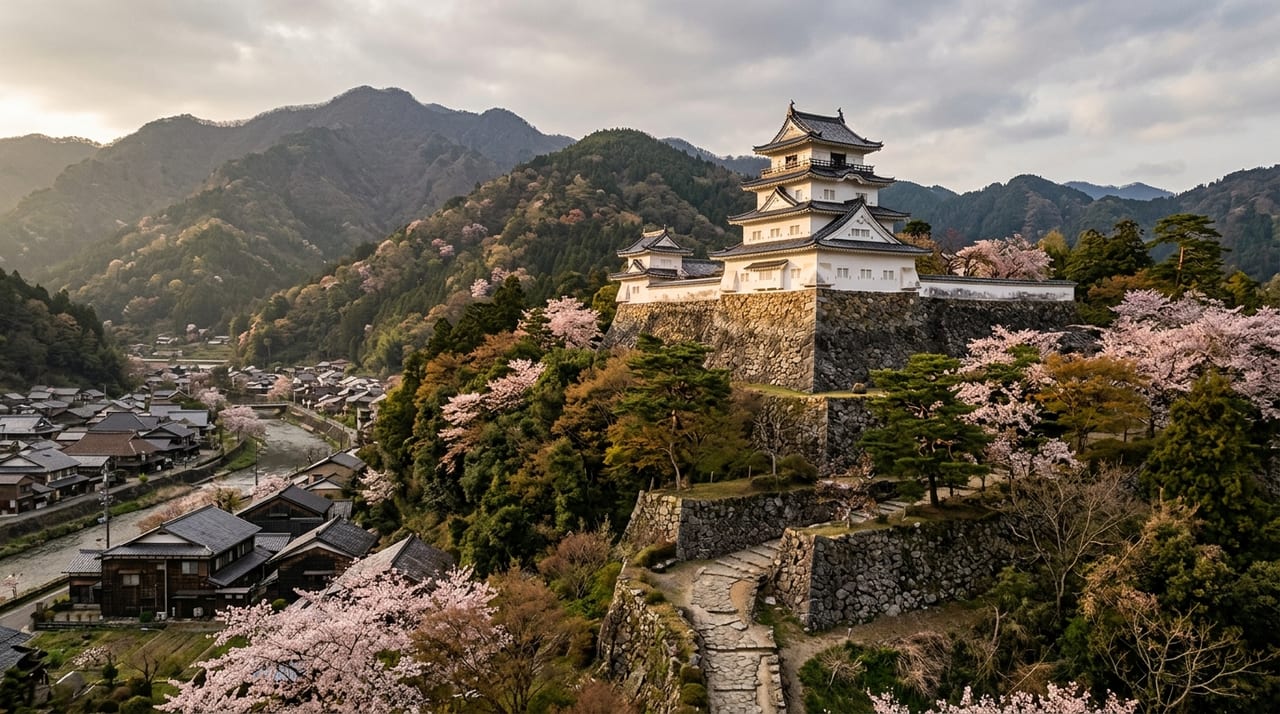
 * Image is for illustrative purposes only.
Tage Castle
多気城
Tage Castle is a historic castle in the Kansai region (Northern and Southern Courts period through Sengoku period (14th century–1576)). Its lord was Kitabatake clan (Kitabatake Akiyoshi, Kichika, Harutomo, Tomonori, and others).
Overview
Tage Castle is a mountain castle built on a mountaintop at an elevation of about 560 meters (relative height of about 240 meters) in Tage, Ichishi District, Ise Province, present-day Misugi-chō, Tsu City, Mie Prefecture. It was the base from which the Kitabatake clan governed South Ise for nine generations over roughly 240 years. The Kitabatake clan descended from Kitabatake Chikafusa (1293–1354), a court noble and military commander who supported the Kenmu regime of Emperor Go-Daigo. As a prestigious house, it played an active role as a pillar of the Southern Court during the Nanboku-chō conflict, in both Ōshū and Ise. Chikafusa was also a learned scholar who wrote the Jinnō Shōtōki, and an atmosphere of culture and learning lingered in the castle town of Tage. The castle is said to have been built by Kitabatake Akiyoshi in Kōkoku 3 (1342) or Kōkoku 4 (1343), and it functioned as the center of politics, military affairs, and culture in South Ise. The castle is a mountain fortress that makes use of a steep ridge, with two enclosures lined up: the northeast enclosure and the southwest enclosure. Two horikiri (dry moats) were cut across the ridge, and in combination with the steep slopes they provided strong defensive capability. At the foot of the mountain, a residence of the Kitabatake clan (Tage Gosho, on the site of present-day Kitabatake Shrine) was also established, forming a governing base in which castle and residence were integrated as one. In Eiroku 12 (1569), Oda Nobunaga invaded South Ise, and after the Battle of Ōkōchi Castle, a peace was concluded on the condition that Nobunaga's second son, Oda Nobukatsu (then known as Chasenmaru), would be adopted as the heir of Kitabatake Tomofusa. However, in Tenshō 4 (1576), retainers acting on Nobukatsu's orders killed Kitabatake Tomonori and his relatives at Mise Gosho (the Mise Incident). Troops were also sent to Tage Castle, the castle buildings were burned down, and the rule of the Kitabatake clan came to an end. Dry moats and earthen ramparts remain at the castle ruins, which convey well the landscape of a medieval mountain castle. The site is currently protected as a National Historic Site, and surveys and maintenance of its remains are in progress.
Connection to Swords
The Kitabatake clan was a family of court-noble warriors who combined literary and martial accomplishments. The eighth head, Kitabatake Tomonori, was fond of swordsmanship and protected swordsmen who traveled to train. He is said to have studied swordsmanship and strategy with Tsukahara Bokuden, receiving the secret technique Hitotsu no Tachi, and it is also handed down that he learned the sword from Kamiizumi Nobutsuna. He is thus regarded as a sword-master daimyo.
Highlights
- Base from which the Kitabatake clan governed South Ise for nine generations over about 240 years
- Mountain castle conveying the history from the Nanboku-chō period through the Sengoku period
- Integrated historical landscape together with the Kitabatake clan residence ruins
- Castle associated with sword-master daimyo Kitabatake Tomonori
- Stage of the downfall of the Kitabatake clan at the hands of Oda Nobunaga
* Opening hours and admission fees are subject to change. Please check the official website before visiting.