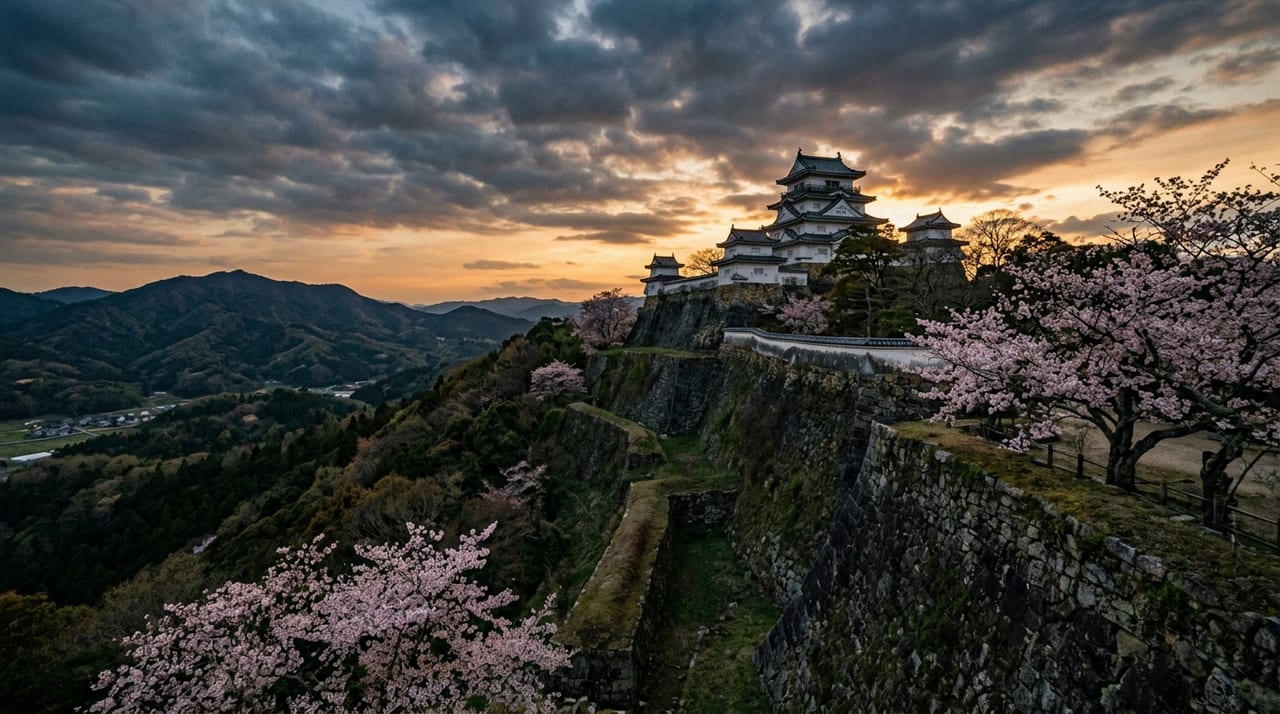
 * Image is for illustrative purposes only.
Iimoriyama Castle
飯盛山城
Iimoriyama Castle is a historic castle in the Kansai region (Tenbun era (mid-16th century, ca. 1532–1555) expansion). Its lord was Kizawa Nagamasa / Miyoshi Nagayoshi.
Overview
Miyoshi Nagayoshi's Base for Ruling the Realm
Iimoriyama Castle is a mountain castle built on Mount Iimori, 314 meters high, spanning Daito City and Shijonawate City in Osaka Prefecture. It is known as the greatest center of power of Miyoshi Nagayoshi, who seized control of the realm in the mid-16th century. The castle built by Kizawa Nagamasa is said to be its predecessor. When Miyoshi Nagayoshi entered the castle in Eiroku 3 (1560) and carried out large-scale renovations, it came to function as one of the largest mountain castles in the Kinai region.
Miyoshi Nagayoshi and the "First Ruler of the Realm"
Miyoshi Nagayoshi is a warlord who is often described in Japanese history as the "first Ruler of the Realm." In Tenbun 18 (1549), Nagayoshi ended his retainer relationship with Hosokawa Harumoto and placed the authority of the kanrei effectively under his control. In Tenbun 19 (1550), he expelled Muromachi shogun Ashikaga Yoshiteru from Kyoto. In Tenbun 22 (1553), he pursued Yoshiteru to Kutsuki in Omi, bringing Kyoto effectively under his control. During this period, although the nominal authority of the Muromachi shogunate remained, the actual political ruler of Japan was Miyoshi Nagayoshi. He is sometimes placed as a Ruler of the Realm who preceded Oda Nobunaga. While based at Iimoriyama Castle, Nagayoshi ruled the Kinai with abundant wealth and military power backed by the economic strength of Sakai.
Structure of Iimoriyama Castle
Iimoriyama Castle is a typical Sengoku mountain castle that made maximum use of its ridges. It has a complex defensive system in which numerous enclosures (kuruwa) are arranged in tiers from the summit down the mountainside. More than 70 kuruwa have been confirmed on the ridge, and at its peak the castle extended about 1.2 kilometers north to south and about 500 meters east to west. Recent excavations have found remains of stone walls on a larger scale than expected, revealing that the castle made heavy use of stone walls. Its construction date is estimated to be earlier than that of Komakiyama Castle, which is known as a castle fortified with stone walls.
Shijonawate and the Memory of the Sengoku Period
At the foot of Mount Iimori lies Shijonawate, which is also known as the site of the Battle of Shijonawate. In Shohei 3 (1348), during the Northern and Southern Courts period, Kusunoki Masatsura was defeated there by the large army of Ko no Moronao. Masatsura, the eldest son of Kusunoki Masashige, carried on his father's will and fought for the Southern Court, meeting a fierce end on this ground. Two hundred years after the turmoil of the Northern and Southern Courts, Miyoshi Nagayoshi, a new powerful figure, ruled the Kinai from the same land of Mount Iimori, which gives a sense of the cause and effect of history. Today, Shijonawate Shrine has a shrine building enshrining Kusunoki Masatsura. Together with the ruins of Iimoriyama Castle, it offers historical tourism with the theme of "loyalty."
Connection to Swords
The relationship between Miyoshi Nagayoshi's Iimoriyama Castle and the culture of swords is discussed through its close connection with Sakai, a special city. Nagayoshi took note of Sakai's economic power and put the wealth from trade there into politics, military affairs and culture. At that time Sakai was also an important base for the circulation of Japanese swords. Famous blades from various regions, such as Bizen, Soshu and Yamashiro, circulated throughout the country through the hands of Sakai merchants. Nagayoshi is said to have possessed the renowned blade "Iwakiri Kaifu" (made by Ashu Ujiyoshi), and warriors under the Miyoshi clan wore swords made by master smiths from various regions. In particular, Matsunaga Hisahide, Nagayoshi's chief retainer, is known for his artistic sensibility and owned many famous tea utensils. Matsunaga Hisahide is famous for the anecdote that although Nobunaga repeatedly asked him for the renowned tea kettle "Hiragumo" (Ko-Tenmyō Hiragumo), he never handed it over. However, he presented famous tea utensils such as "Tsukumogami Nasu" to Nobunaga. The Kinai during the rule of the Miyoshi clan was a period of recovery from the chaos after the Onin War. It was also an important period when sword smiths settled in cities again and resumed their production.
Highlights
- Summit Honmaru Ruins and Stone-Wall Remains — massive stonework confirmed by recent excavations, significantly larger than previously expected
- Mountain Trail (Iimori Mountain Hiking Course) — panoramic views overlooking the Osaka Plain and Ikoma Mountain Range
- Shijonawate Shrine — sacred site of the Northern and Southern Dynasties era, enshrining Kusunoki Masatsura, located near the Iimori Mountain Castle ruins
- Shijonawate City Historical and Folk Museum — displays excavation materials from Miyoshi Nagayoshi and Iimori Mountain Castle
- Northern and Southern Dynasties-Related Historic Sites — location of the Battle of Shijonawate and the site of Kusunoki Masatsura's final stand
* Opening hours and admission fees are subject to change. Please check the official website before visiting.